
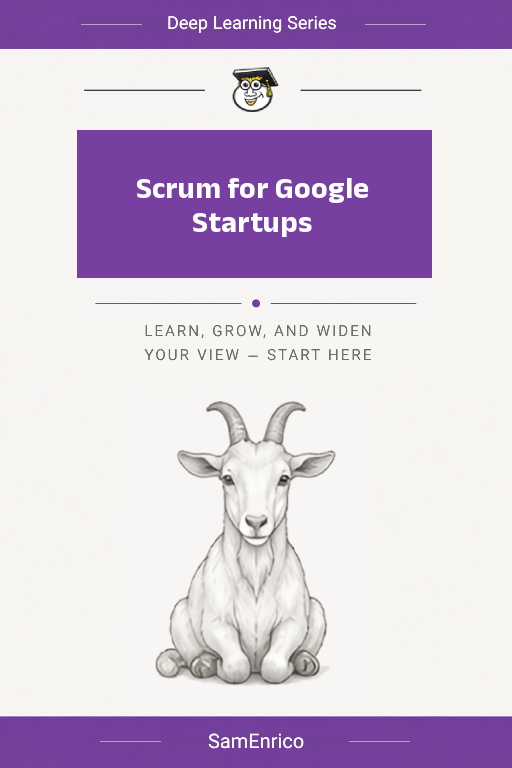
Non-FictionStartup GuideScrum OKRs
Scrum for Google Startups eBook
Implement Google's blend of Scrum with OKRs for go
Implement Google's blend of Scrum with OKRs for goal-driven sprint planning in search and AI startups.
Formats
Free sample
Chapter 1: The Velocity Trap--–- In 2019, a search startup called Relevant.ly raised $15 million from a top-tier venture capital firm. The founders had impeccable credentials: Ph Ds from Stanford, engineering leads from Google Search, and a proprietary dataset that promised to revolutionize e-commerce discovery. They hired fifty engineers, product managers, and data scientists. They adopted Scrum with religious devotion. They ran two-week sprints, held daily standups, maintained a pristine Jira board, and never—not once in eighteen months—missed a sprint commitment.
They shipped forty-seven model updates, three major feature releases, and over two thousand individual tasks. Their burndown charts were works of art. Their velocity charts trended steadily upward. By every traditional measure of software engineering productivity, Relevant.ly was a world-class operation. And in the nineteenth month, they ran out of money and shut down.The post-mortem revealed a devastating truth: not a single one of those forty-seven model updates had improved their core business metric.
They had built a feature factory—a machine that produced output with astonishing efficiency but delivered zero outcome. The engineers had done everything right according to the Agile manifesto. The product managers had written pristine user stories. The Scrum Master had protected the team from interruptions. And none of it mattered because they had optimized for the wrong thing.This is the death that awaits AI startups who worship velocity.The Measure That Lies Every Scrum team knows velocity.
It is the number of story points a team completes per sprint. It is plotted on charts, celebrated when it rises, and mourned when it falls. It is used to forecast release dates, evaluate team performance, and justify hiring requests. And it is almost completely meaningless for AI startups.Velocity measures output—the quantity of work performed. But output is not outcome.
Output is shipping a model. Outcome is improving search relevance. Output is writing ten thousand lines of code. Outcome is reducing latency by fifty milliseconds. Output is closing one hundred Jira tickets.
Outcome is increasing user retention by five percent. The two are correlated only when you are building the right things. And when you are building the wrong things, output becomes a accelerator of failure—you just go bankrupt faster.John Doerr, the venture capitalist who introduced OKRs to Google, captured this distinction in his book Measure What Matters with a phrase that should be tattooed on every AI startup's wall: "Ideas are easy. Execution is everything. But execution of the wrong idea is the most expensive kind of waste." The tragedy of Relevant.ly was not that they executed poorly.
They executed brilliantly. The tragedy was that they executed the wrong ideas with world-class efficiency.For AI startups specifically, the output/outcome gap is even more dangerous than in traditional software. A web application either works or it doesn't. The relationship between work and result is deterministic: write the code, deploy the code, the feature exists. AI is probabilistic.
You can write perfect training code, use state-of-the-art architectures, and still produce a model that performs worse than a simple heuristic. When that happens, traditional Scrum has no vocabulary for the result. The team did the work. The story points are completed. The velocity chart goes up.
But the outcome is negative—you shipped technical debt disguised as progress.The CFR Alternative The antidote to the output obsession is a framework that most Scrum practitioners have never heard of: CFRs, which stands for Conversations, Feedback, and Recognition. Introduced by Doerr as the companion to OKRs, CFRs replace the stale status meeting with a dynamic, outcome-focused dialogue.Let me be explicit about what this means for your AI startup. A traditional Scrum standup asks three questions: What did you do yesterday? What will you do today? What blockers do you have?
These questions are about activity. They assume that activity leads to progress, which is true only when you are already pointed in the right direction.A CFR-driven conversation asks different questions: What outcome did we move toward yesterday? What evidence do we have that our work is improving the metrics that matter? What are we learning that changes what we should do next? These questions are about impact.
They force the team to confront the uncomfortable possibility that they are working hard on the wrong things.The Conversation component of CFRs is a weekly one-on-one between each team member and their manager. It is not a status update. It is a strategic dialogue about three topics: (1) progress toward Key Results, (2) obstacles to outcomes, and (3) career growth. The manager's job is not to check boxes but to ask "How do you know that work is moving the needle?" until the answer is specific and measurable.The Feedback component is continuous and bidirectional. In a healthy CFR culture, anyone can give anyone else feedback at any time, without waiting for a sprint retrospective or performance review.
For AI teams specifically, feedback must include technical critique of model architecture, data quality, and evaluation methodology. A feedback culture that avoids technical substance is just politeness—and politeness does not improve models.The Recognition component is the most counterintuitive for Scrum veterans. You recognize outcomes, not effort. You do not celebrate the engineer who worked eighty hours to ship a model that didn't improve metrics. You celebrate the engineer who identified that the model was doomed after three days, pivoted to a different approach, and salvaged the sprint.
Recognition for outcomes means celebrating strategic failure as much as success—a theme we will explore in depth in Chapter 8.What Is Technical Debt, Really?The concept of technical debt was introduced by Ward Cunningham in 1992 to describe the trade-off between shipping quickly and shipping cleanly. In traditional software, technical debt means messy code that will need to be refactored later. In AI startups, technical debt means something more insidious: models that pass tests but fail in production, data pipelines that work on sample data but break at scale, and evaluation metrics that look good on paper but don't correlate with user behavior.When you ship a traditional software feature that doesn't improve user outcomes, you have wasted time. When you ship an AI model that doesn't improve user outcomes, you have done worse than waste time—you have created future work. Someone will need to debug why the model is underperforming.
Someone will need to retrain it with better data. Someone will need to explain to leadership why the "improvement" made things worse. That is debt with compounding interest.The chapter that follows this one will introduce the Two-Speed Engine framework for planning sprints. Chapter 3 will introduce the Two-OKR Rule for distinguishing exploration from production work. But before we get to those frameworks, we need a rule so fundamental that it governs everything else.The Traceability Rule Here is the rule that will save more wasted effort than any other in this book: Every story point must be traceable to a Key Result, or it does not enter the sprint.This rule has three implications that transform how you plan work.First, story points are not free.
In traditional Scrum, story points are a measure of effort. A task that is estimated at five points is assumed…
This is the end of the free sample. Get the eBook to keep going. Buy now
About this book
Details
- Author
- Wiseman Catharine
- Publisher
- SamEnrico
- Language
- English
- Genre
- Non-Fiction, Startup Guide, Scrum OKRs
- Released
- 2026-06-01
- Pages (approx.)
- 146
- Available as
- eBook, Audiobook

Read better in the ZLOADR app
Your eBooks on your phone or tablet. Sign in with your SamEnrico account and start reading.
More by Wiseman Catharine
 Self Hypnosis Progressive Relaxation CourseWiseman Catharine$11.99
 Beginner's Kettlebell SwingWiseman Catharine$11.99Beginner's Kettlebell SwingWiseman Catharine$11.99
 Anger in Long Distance RelationshipsWiseman Catharine$11.99
 Student Panic Attack ManagementWiseman Catharine$11.99
 Chunking for Bulletin JournalingWiseman Catharine$11.99
 Quantum Dreams in the Desert: The Pioneers of Middle Eastern Quantum ScienceWiseman Catharine$11.99
 The Silk Road’s Last Emperor: A Forgotten Dynasty’s RiseWiseman Catharine$11.99
 Understanding EndometriosisWiseman Catharine$17.99
 AI Art Niche SelectionWiseman Catharine$12.99
 Fruit Smoothie MakerWiseman Catharine$11.99
 How to Start a Continuous Cast Products Made of Steel Business (Beginners Guide)Wiseman Catharine$11.99
You may also like
 Hong Kong Handover 1997Dunn Johnnie$11.99
 Zumba For Postnatal Recovery CourseNeal Christian$11.99
 Zumba for BeginnersLadner Nikia$11.99
 YouTube Comment Mining GuideHumes Pandora$12.99
 Worry Box MeditationCarlin Rudy$11.99
 Workplace Stress MeditationNguyen Lynn$11.99
 Workplace Stress and Sleep RepairHawley Ivory$11.99
 Workplace Perfectionism CureDelaney Jeffry$11.99
 Workplace Injustice Anger GuideWallen Isabelle$11.99
 Work Addiction and Burnout LinkGreenwood Ester$11.99
 Women in Yoga and WellnessBeattie Galina$11.99
 Women in Stand Up ComedyChun Evangeline$11.99