
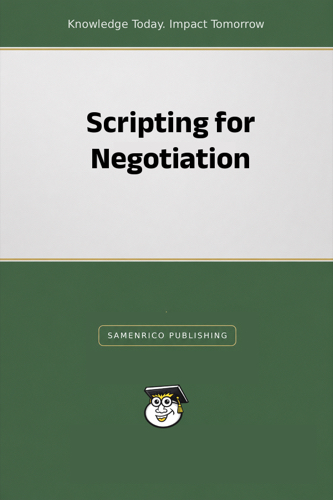
Scripting for Negotiation eBook
Deal making hypnosis scripts.
Deal making hypnosis scripts.
Formats
Free sample
Chapter 1: The Unfair Advantage...–- Most people enter a negotiation believing they are about to engage in a rational exchange of arguments. They prepare their data, rehearse their talking points, and steel themselves for the inevitable pushback. They believe that the person with the better logic, the stronger evidence, or the louder voice will win the day. This belief is not merely incomplete—it is dead wrong. The truth, revealed by decades of research into persuasion, hypnosis, and decision neuroscience, is that every conversation you have ever had has already been a form of hypnosis.
You have been in trances your entire life. So has everyone you have ever negotiated with. The only question is whether you will learn to direct that trance or remain a passive passenger inside someone else's.This chapter dismantles the myth of rational negotiation and replaces it with a radically different model: conversational hypnosis. You will learn why top negotiators don't debate, argue, or persuade in the traditional sense. Instead, they direct.
They guide. They create the conditions under which the other side feels they are convincing themselves. And they do all of this without swinging watches, without chanting, and without anyone ever feeling manipulated. By the end of this chapter, you will understand the foundational architecture of hypnotic negotiation and possess a calibrated opening script that has been proven to drop resistance by approximately forty percent before a single substantive word is exchanged.The Myth of the Rational Negotiator Let us begin with a simple exercise. Imagine you are about to negotiate the price of a used car.
The seller is asking $15,000. You believe the car is worth $12,000. In the traditional model, you would present your evidence: comparable sales, maintenance history, market conditions. The seller would present theirs. You would argue, counter-argue, and eventually land somewhere in the middle.
This is what most negotiation books teach. It is also a fantasy.The reality is that by the time you sit down to exchange arguments, your brain has already made a series of emotional decisions that will determine the outcome far more than any spreadsheet ever could. Do you like the seller? Does their body language make you feel safe or defensive? Are you in a good mood or a bad mood?
Did you eat lunch? These factors, none of which have anything to do with the rational merits of the deal, will influence your final agreement as much as—if not more than—the actual numbers.Research in behavioral economics has demonstrated this repeatedly. In one famous study, judges reviewing parole cases were far more likely to grant parole immediately after a meal break than just before one. The evidence presented had not changed. The law had not changed.
What changed was the judge's blood sugar and, consequently, their emotional state. The rational mind, it turns out, is not the captain of the ship. It is the press secretary—brought in after the decision has already been made to construct a plausible narrative of why the decision made sense.This is where the concept of hypnosis enters. Not the stage hypnosis of television specials, where subjects quack like ducks or forget their own names. That is entertainment.
Real hypnosis, the kind studied by clinicians and researchers for over a century, is something far simpler and far more relevant to negotiation. It is a state of focused attention in which the critical, analytical faculty of the mind is temporarily bypassed, allowing suggestions to travel directly to the subconscious where they are accepted as true.Debunking the Swinging Watch The first thing to understand is what negotiation hypnosis is not. It is not mind control. It does not involve eye fixation, passivity, or any loss of autonomy. You cannot make someone agree to a deal that is against their fundamental interests any more than you can make them fly by flapping their arms.
The swinging watch is a theatrical prop, not a neurological tool.What negotiation hypnosis actually is involves a concept called "bypassing the critical factor." The critical factor is the part of your brain that acts as a gatekeeper, evaluating incoming information and deciding whether to accept it or reject it. It is the voice that says, "That's a sales tactic," or "I don't trust this person," or "This feels manipulative." Every suggestion you make in a negotiation must pass through this gatekeeper before it can reach the subconscious, where real decisions are formed.The skilled hypnotic negotiator does not try to destroy the critical factor. That would be impossible and, frankly, undesirable—the critical factor protects us from actual manipulation. Instead, the skilled negotiator learns to speak in ways that the critical factor does not recognize as a threat. Indirect suggestions, presuppositions, embedded commands, and carefully calibrated tonality all serve the same purpose: they deliver the directive while the critical factor is looking elsewhere, occupied with some minor detail or narrative distraction.Think of the critical factor as a security guard at the door of a nightclub.
The guard's job is to keep out troublemakers. A direct command—"Let me in!"—will get you thrown out immediately. But what if you approach the guard with a clipboard and a uniform? What if you look like you belong there? What if you arrive during a shift change when the guard is distracted?
The guard still has the same authority. You have simply bypassed it by not triggering the alert in the first place.The Trance of Ordinary Conversation Here is the most important insight of this chapter: you are already in a trance right now. So is everyone you speak to. Ordinary conversation is not a state of pure, rational consciousness. It is a sequence of automatic responses, learned scripts, and unconscious pattern completions.Consider what happens when someone asks you, "How are you?" You do not pause to calculate an honest assessment of your physical and emotional state.
You say, "Fine, thanks," automatically. That is a trance response. Consider what happens when you hear a familiar jingle. The associated product springs to mind before you have any conscious intention to recall it. That is a trance response.
Consider what happens when you are driving a familiar route and suddenly realize you have no memory of the last five minutes. That is a trance.Everyday life is filled with these micro-trances. They are not abnormal. They are the default state of the human brain, which is designed to automate routine tasks to conserve cognitive energy. The problem—and the opportunity—is that most people navigate these trances blindly.
They are passive passengers inside someone else's conversational architecture, responding to cues they do not consciously recognize.The hypnotic negotiator flips this dynamic. Instead of being the passenger, you become the architect. You learn to recognize the trance states your counterpart is already in—the automatic responses, the learned assumptions, the emotional loops—and you learn to direct them toward a mutually beneficial outcome. You are not inserting foreign suggestions into a resistant mind. You are gently redirecting a river that was already flowing.The Rapport Sync: Pre-Verbal Hypnosis Before any script is spoken, before any presupposition is deployed, before any embedded command is marked, the negotiation is already being…
This is the end of the free sample. Get the eBook to keep going. Buy now
About this book
Details
- Author
- Stevens Rosemarie
- Publisher
- SamEnrico
- Language
- English
- Genre
- Non-Fiction, Self-Help, Negotiation
- Released
- 2026-06-05
- Pages (approx.)
- 131
- Available as
- eBook, Audiobook

Read better in the ZLOADR app
Your eBooks on your phone or tablet. Sign in with your SamEnrico account and start reading.
More by Stevens Rosemarie
 Email Micro Learning UseStevens Rosemarie$11.99
 Ulta Haul Comparison GuideStevens Rosemarie$11.99
 Focus Muscle TrainingStevens Rosemarie$11.99
 Karen Carpenter Voice VelvetStevens Rosemarie$11.99
 The Startup Chart of AccountsStevens Rosemarie$11.99
 Breath Awareness for AthletesStevens Rosemarie$11.99
 Weekend Time Blocking GuideStevens Rosemarie$11.99
 Blade of the Forgotten: The Ronin Who Defied the ShogunStevens Rosemarie$11.99
 The Vanishing of the Cantonese Merchant: A Triad’s Shadow in Colonial AfricaStevens Rosemarie$11.99
 Ultimate Handbook Guide to Johannesburg : (South Africa) Travel GuideStevens Rosemarie$11.99
 Black Salsify: Root Harvesting GuideStevens Rosemarie$11.99
 Networking Outreach TrackerStevens Rosemarie$12.99
You may also like
 The Negotiation Table MapBest Leighann$11.99
 The Assertive Request FormulaFarrar Emogene$11.99
 NVC In Business NegotiationLink Shalonda$11.99
 Improv for NegotiationCantrell Elene$11.99
 Negotiation Nonverbal Strategy GuidePeralta Isabelle$11.99
 Negotiation Assertiveness GuideGarcia Jaime$11.99
 Imposter Syndrome and Salary NegotiationTovar Chassidy$11.99
 The No Blame Conversation MethodCantu Latosha$11.99
 The Door in Face Negotiation TacticBohn Sha$11.99
 The Contrast Persuasion GuideLouis Claude$11.99
 Persuasion for NegotiationsFinley Yajaira$11.99
 Personal Ing For Success Negotiation LeverageFogle Nakisha$11.99