
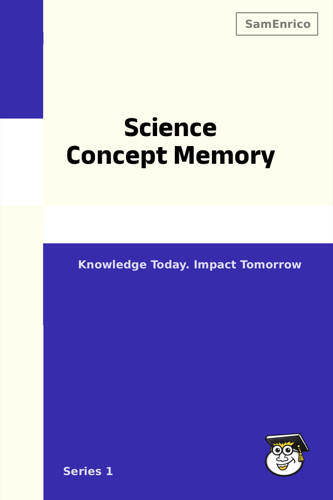
Science Concept Memory eBook
Understand and recall complex scientific processes
by Beebe Hien
Understand and recall complex scientific processes.
Formats
Free sample
Chapter 1: The Vanishing Aha--You are about to discover something uncomfortable. Not painful, not humiliating, but uncomfortable in the way that all useful truths are uncomfortable at first.Here it is: you have probably wasted hundreds of hours studying.Not because you are lazy. Not because you are bad at science. Not because your brain is somehow defective. But because you have been using a set of study strategies that feel productive but are, in fact, almost entirely useless for the kind of memory that science demands.Let me prove this to you in the next thirty seconds.Think back to your last STEM exam.
Any exam – physics, biology, chemistry, calculus, computer science. Now answer this question honestly: how many times did you look at a problem and think, "I know this. I absolutely know this. I saw it in the textbook yesterday. It was on page 147, the example with the diagram.
I highlighted it. I even nodded along while reading it." And then – nothing. Your mind went blank. The formula was gone. The mechanism slipped away.
The algorithm dissolved like a sugar cube in hot tea.If this has never happened to you, put this book down and give it to someone else. You do not need it.For the rest of us, this chapter explains why that happens. More importantly, it explains why that experience – the vanishing aha – is not a sign that you are bad at science. It is a sign that you have been confusing two completely different kinds of memory. And once you understand the difference, everything changes.The Paradox at the Heart of Science Learning There is a paradox that every serious student of science encounters, usually somewhere between the second midterm and the final exam.
The paradox is this: you can recognize a concept perfectly well when you see it, but you cannot recall it when you need it.Consider a simple example. I am going to show you a formula. You have almost certainly seen it before:F = ma You recognize it. It is Newton's second law. Force equals mass times acceleration.
You knew that. You probably learned it in high school. You may have used it in a physics class last semester.Now close your eyes – actually close them – and try to state the law of universal gravitation from memory. Not the symbol version. The full sentence version.
"Every particle attracts every other particle..." Go ahead. Try it.Did you get it? Many people can recognize the formula – F = G(m₁m₂)/r² – but struggle to state the law in plain English. Even more struggle to explain why the force decreases with the square of the distance, not the cube or the simple inverse. They recognize the symbol but cannot recall the reasoning that gives the symbol its meaning.This is the paradox.
Recognition is easy. Recall is hard. And science – real science, the kind that shows up on exams and in laboratories and in life-or-death engineering decisions – requires recall, not recognition.Recognition Memory: The Impostor Let us start with recognition memory because it is the impostor. It is the memory system that makes you feel like you know something when you actually do not.Recognition memory is the brain's familiarity detector. It answers a simple question: have I encountered this before?
That is it. Recognition does not require you to produce anything. It only requires you to match an incoming stimulus – a word, a picture, a formula, a face – against a stored trace in your memory. If the match is close enough, you feel a buzz of familiarity. "Yes," you think, "I have seen that before."Here is why recognition is deceptive.
You can recognize a formula without understanding a single thing about it. You can recognize the chemical structure of glucose – those six carbons, the ring formation – without being able to explain why it is a reducing sugar. You can recognize the syntax of a for loop in Python without being able to write one that actually runs. Recognition is passive. It requires no construction, no generation, no active retrieval.
It just requires a match.And yet, most students study as if recognition were the goal. They read their textbook. They highlight key passages. They reread their notes. They watch lecture videos again.
They do all of this while feeling a growing sense of familiarity. The material becomes increasingly recognizable. And they mistake that growing familiarity for genuine learning.This mistake has a name. Psychologists call it the illusion of knowing.The Illusion of Knowing The illusion of knowing is one of the most replicated findings in the science of learning. It works like this: when you expose yourself to information repeatedly – by reading it, highlighting it, or listening to a lecture about it – your brain becomes more fluent in processing that information.
The words feel smoother. The concepts feel easier. The diagrams feel more familiar.But fluency is not understanding. And familiarity is not recall.In a landmark study published in the Journal of Experimental Psychology, researchers asked students to study a passage of text using one of two methods. The first group simply read the passage four times.
The second group read it once and then practiced recalling it from memory three times. Afterward, both groups were asked to predict how well they would perform on a test. The first group – the re-readers – predicted high scores. They felt confident. The passage was familiar.
It made sense. The second group – the recallers – predicted lower scores. They had struggled. They had forgotten things. They felt less confident.Then both groups took the actual test.
The re-readers performed poorly. The recallers performed excellently. The re-readers had fallen for the illusion of knowing. The recallers had not.Here is the painful truth: highlighting, rereading, summarizing, and reviewing notes are among the least effective study strategies ever studied. In meta-analyses of hundreds of experiments, these methods consistently rank near the bottom.
They feel productive because they increase recognition. But they do not build recall. And science demands recall.Generative Recall: The Real Goal If recognition is the impostor, generative recall is the real thing. Generative recall is the active, constructive process of producing information from memory without external cues. It is not recognizing the right answer among four options.
It is writing the answer from scratch. It is not nodding along while reading a worked example. It is closing the book and solving the problem yourself. It is not saying "oh yes, I remember that mechanism." It is drawing every arrow, every electron movement, every intermediate compound without looking.Generative recall is harder than recognition. Much harder.
It feels slower. It feels more frustrating. It exposes your gaps mercilessly. And that is exactly why it works.When you generate an answer from memory – even a wrong answer – you are doing something that passive recognition never does. You are forcing your brain to construct a representation, to assemble pieces, to follow a causal chain, to produce something from nothing.
That act of construction leaves a trace. A deep, durable, myelinated trace.Think of it this way. Recognition is like looking at a photograph of a place you have visited. You think, "Yes, I was there."…
This is the end of the free sample. Get the eBook to keep going. Buy now
About this book
Details
- Author
- Beebe Hien
- Publisher
- SamEnrico
- Language
- English
- Genre
- Non-Fiction, Self-Help, Science
- Released
- 2026-06-08
- Pages (approx.)
- 153
- Available as
- eBook, Audiobook

Read better in the ZLOADR app
Your eBooks on your phone or tablet. Sign in with your SamEnrico account and start reading.
More by Beebe Hien
 TM in Corporate WellnessBeebe Hien$11.99
 Failure Exposure Therapy GuideBeebe Hien$11.99
 Request Conversations That SucceedBeebe Hien$11.99
 Melatonin for Shift AdjustmentsBeebe Hien$11.99
 The Sibling's Gender ChangeBeebe Hien$11.99
 Goal Setting for Truck DriversBeebe Hien$11.99
 CPR for RestaurantsBeebe Hien$11.99
 The Codebreakers: Alan Turing's Secret War Against the UnthinkableBeebe Hien$11.99
 Blood and Silk: The Rise and Fall of the Khmer EmpireBeebe Hien$11.99
 The Essential Guide to Avant-gardeBeebe Hien$11.99
 Three Platform Payment Settlement WorkbookBeebe Hien$12.99
 Aflatoxin Control for ExportsBeebe Hien$12.99
You may also like
 TM Benefits Science GuideOsborn Amina$11.99
 Workplace Stress Reduction for ScientistsMayes Dede$11.99
 Legacy for ScientistsMojica Devin$11.99
 The Science Communication TalkEddy Cathrine$11.99
 Scientific Pattern RecognitionSchindler Royce$11.99
 Public Speaking for ScientistsMesser Deidra$11.99
 Imposter Syndrome for ScientistsTurnbull Tyesha$11.99
 Dream Journaling for ScientistsPurnell Pearlie$11.99
 Creative Habits for ScientistsSykes Gregory$11.99
 Weekly Review for Scientists ManualTurley Digna$11.99
 The Science Student Memory GuideHam Kimberley$11.99
 Scientist Lab Time BlockingAvalos Alesha$11.99