
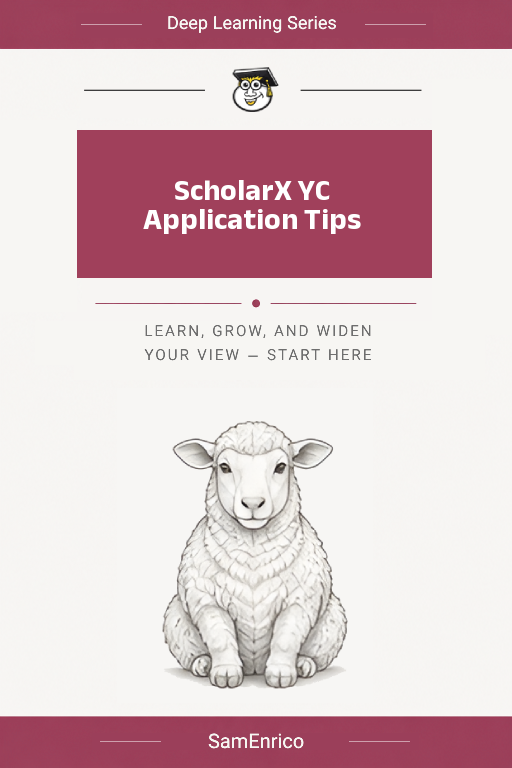
Non-FictionStartup GuideAccelerator PrepScholarship Tech
ScholarX YC Application Tips eBook
Study ScholarX Y Combinator scholarship marketplac
Study ScholarX Y Combinator scholarship marketplace application and apply their platform story to edtech.
Formats
Free sample
Chapter 1: The $150 Billion Mirage...--The security guard didn’t look up when he said it.Bola Lawal was twenty years old, standing at the entrance of his university’s engineering building in Ogun State, Nigeria. He had the highest grades in his department. He had never missed a class. He had done everything right. In his hand was a worn backpack containing textbooks he couldn’t afford to replace.
In his bank account was the equivalent of twelve US dollars.“No fees, no exam,” the guard repeated, now bored. “Come back next year.”Lawal watched his classmates file past him into the hall. Some glanced at him with pity. Most looked away. He stood there for ten minutes, not moving, until the guard finally closed the door.
That was the day he learned that talent without liquidity is worthless. That was the day he decided to burn the system down—not with anger, but with a marketplace.This book is not about scholarships. It is about what happens when millions of talented people are treated like they do not exist. And it is about how one company turned “zero liquidity” into a billion-dollar insight.The Most Dangerous Statistic in Education Let us begin with a number that will appear throughout this book: $150 billion.That is the estimated value of global scholarship money available annually, according to UNESCO and the World Bank. It is a staggering figure.
It suggests that the money exists. It suggests that the problem of education access is not a scarcity problem but a distribution problem.Here is the problem with that number: it is a lie.Not a lie in the factual sense—the money does exist. But it is a lie in the practical sense because nearly eighty percent of that $150 billion is restricted. Restricted means it is available only to specific categories of students: Ph D candidates, not undergraduates. US citizens, not Nigerians.
Students already enrolled at partner universities, not those trying to get in. Students studying specific subjects (engineering, medicine) not humanities. Students from specific ethnic backgrounds. Students with specific gender identities. The restrictions go on for pages.The remaining twenty percent—roughly $30 billion—is so poorly advertised, so buried in government websites, and so riddled with fraud that most eligible students never apply.
According to a 2022 study by the International Education Finance Corporation, only twelve percent of students in emerging markets have ever submitted a scholarship application. The other eighty-eight percent assume, correctly in most cases, that the application process is a trap designed to extract personal data or application fees.So here is the real number: 30billionofaccessiblebutinvisiblescholarshipmoney,competingagainst30 billion of accessible but invisible scholarship money, competing against 30billionofaccessiblebutinvisiblescholarshipmoney,competingagainst2 billion in annual fees paid to fraudulent agents, serving a population of over 20 million out-of-school children in Nigeria alone, plus another 50 million across India, Pakistan, Bangladesh, and Kenya.The problem is not that the money is missing. The problem is that the money is locked in a vault, and the key is held by gatekeepers who profit from keeping it there.The Two Broken Models To understand why Scholar X exists, you must first understand what it replaced. The education marketplace, before Scholar X, was bifurcated into two equally useless models.Model One: The White-Glove Consultant In this model, a wealthy family pays 5,000to5,000 to 5,000to20,000 to a study abroad consultant. The consultant holds the student’s hand through every step: university selection, application essays, visa preparation, even airport pickup.
The service is excellent. The outcomes are strong. The problem is that ninety-nine percent of the world cannot afford it.These consultants are not evil. They are running a rational business. They charge high prices because their clients have high willingness to pay.
But their existence warps the market. Universities see these polished, consultant-prepared applications and begin to expect that level of professionalism. Students who cannot afford consultants are penalized—not explicitly, but implicitly, because their applications look amateurish by comparison.Model Two: The Scholarship Board In this model, a government or foundation posts a list of scholarships on a website. Students are expected to find the list, read the requirements, gather the documents, and submit an application. No hand-holding.
No feedback. No second chances.This model serves the desperate, but it serves them poorly. A student in rural Nigeria with intermittent internet access cannot navigate a fifty-page PDF of scholarship requirements. A student in India whose first language is Tamil cannot write a competitive essay in academic English without coaching. A student in Pakistan who needs $500 for tuition cannot wait six months for a scholarship board to process applications.The scholarship board model assumes that students have time, bandwidth, language fluency, and application literacy.
Most do not.The Gap Between Them Between the $5,000 consultant and the zero-service scholarship board lies a vast, empty space. This space is occupied by students who have talent, ambition, and grades—but no liquidity. They cannot afford the consultant. They cannot navigate the board. They are trapped.Scholar X was built to fill that space.Reframing the Problem: From Search to Marketplace Most Edtech startups begin with the wrong question.
They ask: “How do we help students find scholarships?”This is a search problem. Search problems have search solutions: a better filter, a smarter algorithm, a more comprehensive database. But search solutions fail for a simple reason: they assume the money exists and is accessible. As we have already established, the money exists but is restricted, or is accessible but invisible. A better search engine does not fix restricted money.
A better filter does not make invisible money visible.Scholar X asked a different question: “How do we create new funding where none exists?”This is a marketplace problem. A marketplace connects supply and demand. In Scholar X’s case, the demand is students who need funding. The supply is sponsors, donors, universities, and employers who want to fund them.The insight that changed everything was this: the supply already exists, but it is fragmented and passive. There are thousands of wealthy diaspora Nigerians who would happily sponsor a student if the process were trustworthy and transparent.
There are hundreds of universities that would pay a commission for a vetted, serious applicant. There are dozens of employers who would prepay tuition in exchange for a work commitment after graduation. None of these supply sources are accessible through traditional scholarship boards or consultant networks.By reframing the problem from “search” to “marketplace,” Scholar X unlocked a billion-dollar opportunity that the incumbents had completely missed.The Size of the Prize Let us put numbers on this opportunity.The global market for study abroad consulting is estimated at 40billionannually.Thatistheamountstudentsandfamiliespaytoconsultants.Theglobalmarketforscholarshipadministrationisestimatedat40 billion annually. That is the amount students and families pay to consultants. The global market for scholarship administration is estimated at 40billionannually.Thatistheamountstudentsandfamiliespaytoconsultants.Theglobalmarketforscholarshipadministrationisestimatedat10 billion annually.
That is the amount governments and foundations spend to run scholarship programs. The global market for education loans is estimated at $200 billion annually.Scholar X competes in none of these markets.It competes in the market for unmediated matching—the space where students meet sponsors directly, without consultants, without banks, without government bureaucracy. This market is currently estimated at zero dollars because it does…
This is the end of the free sample. Get the eBook to keep going. Buy now
About this book
Details
- Author
- Lockett Karon
- Publisher
- SamEnrico
- Language
- English
- Genre
- Non-Fiction, Startup Guide, Accelerator Prep, Scholarship Tech
- Released
- 2026-06-01
- Pages (approx.)
- 145
- Available as
- eBook, Audiobook

Read better in the ZLOADR app
Your eBooks on your phone or tablet. Sign in with your SamEnrico account and start reading.
More by Lockett Karon
 Virtual Meeting Camera On PolicyLockett Karon$11.99
 Chat Communication NormsLockett Karon$11.99
 The Governor's DogLockett Karon$11.99
 Justin Rose English Rose BioLockett Karon$11.99
 Data Leak PR Crisis Communication GuideLockett Karon$11.99
 Breaking Barriers: The Unseen Fight of Senator Carol Moseley BraunLockett Karon$11.99
 The Salt of the Earth: The Great Strike That Shaped Modern LaborLockett Karon$11.99
 Associate Vice PresidentLockett Karon$11.99
 Assemble to Order SchedulingLockett Karon$12.99
 Understanding Cocaine Antenatal InfectionLockett Karon$17.99
 Ultimate Handbook Guide to Sofia : (Bulgaria) Travel GuideLockett Karon$11.99
You may also like
 Hong Kong Handover 1997Dunn Johnnie$11.99
 Zumba For Postnatal Recovery CourseNeal Christian$11.99
 Zumba for BeginnersLadner Nikia$11.99
 YouTube Comment Mining GuideHumes Pandora$12.99
 Worry Box MeditationCarlin Rudy$11.99
 Workplace Stress MeditationNguyen Lynn$11.99
 Workplace Stress and Sleep RepairHawley Ivory$11.99
 Workplace Perfectionism CureDelaney Jeffry$11.99
 Workplace Injustice Anger GuideWallen Isabelle$11.99
 Work Addiction and Burnout LinkGreenwood Ester$11.99
 Women in Yoga and WellnessBeattie Galina$11.99
 Women in Stand Up ComedyChun Evangeline$11.99