
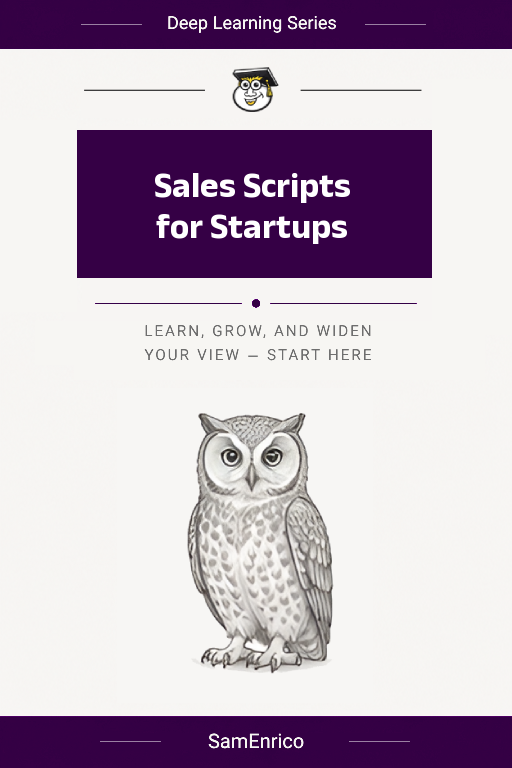
Sales Scripts for Startups eBook
Write scripts for early-stage startups with limite
Write scripts for early-stage startups with limited brand recognition and no case studies.
Formats
Free sample
Chapter 1: The Shame Question--–- The first time a prospect asked me, “Who else uses you?” I felt my stomach drop. I was 24 years old, three months into building my first startup, and I had exactly zero customers. I had a prototype, a dream, and a growing credit card bill. What I did not have was a single name I could drop. So I did what most founders do.
I lied. Well, I did not lie exactly. I “spun.” I said, “We are in conversations with several leading companies in your space.” The prospect nodded, smiled the smile of someone who has heard that line a hundred times, and said, “Call me when those conversations turn into contracts.” He never picked up my calls again.That moment taught me something painful. The question “Who else uses you?” is not a request for information. It is a test.
And most founders fail it not because they lack case studies, but because they feel shame about lacking them. That shame leaks into their voice, their posture, and their scripts. The prospect does not hear “we are new.” They hear “we are not ready for you.”This book exists because the sales industrial complex has lied to you. The gurus, the Linked In influencers, the Saa S sales bros with their MEDDIC certifications and their discovery frameworks – they all assume you have a brand. They assume you have case studies.
They assume you have a marketing team generating leads. But you are a startup founder. You have none of those things. And that is not a weakness. It is the only advantage you have.Here is the truth that will make you a bestseller: Case studies are for cowards.
Real founders sell pain, not proof. They sell attention, not authority. They sell the fact that they have nothing to lose, while their incumbents have everything to protect. This chapter will teach you how to answer the shame question so honestly and so differently that the prospect forgets to ask for proof. By the end of this chapter, you will never freeze again when someone asks, “Who else uses you?” Instead, you will smile.
Because you will know something they do not: your lack of social proof is your social proof.The Anatomy of the Shame Question Let us break down what is actually happening when a prospect asks, “Who else uses you?” On the surface, they want validation. They want to know that other smart people have made this decision before them. This is called social proof, and it is a well-documented psychological shortcut. Humans are herd animals. We look to others to tell us what is safe.
But here is the thing about startups: you are not selling safety. You are selling change. And change is never safe.Robert Cialdini, in his classic work on persuasion, identified social proof as one of the six weapons of influence. But he also noted that social proof works best when the situation is uncertain. The prospect is uncertain.
You are new. They do not know if you will deliver. So they ask for evidence that others have taken the risk and survived. That is fair. But here is what most sales books miss: social proof is only one form of evidence.
It is not the only form. And for a startup with no customers, it is the worst form because you cannot produce it.What you can produce is something far more powerful: intellectual authority. Intellectual authority is the ability to describe the prospect’s problem more accurately than they can describe it themselves. When you do that, the prospect stops thinking about your lack of customers and starts thinking about their own lack of solutions. They stop asking “who else?” and start asking “how soon?”Consider this.
If a doctor tells you that you have a rare disease and then describes every symptom you have been hiding from your family, you do not ask for a list of other patients they have cured. You ask for the treatment. The doctor’s authority does not come from social proof. It comes from diagnosis. Your job is to become that doctor.
You are not selling a product. You are diagnosing a problem so accurately that the prospect feels seen, heard, and slightly uncomfortable. That discomfort is where trust begins.Why Vulnerability Destroys Skepticism There is a concept in negotiation theory called the “vulnerability loop.” It works like this: when one party admits a weakness first, the other party is neurologically compelled to lower their guard. You see this in hostage negotiations, in marriage counseling, and yes, in startup sales. The reason is simple.
Brains are wired to detect threats. When you admit something that could hurt you – “we have no case studies” – you signal that you are not trying to manipulate the prospect. Manipulators hide their weaknesses. Honest people expose them.Let me be very clear about what vulnerability means in this book, because the word gets thrown around a lot. Vulnerability is not crying on a sales call.
It is not sharing your childhood trauma. It is not being weak. Vulnerability, as I define it for the purpose of selling without case studies, is the strategic admission of an obvious weakness before the prospect can use it against you. It is a preemptive strike.Most founders wait for the prospect to ask, “Who else uses you?” Then they stammer, deflect, or lie. That is reactive vulnerability, and it smells like fear.
What you want is proactive vulnerability. You want to say the thing they are thinking before they say it. You want to take the weapon out of their hands by handing it to them yourself.Here is the difference. Reactive sounds like this: “Well, we are pretty new, but we have some pilot customers, and we are really excited about…” (translation: please do not ask follow-up questions). Proactive sounds like this: “Honestly, you will not find any case studies from companies your size.
We made a deliberate choice to stay small until we solve this specific problem for our first ten partners. You will not get a polished product. You will get my personal cell phone number and our entire engineering team’s attention. Which matters more to you right now?”Notice what happened there. You did not wait for the question.
You answered it before it was asked. You reframed the weakness as a deliberate choice. And then you asked a question that forces the prospect to choose between two things: a polished product or engineering attention. No startup can offer both. Large vendors offer polished products and support tickets.
You offer chaos and obsession. That is a trade many prospects are desperate to make.The Diagnostic Reframe The single most important shift you will make in this entire book is moving from selling a solution to selling a diagnosis. This is not a semantic trick. It is a fundamental reorientation of how you talk to prospects. When you sell a solution, you are selling yourself.
You are asking the prospect to trust you, your team, your product, and your future roadmap. That is a heavy lift for someone with no brand. When…
This is the end of the free sample. Get the eBook to keep going. Buy now
About this book
Details
- Author
- Faber Elenore
- Publisher
- SamEnrico
- Language
- English
- Genre
- Non-Fiction, First 30 Days, Startup Sales
- Released
- 2026-06-01
- Pages (approx.)
- 118
- Available as
- eBook, Audiobook

Read better in the ZLOADR app
Your eBooks on your phone or tablet. Sign in with your SamEnrico account and start reading.
More by Faber Elenore
 The Remote Work Transition PeriodsFaber Elenore$11.99
 Meeting Notes SystemFaber Elenore$11.99
 The Groin Strain PreventionFaber Elenore$11.99
 Vegan Food Allergy Cooking CourseFaber Elenore$11.99
 Franchising Your Local Brand Across Borders Tax GuideFaber Elenore$11.99
 The Quantum Crown Heist: How a Parallel Universe King Stole the British MonarchyFaber Elenore$11.99
 CRISPR: The Genetic ScalpelFaber Elenore$11.99
 Understanding Cutaneous AnthraxFaber Elenore$17.99
 IP Fee Payment MethodsFaber Elenore$12.99
 After School Program LeaderFaber Elenore$11.99
 How to Become a Tree PlanterFaber Elenore$11.99