
Non-FictionSelf-HelpSales Skills
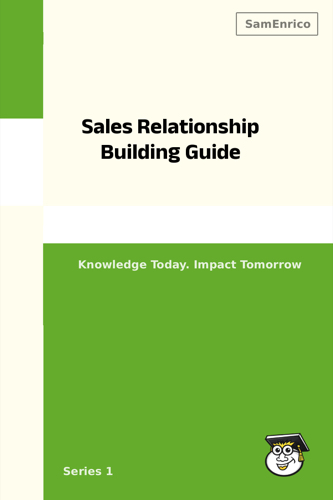
Sales Relationship Building Guide eBook
Turn cold leads into long term clients through tru
Turn cold leads into long term clients through trust and value creation.
Formats
Free sample
Chapter 1: The Funnel Lie--Most salespeople are taught to worship the funnel. You have seen it a hundred times—a wide mouth at the top where cold leads pour in, a narrowing middle where you nurture and pitch, and a tiny spout at the bottom where a fraction emerge as customers. The metaphor is seductive because it is mechanical. It promises predictability. Input equals output.
More leads at the top equals more sales at the bottom. But there is a problem buried beneath this tidy diagram, and it is not a small one. The funnel is a lie.Not because it is inaccurate as a description of volume. Leads do enter, many do drop out, and some do convert. That part is true enough.
The lie is deeper and more corrosive. The funnel teaches you to see relationships as a pipeline. It trains you to view every human interaction as a stage in a linear process that ends with a signature. And once that signature is obtained, the funnel spits the client out the bottom and you start over with a fresh cold lead at the top. This is not relationship building.
It is extraction disguised as efficiency.The modern buyer has figured this out. They have been funnelled before. They have been qualified, nurtured, and closed. They have felt the warm embrace of a salesperson who vanished the moment the contract was signed. They have received the automated sequence that pretended to care.
And now, when your email lands in their inbox or your call lights up their phone, their default response is not curiosity. It is skepticism tinged with exhaustion.This chapter will dismantle the funnel as the dominant metaphor for sales relationships and replace it with something that actually works for the way real human beings buy today. You will learn why the funnel has become a liability, how the Trust Loop creates repeatable growth without manipulation, and why giving value first is not a tactic but an entirely different orientation to your work. By the end of this chapter, you will never look at a pipeline report the same way again.The Unspoken Cost of the Funnel Let us start with a hard truth. The funnel model was not designed for relationships.
It was designed for throughput. It originated in manufacturing and was borrowed by marketing because it described how raw materials become finished goods. Leads were the raw material. Salespeople were the assembly line. Customers were the finished product exiting the factory floor.That metaphor made a certain kind of sense in an era when information was scarce and salespeople held the keys.
If a buyer wanted to know about a product, they had to talk to someone who sold it. The salesperson controlled the narrative, the comparison set, and the pricing. In that world, the funnel was a reasonable approximation of power dynamics.That world is gone. Today, the average B2B buyer completes nearly seventy percent of their purchase research before they ever speak to a salesperson. They have already read your competitor's reviews, watched the demo videos, and calculated the ROI spreadsheets.
By the time you get your first conversation, they do not need you for information. They need you for something far more difficult to deliver. They need you to be trustworthy.The funnel does not know what to do with trust. Trust is not a stage. You cannot slot it between "discovery" and "proposal" on a whiteboard.
Trust is atmospheric. It permeates or poisons every interaction. And the funnel, with its relentless forward motion, actively discourages the behaviors that build trust.Consider what the funnel rewards. It rewards speed. Move the lead from awareness to interest to decision as quickly as possible.
It rewards volume. More leads at the top, regardless of fit, because some will trickle down. It rewards closure. The deal that signs this quarter is worth more than the relationship that pays dividends for years. These incentives are not neutral.
They shape how you show up, how you listen, and how quickly you reach for the pricing page.The buyer knows this. They have been on the receiving end of the funnel many times. They have heard the eager discovery call that asked thirty questions in twenty minutes. They have received the proposal that arrived suspiciously fast, as if the salesperson had already decided what they needed before they finished explaining it. And they have felt the chilling shift in attention the moment they said "not right now" and were dropped from the automated sequence.This is the unspoken cost of the funnel.
It trains buyers to distrust sellers before you ever open your mouth. You are not starting from zero. You are starting from negative ten, and the only way to climb back to neutral is to behave in ways that no funnel would ever recommend.The Trust Loop: A Better Metaphor If the funnel is linear and seller-centric, what replaces it? The answer is a circular, relationship-centric model called the Trust Loop. Where the funnel has a beginning and an end, the loop has only deepening cycles.
Where the funnel extracts value at the exit, the loop generates value at every turn.The Trust Loop has five stations, arranged not in a line but in a continuous circle:Value → Trust → Permission → Sale → Value Let us walk through each station slowly because this order is counterintuitive and that is the point.Value comes first. Before you ask for anything, before you qualify, before you even fully understand their situation, you offer something useful. This can be small. It can be a specific observation about their industry, a piece of relevant data, a question that reframes a problem they have been ignoring. The scale does not matter as much as the direction.
You are giving before you take.Trust emerges from that value. Not automatically, not instantly, but as a cumulative impression. Each time you deliver something useful without demanding something in return, you deposit a coin in the trust bank. Over time, the balance grows. And trust is the only currency that buys you access to the truth.
Without trust, you get surface answers. With trust, you get real problems, real budgets, real timelines, and real fears.Permission is what trust enables. A prospect who trusts you will grant you access that a stranger would never allow. Permission to ask harder questions. Permission to challenge their assumptions.
Permission to bring in other stakeholders. Permission to discuss pricing without defensiveness. Permission is not a one-time gate. It is renewed in every interaction, and it is the clearest signal that trust is alive.Sale is not the end of the loop. It is simply a milestone within it.
When value, trust, and permission are all present, the sale becomes a logical step rather than a wrestling match. You do not close. You conclude. The difference is everything. Closing is something you do to someone.
Concluding is something you do with someone.Value appears again because the loop does not end at the contract. After the sale, you deliver more value. Implementation support, proactive insights, introductions to your network, warnings about industry changes. This post-sale value circles back to deepen trust…
This is the end of the free sample. Get the eBook to keep going. Buy now
About this book
Details
- Author
- Draper Vanesa
- Publisher
- SamEnrico
- Language
- English
- Genre
- Non-Fiction, Self-Help, Sales Skills
- Released
- 2026-06-10
- Pages (approx.)
- 125
- Available as
- eBook, Audiobook

Read better in the ZLOADR app
Your eBooks on your phone or tablet. Sign in with your SamEnrico account and start reading.
More by Draper Vanesa
 Self Hypnosis For Emotional RegulationDraper Vanesa$11.99
 Procrastination Cure for StudentsDraper Vanesa$11.99
 Physical Strain ManualDraper Vanesa$11.99
 Menopause Transition PeriodsDraper Vanesa$11.99
 Shadows of the Silk Road: The Forgotten War of the SteppeDraper Vanesa$11.99
 The Clockwork Tide: Medieval Automation in the Indian OceanDraper Vanesa$11.99
 Data Operations SpecialistDraper Vanesa$11.99
 How to Become a Career-guidance TechnicianDraper Vanesa$11.99
 Understanding Ectodermal DysplasiaDraper Vanesa$17.99
 Voiceover Website GuideDraper Vanesa$12.99
 Brazil Data Protection GuideDraper Vanesa$12.99
You may also like
 Hong Kong Handover 1997Dunn Johnnie$11.99
 Zumba For Postnatal Recovery CourseNeal Christian$11.99
 Zumba for BeginnersLadner Nikia$11.99
 YouTube Comment Mining GuideHumes Pandora$12.99
 Worry Box MeditationCarlin Rudy$11.99
 Workplace Stress MeditationNguyen Lynn$11.99
 Workplace Stress and Sleep RepairHawley Ivory$11.99
 Workplace Perfectionism CureDelaney Jeffry$11.99
 Workplace Injustice Anger GuideWallen Isabelle$11.99
 Work Addiction and Burnout LinkGreenwood Ester$11.99
 Women in Yoga and WellnessBeattie Galina$11.99
 Women in Stand Up ComedyChun Evangeline$11.99