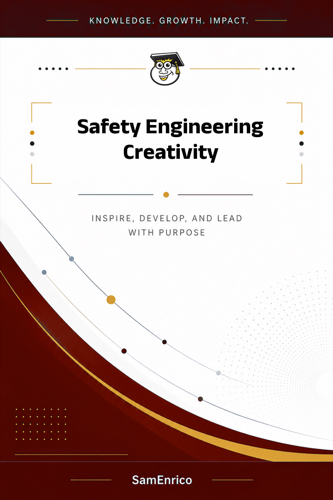
Safety Engineering Creativity
Generate novel hazard controls and fail safe desig
Generate novel hazard controls and fail safe designs using creative thinking.
Formats
About this book
Free sample
Chapter 1: The Titanic Syndrome--–- On the night of April 14, 1912, the RMS Titanic carried 2,224 passengers across the North Atlantic. The ship was the largest moving object ever built. Its designers had called it "practically unsinkable." Sixteen watertight compartments, advanced for the era, meant that even if four were breached, the vessel would stay afloat. No one imagined that an iceberg could scrape along the hull, opening six compartments to the sea. No one had designed for that scenario.
The code book of the day did not include it. And so, 1,517 people died not because the ship was weak, but because the imagination of its builders was limited to what had already been seen.This chapter argues that the safety engineering profession has become a prisoner of its own success. Decades of developing codes, standards, checklists, and best practices have created a culture where "compliance" is mistaken for "safety." Engineers take pride in following the rules. Regulators demand proof of adherence. Lawsuits punish deviation from established norms.
And yet, disasters continue to occur—not because the rules were violated, but because the rules did not anticipate the scenario that unfolded.The most significant hazards are not technical failures of materials or machines. They are failures of imagination. This book exists to remedy that failure. But before we can build creative solutions, we must first understand the psychological and organizational barriers that keep safety engineering trapped in reactive compliance rather than proactive creativity.The Paradox of Zero For decades, the safety profession has pursued a noble but misleading goal: zero incidents. Zero recordable injuries.
Zero lost-time accidents. Zero environmental releases. On its face, this seems unobjectionable. Who would argue for more accidents?The problem is that the pursuit of zero creates perverse incentives. When the goal is zero, any incident becomes evidence of failure.
Managers hide near-misses. Operators skip reporting minor deviations. Engineers stick to proven designs because a novel solution that fails carries catastrophic career risk, while a standard solution that fails is simply "bad luck" or "unforeseeable." The organization optimizes for the appearance of safety rather than the reality of…
This is the end of the free sample. Get the eBook to keep going. Buy now
Contents
- Chapter 1
- Chapter 2
- Chapter 3
- Chapter 4
- Chapter 5
- Chapter 6
- Chapter 7
- Chapter 8
- Chapter 9
- Chapter 10
- Chapter 11
- Chapter 12
Details
- Author
- Shuler Marylou
- Publisher
- SamEnrico
- Language
- English
- Genre
- Non-Fiction, Self-Help, Safety Engineering
- Released
- 2026-06-10
- Pages (approx.)
- 140
- Available as
- eBook, Audiobook

Read better in the ZLOADR app
Your eBooks on your phone or tablet. Sign in with your SamEnrico account and start reading.
More by Shuler Marylou
 Growth Mindset For AnxietyShuler Marylou$11.99
 Overcoming Isolation in AddictionShuler Marylou$11.99
 Inoculation Persuasion TheoryShuler Marylou$11.99
 The Fish and Seafood LongevityShuler Marylou$11.99
 Nefertiti's Veil: The Hidden Queen of the SunShuler Marylou$11.99
 Reverse Charge Mechanism GuideShuler Marylou$12.99
 African Founder YC Cohort GuideShuler Marylou$12.99
 Understanding Trypanosomiasis, East AfricanShuler Marylou$17.99
 How to Start a Dolls Made of Rubber Business (Beginners Guide)Shuler Marylou$11.99
 Construction General LabourerShuler Marylou$11.99