
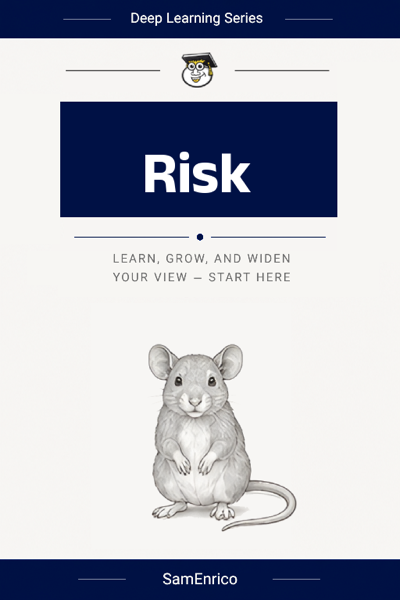
Free sample
Chapter 1: The Casino Inside You--– The first time I watched a rational man destroy himself, he was sitting across from me at a poker table in Las Vegas, wearing a suit that cost more than my first car. His name was David, and he was a hedge fund manager from Greenwich, Connecticut. He had a degree from Wharton, an MBA from Stanford, and a reputation for being the smartest person in any room he entered. I knew all of this because he told me, at length, between hands. He was at the Bellagio for a finance conference, and he had decided to “relax” by playing no-limit Texas Hold’em at the 10/10/10/20 blinds table.
I was there because I was researching a story on professional gamblers, and the pro sitting to my left had agreed to let me observe.David played well for the first hour. He folded bad hands. He raised when he had position. He calculated pot odds with the precision of someone who had spent a decade evaluating risk-adjusted returns. He was up about two thousand dollars when it happened.
He was dealt a pair of aces—the best possible starting hand in Texas Hold’em. He raised. Someone re-raised. He re-raised again. By the time the flop came, there was already four thousand dollars in the pot.
The flop was ace, nine, three—all different suits. David had three aces. The statistical probability of being dealt a pair of aces is about one in two hundred twenty. The probability of flopping three of a kind when you start with a pair is about one in eight. David had just hit a one-in-seventeen-hundred combination.
He was ecstatic. He bet four thousand dollars. The only other player in the hand—a quiet man in a baseball cap who had said nothing for two hours—called.The turn card was a seven. David bet eight thousand. The man in the baseball cap called again.
The river card was a deuce. David pushed all in—his remaining twelve thousand dollars. The man in the baseball cap hesitated for ten seconds, then called. David triumphantly turned over his three aces. The man in the baseball cap turned over four, five, six—of clubs.
He had a straight. David had just lost twenty-six thousand dollars on a hand where he was a ninety-five percent favorite after the flop. The ninety-five percent happened. That is poker. But what happened next is why I am writing this book.David did not get up.
He did not take a walk. He did not go to the bar and order a drink and call it a night. He pulled out another ten thousand dollars in chips and said, “I’m due.” He played for six more hours. He chased his losses. He started playing hands he would have folded an hour earlier.
He started calling raises instead of folding. He started staying in pots long after the math said he should leave. By the time the sun came up over the desert, David had lost one hundred forty-seven thousand dollars. He had not lost it to bad luck. He had lost it to his own brain.
The hedge fund manager who spent his days managing credit default swaps and emerging market debt had no idea how to manage himself.That night at the Bellagio taught me something that ten years of business school could not: the difference between risk and gambling is not in the odds. It is in the person calculating them. David knew the odds. He could have recited the probability of hitting a straight with a four-five-six suited better than anyone at that table. But knowledge is not enough.
You can know that a food is bad for you and eat it anyway. You can know that a relationship is toxic and stay in it anyway. You can know that a trade is reckless and make it anyway. The gap between knowing and doing is where money goes to die. This book is about closing that gap.The Two Systems That Run Your Brain Before we can understand why David blew one hundred forty-seven thousand dollars in a single night, we have to understand how the human brain makes decisions.
The most useful framework for understanding this comes from Daniel Kahneman, the psychologist who won a Nobel Prize in Economics for work he did with his late partner Amos Tversky. Their central insight is that the brain operates using two distinct systems, which Kahneman called System 1 and System 2. You have experienced the tension between these two systems thousands of times. You just did not have names for it.System 1 is fast. It is automatic.
It is emotional. It is the part of your brain that snatches your hand away from a hot stove before you have even registered the word “hot.” It recognizes faces, reads emotions, and completes the phrase “bread and…” without you having to think about it. System 1 is running constantly, using about twelve percent of your brain’s energy to manage the millions of decisions you make every day without noticing. When you drive a familiar route and suddenly realize you have arrived without remembering the journey, that is System 1. When you look at a stranger and immediately feel that something is “off,” that is System 1.
System 1 is brilliant at what it evolved to do, which was keep a hunter-gatherer alive on the savanna. But the savanna did not have poker tables. The savanna did not have options contracts or margin accounts or cryptocurrency exchanges. And that is where the trouble begins.System 2 is slow. It is deliberate.
It is logical. It is the part of your brain that solves long division, compares mortgage rates, and decides whether to accept a job offer. System 2 requires effort. It burns glucose—literally. Studies have shown that people who perform demanding cognitive tasks experience drops in blood sugar, and that replenishing that sugar restores their mental performance.
System 2 is also lazy. It will accept the answers that System 1 provides unless you actively force it to engage. This is not a design flaw; it is a feature. System 2 is expensive to run, so your brain defaults to System 1 whenever possible. The problem is that System 1, for all its speed and efficiency, is systematically irrational.
It operates using rules of thumb called heuristics, and those heuristics, when applied to modern financial decisions, produce predictable errors called cognitive biases.Here is a simple test that Kahneman and Tversky used to demonstrate the difference between the two systems. Try it yourself. Do not read ahead until you have an answer.A bat and a ball together cost one dollar and ten cents. The bat costs one dollar more than the ball. How much is the ball?If you answered ten cents, you are in excellent company.
More than half of the students at Harvard, MIT, and Princeton gave that answer. It is also wrong. If the ball cost ten cents, the bat would cost one dollar and ten cents, and the total would be one dollar and twenty cents. The correct answer is five cents. The bat costs one dollar and five cents, the ball costs five cents…
This is the end of the free sample. Get the eBook to keep going. Buy now
About this book
Details
- Author
- Mcneal Kenneth
- Publisher
- SamEnrico
- Language
- English
- Genre
- Non-Fiction, Informative, Educational
- Released
- 2026-05-04
- Pages (approx.)
- 146
- Available as
- eBook, Audiobook

Read better in the ZLOADR app
Your eBooks on your phone or tablet. Sign in with your SamEnrico account and start reading.
More by Mcneal Kenneth
 The Cross Border Remote WorkMcneal Kenneth$11.99
 Intuitive Eating For College Students GuideMcneal Kenneth$11.99
 Personal Ing For Success Differentiation GuideMcneal Kenneth$11.99
 Parental Anger First Aid ManualMcneal Kenneth$11.99
 Drug Nutrient Depletion PainMcneal Kenneth$11.99
 Pill Poppers & Power Brokers: The Inside Story of the OxyContin EmpireMcneal Kenneth$11.99
 The Maya Mathematicians: Decoding the Secrets of the Olmec and the Birth of Calculus in the AmericasMcneal Kenneth$11.99
 Understanding Biliary CirrhosisMcneal Kenneth$17.99
 US Business Visa for LLC OwnersMcneal Kenneth$12.99
 African Coding Bootcamp RiseMcneal Kenneth$12.99
 How to Start a Probate Registry Business (Beginners Guide)Mcneal Kenneth$11.99