
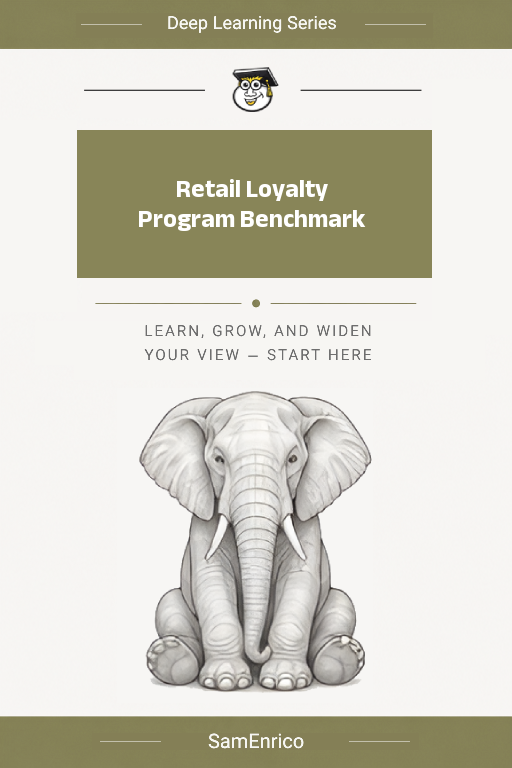
Non-FictionStrategic AtlasRetail
Retail Loyalty Program Benchmark eBook
Compares loyalty programs from top retailers inclu
Compares loyalty programs from top retailers including points systems, VIP tiers, and experiential rewards.
Formats
Free sample
Chapter 1: The Enrollment Lie--–- On a Tuesday morning in March, a loyalty director at a midsize apparel brand did something she had done every quarter for three years. She opened her program dashboard, exported the enrollment numbers, added a celebratory emoji to the slide deck, and presented to her CEO that membership had grown 22% year over year. The CEO applauded. The team received bonuses. And not a single person in the room asked the only question that mattered: how many of those new members had actually changed their behavior?This scene plays out thousands of times every month in retailers around the world.
Loyalty programs are celebrated for their enrollment growth, praised for their point accrual rates, and rewarded for their redemption volumes. Meanwhile, the same retailers quietly accept that their retention rates have barely budged, their share of wallet remains flat, and their most valuable customers are just as likely to defect as they were before the program launched. The industry has built an elaborate theater of loyalty while mistaking the props for the performance.This chapter is not another cheerleader’s guide to launching a loyalty program. It is an autopsy of why most programs fail, a dismantling of the assumptions that keep mediocre programs alive, and a recalibration of what loyalty actually means. By the time you finish this chapter, you will understand why over 70% of retail loyalty programs fail to drive genuine behavioral change, why your enrollment numbers are likely lying to you, and what separates the few programs that actually work from the many that merely exist.The Great Enrollment Deception Let us begin with a confession that most loyalty consultants will never make: enrollment is the cheapest form of loyalty.
It costs almost nothing to get a customer to click a button, enter an email address, or scan a QR code at a register. The customer invests seconds. The retailer gains a data point. And both parties go home believing something meaningful has occurred.But here is the uncomfortable truth. When the Bond Brand Loyalty Report analyzed over 500 million loyalty program memberships across dozens of industries, they found that the average active engagement rate—defined as members who actually earn or redeem points at least once per quarter—hovered below 40%.
More than half of enrolled members are ghosts. They exist in the database but not in the behavior.A 2024 meta-analysis of retail loyalty data conducted by the Loyalty Academy found that among 147 retail programs studied, only 22% could demonstrate a statistically significant lift in customer lifetime value attributable to the program itself. The other 78% were effectively running coupon clubs dressed in loyalty clothing. Customers joined for the signup discount, stayed for the occasional email, and left the moment a competitor offered a better deal.The problem is not that these retailers are incompetent. The problem is that they have conflated two entirely different constructs: enrollment and loyalty.
Enrollment is a transaction of attention. Loyalty is a pattern of behavior. One takes seconds. The other takes years. And the distance between them is where most programs die.Consider the anatomy of a typical retail program launch.
A marketing team designs a points structure, often borrowing from a competitor. An agency builds a mobile app or a web portal. A legal team drafts terms and conditions. Then the program goes live with a big email blast, some in-store signage, and a modest paid media campaign. Customers enroll.
The team celebrates. And then nothing changes.The customers who were already loyal continue buying. The customers who were already price-sensitive continue chasing discounts. And the customers in the middle—the ones the program was supposedly designed to convert—do exactly what they did before: they buy wherever the price and convenience lead them. The program has added cost without adding value, complexity without clarity, and noise without signal.This phenomenon has a name in behavioral economics: the distinction between behavioral loyalty and emotional loyalty.
Behavioral loyalty is what happens when a customer buys from you repeatedly because it is easy, familiar, or simply less effort than switching. It is the loyalty of inertia. Emotional loyalty is what happens when a customer buys from you repeatedly because they actively prefer you, advocate for you, and feel a connection to your brand. It is the loyalty of affinity.Most retail loyalty programs train the former while pretending to build the latter. A points program that offers discounts on future purchases does not create emotional attachment.
It creates a transactional habit. The customer is not loyal to the brand. They are loyal to the discount. And when that discount becomes available elsewhere, or when the earning rate feels too slow, they leave without a second thought.The 70% Failure Rate: What It Really Means The statistic that opens this chapter—“over 70% of retail loyalty programs fail to drive genuine behavioral change”—comes from a synthesis of three major industry studies conducted between 2022 and 2025. The first, from Forrester Research, found that 68% of loyalty programs fail to achieve their stated retention goals.
The second, from the Harvard Business Review, found that 72% of loyalty program members report that the program has “little to no influence” on where they choose to shop. The third, from the Loyalty Academy’s proprietary benchmark database, found that 74% of programs show no measurable lift in share of wallet among enrolled members compared to non-enrolled customers.Taken together, these findings paint a damning picture. The vast majority of loyalty programs are not actually changing customer behavior. They are merely tracking it. They are expensive dashboards masquerading as growth engines.But the picture is even worse when you dig into the distribution.
Among the 30% of programs that do show some lift, the magnitude varies wildly. At the top, a handful of programs—less than 5% of the total—achieve extraordinary results, driving 30–50% increases in customer lifetime value and reducing churn by half or more. These are the Nikes, the Sephoras, the Starbucks of the world. They are the exception, not the rule.The remaining 25% of “successful” programs show only marginal lifts of 5–10% in lifetime value, which barely covers the cost of running the program when you factor in technology, marketing, rewards, and personnel. These programs are technically positive but practically irrelevant.
They would generate more shareholder value by shutting down and sending the savings to the bottom line.This distribution—a tiny tail of extraordinary success, a modest middle of marginal returns, and a long tail of outright failure—suggests that loyalty programs are not a reliably effective strategy. They are a high-risk, high-reward gamble that most retailers lose. And yet, the industry continues to launch new programs at a furious pace, driven by fear of falling behind competitors and faith in a model that the data says does not work.Why Most Retailers Keep Building Broken Programs If the evidence is so clear, why do retailers keep building programs that fail? The answer lies in four cognitive traps that plague loyalty program design. Understanding these traps is the first step toward escaping them.The Mimicry Trap The most common approach to loyalty program design is also the most dangerous: copying what competitors do.
A retailer looks at a rival’s program, notices that it has a points structure and three tiers, and concludes that…
This is the end of the free sample. Get the eBook to keep going. Buy now
About this book
Details
- Author
- Villanueva Rufina
- Publisher
- SamEnrico
- Language
- English
- Genre
- Non-Fiction, Strategic Atlas, Retail
- Released
- 2026-06-01
- Pages (approx.)
- 156
- Available as
- eBook, Audiobook

Read better in the ZLOADR app
Your eBooks on your phone or tablet. Sign in with your SamEnrico account and start reading.
More by Villanueva Rufina
 The Caffeine Cutoff GuideVillanueva Rufina$11.99
 Swimming HIIT Training GuideVillanueva Rufina$11.99
 Assertiveness for Teens GuideVillanueva Rufina$11.99
 Worry Journal MeditationVillanueva Rufina$11.99
 Orchestra Pit Confessions MemoirVillanueva Rufina$11.99
 The East India Company: Merchants of EmpireVillanueva Rufina$11.99
 The Breeder's Guide to Giant Chinchilla RabbitsVillanueva Rufina$11.99
 Free to Paid SaaS GuideVillanueva Rufina$12.99
 First CookVillanueva Rufina$11.99
 How to Become a Long-wall-mining-machine TenderVillanueva Rufina$11.99
You may also like
 Hong Kong Handover 1997Dunn Johnnie$11.99
 Zumba For Postnatal Recovery CourseNeal Christian$11.99
 Zumba for BeginnersLadner Nikia$11.99
 YouTube Comment Mining GuideHumes Pandora$12.99
 Worry Box MeditationCarlin Rudy$11.99
 Workplace Stress MeditationNguyen Lynn$11.99
 Workplace Stress and Sleep RepairHawley Ivory$11.99
 Workplace Perfectionism CureDelaney Jeffry$11.99
 Workplace Injustice Anger GuideWallen Isabelle$11.99
 Work Addiction and Burnout LinkGreenwood Ester$11.99
 Women in Yoga and WellnessBeattie Galina$11.99
 Women in Stand Up ComedyChun Evangeline$11.99