
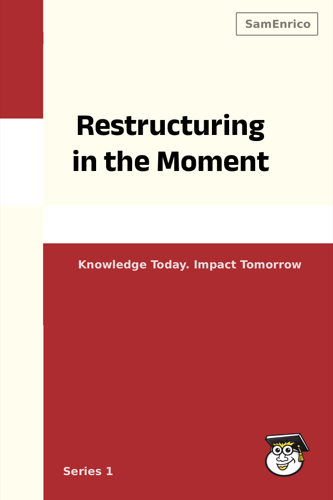
Restructuring in the Moment eBook
Apply cognitive techniques during active anger wit
Apply cognitive techniques during active anger without leaving situation.
Formats
Free sample
Chapter 1: The Failure of Flight...--–- The first time someone told you to "just walk away," you probably felt a flicker of relief. Permission to escape. But then you actually tried it. You left the room, heart pounding, jaw clenched, and spent the next twenty minutes rehearsing everything you should have said. By the time you returned, you were not calmer.
You were more furious, more rehearsed, and less willing to compromise. And the other person? They had spent those same twenty minutes feeling abandoned, rejected, or victorious. The problem was not solved. It was frozen, then reheated, then served back to you with interest.This chapter dismantles the most sacred cow of modern anger management: the universal recommendation to "take a time-out" or "walk away." While well-intentioned, this advice fails for a significant portion of people—especially those in high-stakes relationships where leaving is perceived as abandonment, rejection, or surrender.
More importantly, this chapter introduces the central distinction that will guide the entire book: retreat versus resetting. You will learn why leaving often makes anger worse, when a strategic pause actually works, and how to train yourself to reset without leaving—a skill that makes time-outs optional rather than mandatory.The Sacred Cow of Anger Management For the past forty years, the standard protocol for anger has been remarkably consistent across self-help books, therapy workbooks, and even clinical guidelines. It goes by many names: the time-out, the cool-down period, the walk-away, the pause. The instructions are almost identical across sources. When you feel anger rising, remove yourself from the situation.
Go to another room. Take a walk. Wait until your physiological arousal drops below a certain threshold—usually twenty to thirty minutes. Then return and discuss the problem calmly.On paper, this makes perfect sense. Anger is associated with elevated heart rate, increased blood pressure, and reduced prefrontal cortex activity.
Removing yourself from the trigger removes the source of continued arousal. Time allows cortisol and adrenaline to metabolize. The body returns to baseline. The thinking brain comes back online. Problem solved.Except it is not.
Not for everyone. Not for most people in high-stakes relationships. And certainly not for the person who has tried this protocol dozens of times and found themselves returning to the conversation more angry than when they left.The problem is not the physiology. The physiology is correct. The problem is the psychology of what happens during the time-out, and the relational consequences of what leaving communicates to the other person.
The standard protocol treats anger as a purely internal, biochemical event that can be solved through isolation. But anger is not just a chemical state. It is a narrative, a relationship, a meaning-making process. When you leave the situation, you do not leave your thoughts behind. You take them with you.
And in the silence of the empty room, those thoughts do not rest. They race.Failure Mode One: Cognitive Fusion and the Rumination Loop Let me describe a scene that may feel familiar. You are in an argument with your partner, your teenager, or a colleague. The temperature rises. Someone says something sharp.
You feel the surge—the heat in your chest, the tightening in your throat, the pressure behind your eyes. You remember the advice: walk away. So you do. You go to the bedroom, or the garage, or the break room. You shut the door.
You sit down. You take a deep breath.And then your brain begins to talk.Can you believe they said that? After everything you have done for them? The disrespect. The sheer gall.
And you just walked away like a coward. You should go back in there and—The thought loop begins. You replay the last thirty seconds of the argument. Then the last minute. Then the last hour.
You generate clever comebacks you wish you had said. You imagine the look on their face if you had delivered that perfect line. You mentally construct an entire closing argument for why you are right and they are wrong. And with each repetition, your heart rate does not fall. It rises.
Your jaw clenches tighter. Your breathing becomes shallower.This is cognitive fusion—a term borrowed from Acceptance and Commitment Therapy (ACT) that describes the phenomenon of becoming so fused with your thoughts that they feel like literal reality. When you are angry and alone, the usual brakes on your thinking are removed. There is no other person to interrupt the loop. No social pressure to be reasonable.
No external feedback that you are spiraling. Just you and the echo chamber of your own righteous indignation.The research on this is sobering. A 2018 study published in the Journal of Behavior Therapy and Experimental Psychiatry found that participants who were instructed to take a time-out during an anger induction actually showed higher physiological arousal after ten minutes of isolation than participants who remained in the presence of the trigger but practiced cognitive reappraisal. The reason? Rumination.
The alone group spent their time mentally rehearsing the offense, while the reappraisal group spent their time reframing it.Here is what happens neurochemically during the rumination loop. When you replay an angry memory, your brain activates the same stress pathways as the original event. The amygdala fires. The hypothalamus signals the pituitary gland. Cortisol and adrenaline flood your system.
You are not calming down. You are reliving the trigger, over and over, each time reinforcing the neural pathway that connects the other person's face to the emotion of rage. By the time you emerge from your time-out, you have practiced anger more times than you would have if you had stayed in the room.This is the hidden curriculum of the standard time-out. It does not teach you to regulate. It teaches you to rehearse.Failure Mode Two: Relational Escalation Through Perceived Abandonment There is a second failure mode that is even less discussed, perhaps because it touches on something more uncomfortable than individual psychology: attachment.
Human beings are wired for connection. When a conflict arises with someone to whom we are attached—a partner, a parent, a child, a close friend—the threat is not just to our pride or our position. The threat is to the bond itself.When you walk away from an attachment figure during a conflict, the other person's brain does not interpret it as "they are practicing a healthy coping skill." Their brain interprets it as abandonment. Stonewalling. Rejection.
Punishment. This is not a metaphor. Neuroimaging studies of attachment rejection show activation in the same brain regions (the anterior cingulate cortex and the insula) that process physical pain.Let me give you an example. A couple is arguing about finances. One partner feels unheard.
Their voice rises. The other partner, following the time-out protocol, says "I need to take a break" and walks out of the room. The first partner, already feeling unheard, now feels left. Their nervous system interprets the departure as evidence that they do not matter. Their anger does not decrease.
It transforms. What was frustration about money becomes rage about abandonment. When the walking-away partner returns twenty minutes later—now slightly less aroused but still cognitively fused with their own rehearsed…
This is the end of the free sample. Get the eBook to keep going. Buy now
About this book
Details
- Author
- Masters Elvera
- Publisher
- SamEnrico
- Language
- English
- Genre
- Non-Fiction, Self-Help
- Released
- 2026-06-09
- Pages (approx.)
- 141
- Available as
- eBook, Audiobook

Read better in the ZLOADR app
Your eBooks on your phone or tablet. Sign in with your SamEnrico account and start reading.
More by Masters Elvera
 Executive Presence GuideMasters Elvera$11.99
 Upwork Long Term Contract ManagementMasters Elvera$11.99
 Loci Method For To Do ListsMasters Elvera$11.99
 The Rescripting VisualizationMasters Elvera$11.99
 The Pendulum InductionMasters Elvera$11.99
 Moldovan Vineyard Worker To OwnerMasters Elvera$11.99
 Ovulation Tracking GuideMasters Elvera$11.99
 The Trollwife's Lament: A Forgotten Nordic CurseMasters Elvera$11.99
 Love Under the Spotlight: Max Reinhardt and the Magic of SalzburgMasters Elvera$11.99
 How to Produce Anti-static FlooringMasters Elvera$11.99
 Growing CarpenteriaMasters Elvera$11.99
 A Collector's Handbook to the Singer Silent SixMasters Elvera$11.99
You may also like
 Workplace Stress MeditationNguyen Lynn$11.99
 Volcano Monitoring ScientistCox Alexis$11.99
 The Tech Professional NetAguiar Nevada$11.99
 The Morning Metta RitualCanales Anya$11.99
 The Chunking Memory TechniqueClanton Hyacinth$11.99
 The Beginner Mistake FixAmmons Cassondra$11.99
 Surrendering to What IsGrimm Reatha$11.99
 Self Hypnosis for Fear of FireBillups Eli$11.99
 Road Rage for Professional DriversBrackett Janise$11.99
 Psychiatric Ward Nurse StressDunning Wyatt$11.99
 Observation vs Evaluation NVCTimmons Alda$11.99
 Networking for Nonprofit ProfessionalsPoole Jesse$11.99