
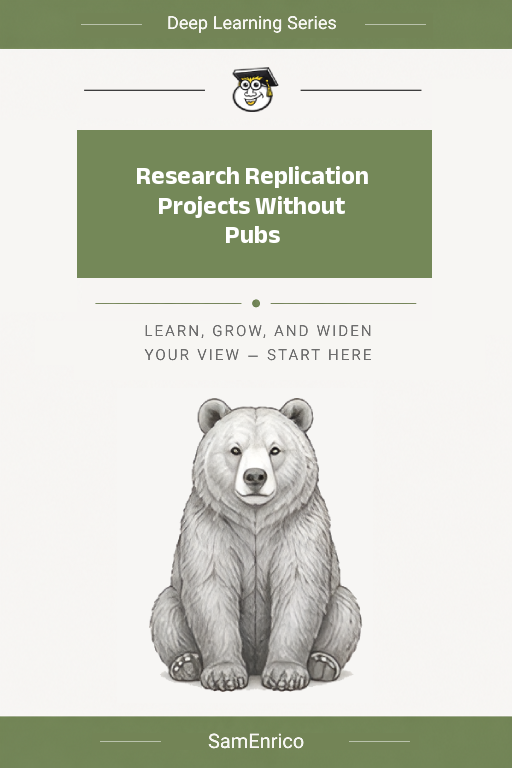
Research Replication Projects Without Pubs eBook
Describe systematic replication attempts that demo
Describe systematic replication attempts that demonstrate methodological rigor and scholarly integrity.
Formats
Free sample
Chapter 1: The Paper That Killed My Certainty--–- It began, as these things often do, not with a scandal but with a quiet, almost private disappointment. I was a graduate student in the early 2010s, and I had just spent eighteen months building an experiment around a finding I had memorized, cited, and taught to undergraduates. The finding was elegant: a subtle priming procedure—a few scrambled sentences about elderly people—made young adults walk more slowly down a hallway. It was the kind of result that justified a career in psychology. It said that our minds were so porous, so unconsciously receptive, that mere words could reshape our bodies.
I believed it. I had built my entire thesis proposal on the assumption that it was true.My study was a conceptual replication. I did not have a lab with a long hallway and a hidden stopwatch, but I had an online platform, a reaction-time task, and a sample of four hundred participants recruited through a small grant from my department. I primed half of them with aging-related words. The other half received neutral primes.
Then I measured how quickly they responded to a task that, in the original design, was supposed to capture something like "slowed walking speed" in the digital domain. I was not trying to debunk anything. I was trying to extend a beautiful finding into a new context.The results came back on a Tuesday. I opened the CSV file, ran the pre-registered analysis I had posted on the Open Science Framework three months earlier, and stared at the output. The p-value was 0.43.
The effect size was -0.03. The confidence intervals straddled zero so comfortably they looked like a hammock. There was nothing there. No slowing. No priming.
No unconscious influence of words on behavior—at least not in my sample, with my measures, on that Tuesday.I spent the next week convinced that I had made a mistake. I checked my code. I re-ran the analysis in a different statistical package. I tested for outliers. I looked for moderators.
I split the sample by age, by gender, by time of day. Nothing changed. The effect was absent. And because I had pre-registered my analysis, I could not simply pretend I had hypothesized something else. I was stuck with the truth: I had tried to replicate a famous finding, and I had failed.Then I discovered that I was not alone.The Crack in the Facade In the months that followed my null result, a series of papers appeared that would permanently alter the landscape of my field.
The first was a direct replication attempt of the elderly priming study, conducted by a team of researchers who had the rare courage to publish a failure. Their result matched mine: no effect. Then came another replication, this time with a larger sample and tighter controls. Again, nothing. Then a meta-analysis pooled all available replications and found that the original effect, so compelling in its first report, shrank to near-zero when averaged across all attempts.I remember the vertigo I felt.
If that finding was false, what else was? The ego depletion studies that claimed self-control was a depletable resource? The social priming studies that suggested flags made people vote conservatively? The power posing studies that promised that standing like Wonder Woman would change your hormone levels? One by one, the landmark studies of my graduate education began to crumble under the weight of replication attempts.This was not the doing of a shadowy cabal of debunkers.
It was the result of a loosely organized, often underfunded, and frequently dismissed community of researchers who had decided to do something simple and radical: check the work. They were not all affiliated with prestigious universities. Many were postdocs on short-term contracts, graduate students with no lab of their own, or faculty at teaching-intensive institutions who conducted research on evenings and weekends. They had no grants for replication because funding agencies rarely paid for verification. They had no career incentives to replicate because promotion committees wanted "novel, high-impact" discoveries.
They did the work anyway.They were, in a phrase I would later adopt for this book, independent verifiers.What This Chapter Will Do This chapter has three purposes. First, it will reframe the so-called "replication crisis" not as a scandal that discredits science, but as a scientific correction that ultimately strengthens it. Second, it will introduce the essential distinctions—replication, reproducibility, robustness—that every independent verifier must master before attempting their first project. Third, it will walk you through the landmark failures that created both the need and the opportunity for systematic replication work. By the end of this chapter, you will understand why your time, your effort, and your integrity matter more than any institutional affiliation.
You will see that a high-quality failure is more informative than a low-quality success. And you will be ready to join a movement that is quietly, persistently, making science more reliable.The Replication Crisis Is Not a Crisis (It Is a Correction)Let me stop you before you absorb the dominant media narrative. Headlines have screamed about the "replication crisis" as if science had been revealed as a fraud. They have featured interviews with disillusioned researchers who claim that "most published findings are false." They have painted a picture of a discipline in ruins.That narrative is wrong.What happened in the 2010s was not a crisis of science. It was a crisis of incentives.
Science, done properly, is self-correcting. A researcher publishes a finding. Other researchers attempt to replicate it. If the finding holds, confidence grows. If it fails, the finding is revised or abandoned.
This is the immune system of science—messy, slow, but effective. The problem was not that science failed. The problem was that for several decades, the immune system was suppressed.Why? Because the academic reward system valorized discovery and punished verification. Journals wanted novel, positive, surprising results.
Grant agencies wanted innovative, high-risk, high-reward proposals. Promotion committees counted publications in "high-impact" journals, where replications were rarely published. A researcher who spent a year replicating someone else's study was seen as uncreative, unproductive, or—worst of all—hostile. The implicit message was clear: do your own work. Leave verification to someone else.The result was predictable.
Without systematic verification, false positives accumulated. Researchers, acting rationally within a broken incentive structure, p-hacked, HARKed, and selectively reported their way to publication lists full of findings that looked too good to be true. And many of them were too good to be true.The replication crisis was not the moment when science broke. It was the moment when science started to fix itself.The independent verifier stands at the center of this correction. You do not need to be employed by a top-tier university to check whether a published finding holds up.
You do not need a million-dollar grant to run a well-powered, pre-registered replication. You need discipline, transparency, and a willingness to accept whatever result emerges—whether it confirms the original or refutes it. In a system that still undervalues verification, you are not a second-class scientist. You are the immune system.Three Distinctions That Will Save You Years of Confusion Before you replicate…
This is the end of the free sample. Get the eBook to keep going. Buy now
About this book
Details
- Author
- Milam Susanna
- Publisher
- SamEnrico
- Language
- English
- Genre
- research, Student's Shortcut
- Released
- 2026-06-01
- Pages (approx.)
- 146
- Available as
- eBook, Audiobook

Read better in the ZLOADR app
Your eBooks on your phone or tablet. Sign in with your SamEnrico account and start reading.
More by Milam Susanna
 The Affirmation Audio MethodMilam Susanna$11.99
 Trent LottMilam Susanna$11.99
 A B Test Market ValidationMilam Susanna$11.99
 Carson Environmental LegacyMilam Susanna$11.99
 Money Worries Practical Coping GuideMilam Susanna$11.99
 Talking About Disability NeedsMilam Susanna$11.99
 Work Life Balance Myth FixMilam Susanna$11.99
 Habit ChecklistMilam Susanna$11.99
 Bipolar Telehealth Navigation CourseMilam Susanna$11.99
 The Oracle of Delphi: Wisdom and Power in Ancient GreeceMilam Susanna$11.99
 Tangaroa's Whisper: The Navigator Who Rode the StormMilam Susanna$11.99
 The Billion-Dollar Block: How One Family Built a Skyscraper EmpireMilam Susanna$11.99
You may also like
 Scientific Research On TM GuideMartens Nathanial$11.99
 Research Proposal Methodology Section MasteryPauley Debroah$11.99
 Research Proposal Appendix CompilationRaines Tyisha$11.99
 Academic Researcher Distraction GuideFord Virgil$11.99
 TM Research and ScienceCovert Nicki$11.99
 Social Anxiety Research ReviewRoberge Cole$11.99
 Research Proposal Significance Section GuideBock Tory$12.99
 Research Proposal Reviewer PsychologyLugo Tawanda$11.99
 Research Proposal Research Questions DesignLara Robbi$11.99
 Research Proposal References and CitationsPatten Shanice$11.99
 Research Proposal Mixed Methods DesignCameron Omega$11.99
 Research Proposal Data Management PlanAnderson Roberto$12.99