
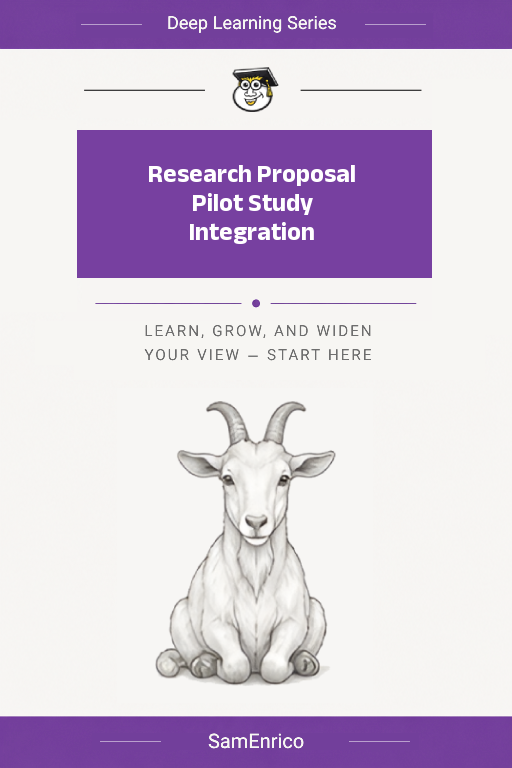
Research Proposal Pilot Study Integration eBook
Report pilot results as preliminary evidence witho
Report pilot results as preliminary evidence without overpromising on statistical significance.
Formats
Free sample
Chapter 1: The Pilot Graveyard--Every year, approximately eighty percent of pilot studies disappear without a trace.Not because the science was bad. Not because the hypothesis was wrong. Not because the intervention failed. The pilots die because they were never designed to live in the first place. They enter the literature as whispers—poster presentations, footnote mentions, a desperate paragraph buried in a grant application's preliminary studies section.
And then they vanish, taking with them the participants' time, the researchers' effort, and—most tragically—the opportunity to learn anything useful before launching a costly, doomed main trial.This is the Pilot Graveyard. And if you are reading this book, you have either visited it, are currently circling it, or will arrive there soon unless something fundamental changes in how you think about small studies.Let me tell you about Dr. Sarah Chen. That is not her real name, but her story is real. She was a mid-career faculty member at a respected research university.
She had an elegant hypothesis about a behavioral intervention for smoking cessation in low-income populations. She ran a pilot study with twenty participants per group. Her results looked promising—an odds ratio of three point five, a p-value of zero point zero three. She published the pilot in a reputable journal, secured a two-million-dollar grant from the National Institutes of Health, and launched a definitive randomized controlled trial with five hundred participants.Three years later, the main trial returned an odds ratio of one point one and a p-value of zero point eight zero. No effect.
Nothing. The pilot's "promising" result was pure noise. Dr. Chen had wasted two million dollars, five hundred people's time, and her own reputation. She almost lost her tenure case.
She told me later: "I did everything right. I ran a pilot. I got a significant result. I powered my main trial based on the pilot's effect size. What went wrong?"Everything.
She did nothing right. She just didn't know it yet.This book exists to ensure you never become Dr. Chen.The Misconception That Kills Pilots Let us start with a simple diagnostic question. When you hear the words "pilot study," what comes to mind?If you are like most researchers I have trained over the past fifteen years, you think something like this: a small version of a real study. A trial with fewer participants.
A preliminary look at whether an intervention works. A way to get "preliminary data" for a grant. A chance to see if the effect is "promising" before investing in a larger study.Every single one of those thoughts is wrong. And every single one of those thoughts leads directly to the Pilot Graveyard.The fundamental misconception is this: a pilot study is not a small trial. It is a fundamentally different kind of investigation with a fundamentally different purpose.
A trial—whether small or large—asks the question: "Does this intervention work?" A pilot study asks a different question entirely: "Can we run a trial of this intervention?"That difference may seem subtle, but it is the difference between building a bridge and testing the soil where the bridge will stand. When civil engineers test soil, they do not ask "will this bridge hold traffic?" They ask "what is the load-bearing capacity of this ground?" They do not build a small bridge as a "pilot" and then scale it up. They test the conditions that will make the full bridge possible.Researchers, by contrast, have convinced themselves that a small trial is a prudent first step. It is not prudent. It is wasteful, misleading, and—as we will see throughout this book—often unethical.The Two Ways Pilots Fail Pilot studies fail in two distinct ways.
The first is obvious: the pilot itself is poorly designed, poorly executed, or answers the wrong question. But the second is more insidious: the pilot is well-designed but then misused by the researcher who treats its results as if they came from a full-scale trial.Let me give you a concrete example of the second type of failure. A researcher runs a pilot with fifteen participants per group. She measures depression scores before and after an intervention. She calculates a p-value—perhaps zero point zero four—and declares the intervention "promising." She then uses the observed effect size from the pilot to calculate the sample size for a main trial.
The pilot showed an effect size of Cohen's d equals zero point eight, so she powers her main trial to detect d equals zero point eight. She needs one hundred participants per group. She secures funding, runs the trial, and finds d equals zero point two—not significant, not meaningful, a complete failure.What happened? The pilot's effect size was not real. With fifteen participants per group, the standard error is enormous.
The true effect size could have been anywhere from d equals zero point one to d equals one point five. By chance, this particular pilot landed on the high end. That is called the Winner's Curse, and we will spend much of Chapter Two dissecting its dangers. For now, understand this: a small sample does not give you a small amount of information about the true effect. It gives you wrong information.
The estimate is not imprecise—it is systematically biased toward extreme values.The researcher would have been better off running no pilot at all and simply guessing the effect size based on published meta-analyses. At least a guess would not have given her false confidence.The Ethical Imperative You Have Never Heard Here is a statement that will sound radical to many readers: running a pilot study to estimate an effect size for a main trial is unethical.I want you to pause and feel the weight of that claim. Unethical. Not just inefficient, not just sloppy—unethical. Why?
Because every participant in a research study is making a sacrifice. They are giving their time, their privacy, sometimes their comfort or safety. They are doing so on the promise that their participation will contribute to scientific knowledge that benefits others.When you run a pilot that is too small to provide reliable estimates of variability or effect size, you are wasting that sacrifice. You are exposing participants to risk without generating usable knowledge. And then—this is the cruelest part—you may use that unreliable estimate to design a main trial that is under-powered, which means you will waste another set of participants' sacrifices on a study that cannot find the truth even if it is there.This is not hypothetical.
Simulation studies have shown that using pilot data to estimate standard deviations for power calculations leads to under-powered main trials approximately forty percent of the time. Forty percent. That means nearly half of all main trials that rely on pilot-derived variance estimates are doomed before they enroll a single participant.There is a better way. The better way is to stop pretending pilots can do things they cannot. The better way is to redefine what a pilot is for.What a Pilot Is Actually For A proper pilot study has exactly one job: to answer feasibility questions.
That is it. Not efficacy. Not effectiveness. Not "promising signals." Feasibility.Feasibility breaks down into four categories, and memorizing these categories…
This is the end of the free sample. Get the eBook to keep going. Buy now
About this book
Details
- Author
- Stubblefield Albertina
- Publisher
- SamEnrico
- Language
- English
- Genre
- research, Student's Shortcut
- Released
- 2026-05-30
- Pages (approx.)
- 137
- Available as
- eBook, Audiobook

Read better in the ZLOADR app
Your eBooks on your phone or tablet. Sign in with your SamEnrico account and start reading.
More by Stubblefield Albertina
 Travel Tech InvestmentStubblefield Albertina$11.99
 The Arm Levitation Trance MethodStubblefield Albertina$11.99
 The Healing Light TechniqueStubblefield Albertina$11.99
 Strength Training For FootballStubblefield Albertina$11.99
 IBS Medication GuideStubblefield Albertina$11.99
 High Pressure Sales Stress PlanStubblefield Albertina$11.99
 OCD and WorkStubblefield Albertina$11.99
 Wu MichelleStubblefield Albertina$11.99
 Flooding Self RegulationStubblefield Albertina$11.99
 The Last Stand at the Sydney Hilton: The Untold Siege of 1980Stubblefield Albertina$11.99
 Anansi Weaves the Sky: The Spider’s Cosmic TrickStubblefield Albertina$11.99
 The Last Breath of the Ice MaidenStubblefield Albertina$11.99
You may also like
 Scientific Research On TM GuideMartens Nathanial$11.99
 Research Proposal Methodology Section MasteryPauley Debroah$11.99
 Research Proposal Appendix CompilationRaines Tyisha$11.99
 Academic Researcher Distraction GuideFord Virgil$11.99
 TM Research and ScienceCovert Nicki$11.99
 Social Anxiety Research ReviewRoberge Cole$11.99
 Research Proposal Significance Section GuideBock Tory$12.99
 Research Proposal Reviewer PsychologyLugo Tawanda$11.99
 Research Proposal Research Questions DesignLara Robbi$11.99
 Research Proposal References and CitationsPatten Shanice$11.99
 Research Proposal Mixed Methods DesignCameron Omega$11.99
 Research Proposal Data Management PlanAnderson Roberto$12.99