
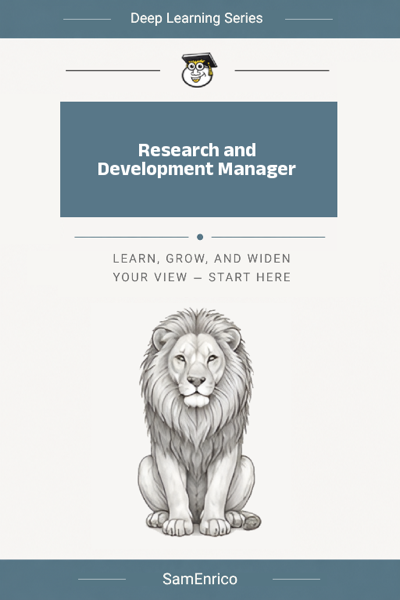
researchInformativeEducational
Research and Development Manager eBook
A Coursebook on Research and Development Manager
A Coursebook on Research and Development Manager
Formats
Free sample
Chapter 1: The Scientist’s Trap--– The first time someone called me a “manager,” I checked over my shoulder to see who they were talking to. I was a scientist. I spoke the language of failure rates, p-values, and electron micrographs. I had spent fifteen years mastering the art of being right. And now, suddenly, I was supposed to lead a team of people who were smarter than me in areas I barely understood, report to executives who couldn’t tell a centrifuge from a spectrometer, and somehow turn the chaos of discovery into something that resembled a business plan.That was my first mistake.
Assuming the title changed everything.The truth is more unsettling. Most R&D managers never fully transition from technical expert to strategic leader. They remain trapped in what I call the Scientist’s Trap – the comfortable, seductive, ultimately destructive belief that technical excellence alone will make them effective leaders. They continue solving problems their teams should solve. They continue prioritizing technical elegance over market relevance.
They continue measuring success by scientific milestones rather than business outcomes. And slowly, invisibly, their teams stop growing, their projects drift into irrelevance, and their organizations lose faith in R&D altogether.This chapter is not a gentle introduction. It is an intervention. Before we discuss portfolio management, Agile methodologies, or intellectual property strategy, we must first confront the identity crisis at the heart of every new R&D manager. You are no longer the smartest person in the room – and that is precisely the point.The Three Faces of R&D: Why One Size Fits None Let us begin with a fundamental distinction that will echo through every subsequent chapter of this book.
Not all research and development is the same. If you manage basic research the same way you manage product development, you will fail. If you hold applied research to the same timelines as incremental engineering, you will destroy creativity. The R&D manager’s first job is to recognize which face of R&D they are leading at any given moment.Basic research is curiosity-driven. It asks “What if?” without a clear commercial answer.
It operates on timelines measured in years or decades. Its outputs are papers, patents, and paradigms – not products. Basic research is the domain of Nobel Prizes and existential uncertainty. Think of Bell Labs in its golden age, where scientists studied the properties of semiconductors without knowing they would eventually invent the transistor. Basic research is expensive, unpredictable, and essential for long-term competitive advantage.
But if you manage it like a factory, you will get nothing but frustration.Applied research sits in the middle. It targets a specific problem or opportunity but does not yet know how to solve it. Applied research asks “How might we?” It operates on timelines of months to a few years. Its outputs are feasibility demonstrations, prototypes, and proof-of-concept data. Applied research is the engine of most industrial R&D – the search for a cheaper catalyst, a more efficient battery, a drug candidate that interacts with a specific protein.
It is uncertain but directed. It tolerates failure because failure teaches the next experiment.Development is the third face. It takes proven concepts and transforms them into products, processes, or services that can be manufactured, sold, and supported. Development asks “How will we?” It operates on weeks to months. Its outputs are production specifications, quality tests, and launch plans.
Development has much lower uncertainty than research. It demands rigor, documentation, and relentless execution. If you manage development like basic research – allowing endless exploration without deadlines – your product will never ship.Here is the trap: most R&D managers are promoted from development roles, where they succeeded by being technically excellent and deadline-driven. Then they are put in charge of applied research teams and wonder why their former methods fail. Or worse, they inherit a basic research group and try to impose stage-gate processes designed for incremental engineering.
The results are predictable: demoralized scientists, gamed metrics, and zero useful output.The effective R&D manager learns to distinguish these three faces instantly. They know that basic research needs space and patience, not milestones and KPIs. They know that applied research needs clear problem statements and hypothesis-driven experiments, not rigid schedules. And they know that development needs disciplined processes and ruthless quality control, not open-ended exploration. One size fits none.From Ivory Tower to Engine Room: The Painful Identity Shift Let me tell you about Priya.
She was the finest materials scientist in her division – a Ph D from MIT, twelve patents, a reputation for solving problems no one else could touch. When her manager left, Priya was the obvious choice for promotion. She accepted eagerly. Finally, she thought, she would have the resources to pursue the projects she believed in.Within six months, she was ready to quit.Her team, she complained, was lazy. They missed deadlines.
They asked her to review every data set. They seemed incapable of making decisions without her approval. And the executives above her kept demanding “business cases” for projects that were clearly years away from commercial application. In her mind, Priya had become a manager. In reality, she had become a super-powered individual contributor who also happened to have a team burning out around her.Priya had fallen into the Scientist’s Trap with both feet.
She believed that her technical brilliance – the very quality that earned her the promotion – was also the quality that would make her a great manager. She continued solving the hardest problems herself. She continued reviewing every detail. She continued measuring her self-worth by how many technical battles she won. And in doing so, she robbed her team of the opportunity to grow, robbed herself of the time to think strategically, and robbed the organization of the leadership it actually needed from her.The shift from “ivory tower” scientist to integrator of technology, strategy, and people requires three fundamental changes in how you see yourself.First, you must accept that your technical contribution is no longer measured by what you personally discover but by what your team discovers because of you.
This is not a demotion. It is a different kind of impact. A Nobel Prize-winning scientist might change one field. An R&D manager who builds a world-class team might change dozens of fields over two decades. Your leverage has increased.
But your ego must shrink.Second, you must stop being the sole decision-maker. The most dangerous phrase in an R&D manager’s vocabulary is “Let me think about it and get back to you.” It sounds responsible. It sounds thoughtful. What it actually means is “I do not trust my team to make this decision, and I will create a bottleneck that slows everything down.” Effective R&D managers push decisions to the lowest possible level. They create clear decision rights.
They accept that their team will sometimes make mistakes – and they recognize that those mistakes are the tuition for learning.Third, you must learn to speak two languages fluently: the language of science and the language of business. Your team needs you to translate executive pressure into technical priorities without destroying morale. Your executives need you…
This is the end of the free sample. Get the eBook to keep going. Buy now
About this book
Details
- Author
- Daniels Alejandro
- Publisher
- SamEnrico
- Language
- English
- Genre
- research, Informative, Educational
- Released
- 2026-05-06
- Pages (approx.)
- 153
- Available as
- eBook, Audiobook

Read better in the ZLOADR app
Your eBooks on your phone or tablet. Sign in with your SamEnrico account and start reading.
More by Daniels Alejandro
 The Gig Economy Schedule OptimizationDaniels Alejandro$11.99
 The Network AuditDaniels Alejandro$11.99
 Parental Medication Self Care GuideDaniels Alejandro$11.99
 Tarantino Pop Culture RemixDaniels Alejandro$11.99
 Minecraft Excessive Play GuideDaniels Alejandro$11.99
 The Phantom of Buenos Aires: The Forger Who Fooled the Elite (1920s)Daniels Alejandro$11.99
 Understanding Menetrier's DiseaseDaniels Alejandro$17.99
 Trello Advanced Features GuideDaniels Alejandro$12.99
 Food Science Safety SkillsDaniels Alejandro$12.99
 Ultimate Handbook Guide to Yaounde : (Cameroon) Travel GuideDaniels Alejandro$11.99
You may also like
 Scientific Research On TM GuideMartens Nathanial$11.99
 Research Proposal Methodology Section MasteryPauley Debroah$11.99
 Research Proposal Appendix CompilationRaines Tyisha$11.99
 Academic Researcher Distraction GuideFord Virgil$11.99
 TM Research and ScienceCovert Nicki$11.99
 Social Anxiety Research ReviewRoberge Cole$11.99
 Research Proposal Significance Section GuideBock Tory$12.99
 Research Proposal Reviewer PsychologyLugo Tawanda$11.99
 Research Proposal Research Questions DesignLara Robbi$11.99
 Research Proposal References and CitationsPatten Shanice$11.99
 Research Proposal Mixed Methods DesignCameron Omega$11.99
 Research Proposal Data Management PlanAnderson Roberto$12.99