
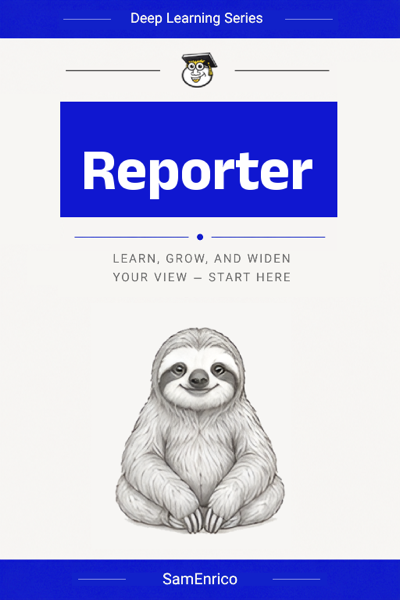
Non-FictionInformativeEducational
Reporter eBook
A Coursebook on Reporter
A Coursebook on Reporter
Formats
Free sample
Chapter 1: The Trust Equation...–- The first thing they don’t tell you in journalism school is that nobody owes you their story. You can have a press pass, a Pulitzer on your wall, and the full weight of the First Amendment behind you, but the woman standing in the doorway of a burned-out apartment building at 2 a.m.—holding a child who has stopped crying because shock has replaced tears—owes you nothing. She will look at your notebook, then at your face, and she will decide in less than two seconds whether you are there to help or to harm. That decision has nothing to do with your GPA, your internship at a prestigious paper, or your understanding of libel law. It has everything to do with one thing: trust.This book is called Reporter, not Journalist, not Content Creator, not Storyteller.
Those words have become soft, overused, drained of meaning. A journalist files reports. A content creator fills spaces between advertisements. A storyteller performs. But a reporter?
A reporter goes to the place where something happened, stands in the actual dust and heat and silence, and comes back with a truth that someone, somewhere, did not want told. That is the job. It is not a job for scribes. It is a discipline of high-stakes thinking, emotional endurance, and, above all, trust-building.This chapter opens with that image—the woman in the doorway—because it is the test every reporter will face, sometimes daily. How do you convince a stranger to trust you with their pain, their secrets, their anger?
How do you earn the right to ask questions when so many before you have asked for the same access and then disappeared, never to share what they learned? And once you have that trust, how do you hold it without breaking it?The answer is not a trick. It is not a technique you can learn in a weekend seminar. It is a way of being in the world that must be practiced until it becomes instinct. This chapter will introduce the foundational shift in how reporters must think about their role—not as gatekeepers deciding what the public is allowed to know, but as verified aggregators who curate, fact-check, and contextualize an overwhelming flood of information.
It will acknowledge the collapse of the old advertising model, the fragmentation of local news, and the rise of what psychologists call "news anxiety"—that low-grade dread that comes from feeling constantly out of the loop. It will explore the different paths into the profession: local papers, wire services, nonprofit newsrooms, digital startups, and the growing world of independent, subscriber-supported reporting. It will address the emotional resilience required to do this work without burning out or becoming cynical. And it will introduce a tension that runs through this entire book: the book will teach you rigorous, objective methods of verification—how to check a fact, how to read a document, how to protect a source—but in Chapter 12, we will question whether "objectivity" itself is the right ultimate goal. For now, know this: you cannot do harm with a verified fact.
You can only do harm with a fact you failed to verify.Let us begin.The Collapse and the Opportunity Every profession has its origin myth. For reporters, the myth is the smoking newsroom: typewriters clacking, editors shouting "Hold the press!" and a grizzled city editor in a fedora telling a young cub, "You get me the facts, kid. I'll get you the story." That world is gone. It has been gone for longer than most working reporters care to admit.The old advertising model—in which newspapers sold subscriptions for pocket change and made their real money from department store ads, car dealership spreads, and classified listings—collapsed in the late 2000s. Craigslist ate classifieds.
Google and Facebook ate display advertising. Between 2004 and 2020, the United States lost more than two thousand local newspapers. Thousands of reporters left the profession. Those who remained often took pay cuts, lost benefits, and were asked to do the work of three people. The romantic image of the reporter as a noble outsider, a crusader with a notepad, became difficult to sustain when many reporters could not afford rent.But here is the paradox: at the exact moment the economic foundation crumbled, the need for reporters exploded.Consider the information environment of 2025.
A single breaking news event—a hurricane, a shooting, a corporate bankruptcy—generates thousands of posts on social media within minutes. Most of them are wrong. Some are deliberately wrong, created by bad actors who understand that misinformation spreads six times faster than the truth. Artificial intelligence can now generate realistic fake photographs, fake audio, and even fake video of people saying things they never said. The old gatekeepers—newspaper editors, television producers—no longer control what the public sees.
The gate is gone. The flood is here.In this environment, the reporter’s role has transformed. You are no longer primarily a gatekeeper deciding what the public should know. That role assumed scarcity: limited space in the newspaper, limited time in the broadcast. Now the problem is not scarcity but abundance—an overwhelming torrent of information, most of it unverified, much of it malicious.
The modern reporter is a verified aggregator: someone who stands in the flood, catches the most urgent pieces, and says to the public, "I have checked this. Here is what is true. Here is what we still do not know. Here is where the other claims fall apart."This shift is not a downgrade. It is an upgrade.
It requires more skill, not less. Anyone can repost a rumor. A verified aggregator must be able to find primary sources, authenticate documents, interview reluctant witnesses, and then write with clarity and speed. That is the job we are training for in this book.The Many Doors into the Newsroom There is no single path into reporting, and the old assumption—that you must start at a small-town paper and work your way up to a metropolitan daily—is only one of many routes. Let us survey the landscape.Local newspapers still exist, though many have shrunk.
A reporter at a local paper in a city of fifty thousand people will cover city council meetings, school board budget fights, high school sports, and the occasional crime blotter. The pay is low. The hours are long. But this remains the best training ground in American journalism because you cannot hide. Every story you write will be read by the people you wrote about.
The mayor will call you. The school superintendent will correct your spelling. The grandmother whose porch collapsed will thank you. You learn, very quickly, that your words have consequences.Wire services like the Associated Press and Reuters operate on a different model: speed and accuracy above all. A wire reporter files for a national or global audience.
There is no room for clever writing or narrative experimentation. The lede must contain the five W's and H in the first paragraph. The story must be structured so that an editor in New York can cut from the bottom without losing essential information. Wire service reporters are…
This is the end of the free sample. Get the eBook to keep going. Buy now
About this book
Details
- Author
- Cantu Rebbeca
- Publisher
- SamEnrico
- Language
- English
- Genre
- Non-Fiction, Informative, Educational
- Released
- 2026-05-11
- Pages (approx.)
- 154
- Available as
- eBook, Audiobook

Read better in the ZLOADR app
Your eBooks on your phone or tablet. Sign in with your SamEnrico account and start reading.
More by Cantu Rebbeca
 The Slot Machine Myth BusterCantu Rebbeca$11.99
 HGH and Diabetes RiskCantu Rebbeca$11.99
 Parent of Anxious Child GuideCantu Rebbeca$11.99
 AI Facial Expression EditingCantu Rebbeca$11.99
 The Parent Somatic Release GuideCantu Rebbeca$11.99
 The Seed That Shook the World: The Untold Story of Norman Borlaug's Green RevolutionCantu Rebbeca$11.99
 The Last Days of the Angola Three: A Fight for JusticeCantu Rebbeca$11.99
 Understanding Bulbospinal Amyotrophy, X-linkedCantu Rebbeca$17.99
 Sibling In Canada CRS BoostCantu Rebbeca$12.99
 Small Business Cash Flow AICantu Rebbeca$12.99
 How to Become a Carbide OperatorCantu Rebbeca$11.99
You may also like
 Hong Kong Handover 1997Dunn Johnnie$11.99
 Zumba For Postnatal Recovery CourseNeal Christian$11.99
 Zumba for BeginnersLadner Nikia$11.99
 YouTube Comment Mining GuideHumes Pandora$12.99
 Worry Box MeditationCarlin Rudy$11.99
 Workplace Stress MeditationNguyen Lynn$11.99
 Workplace Stress and Sleep RepairHawley Ivory$11.99
 Workplace Perfectionism CureDelaney Jeffry$11.99
 Workplace Injustice Anger GuideWallen Isabelle$11.99
 Work Addiction and Burnout LinkGreenwood Ester$11.99
 Women in Yoga and WellnessBeattie Galina$11.99
 Women in Stand Up ComedyChun Evangeline$11.99