
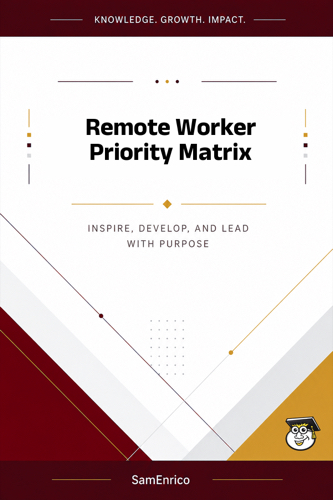
Remote Worker Priority Matrix eBook
Sort tasks by urgency and importance to focus on w
by Reece Fran
Sort tasks by urgency and importance to focus on what matters.
Formats
Free sample
Chapter 1: The Visibility Trap--–- The most dangerous lie in remote work is the one you tell yourself: that someone is watching.You close your laptop at 6 PM. You answered forty-seven emails. You attended five Zoom calls. You updated three spreadsheets. You feel exhausted.
You feel productive. You feel like you earned your paycheck.But when you look back at the week, you cannot name a single thing you finished. Not a proposal sent. Not a problem solved. Not a decision made.
Just activity. Endless, exhausting, empty activity.This is the Visibility Trap.In a traditional office, activity looks like productivity. The person who arrives first, leaves last, and always looks frazzled gets the promotion—regardless of what they actually accomplish. Managers cannot see output directly, so they use proxies: hours at desk, response speed, visible busyness. The Eisenhower Matrix—sorting tasks by urgent and important—was designed for that world.
It assumed you had the luxury of choosing between tasks because your boss could see you choosing.Remote work collapses that system overnight.Nobody sees you typing. Nobody knows you answered fifty emails by 9 AM. Nobody cares how many hours your laptop was open. The only thing that remains is output: did you finish the report? Did you close the deal?
Did the code deploy? Did the customer stop complaining?The Visibility Trap convinces you that if you stop being busy, you will stop being valuable. But the opposite is true. In remote work, busyness is invisible. Only outcomes matter.
And until you accept that, you will spend your days performing productivity for an empty room.This chapter is your intervention.The Guilt-Performance Gap Here is a pattern that repeats in every remote worker I have ever coached. Take a moment to see if it sounds familiar.You start your day with good intentions. You will do deep work. You will focus on the big project. You will ignore distractions.
Then you check Slack. Someone needs an answer. You reply. Then email. A client has a question.
You reply. Then you realize you have been "working" for two hours but have not touched your actual priority. You feel a flicker of guilt.So you open the big project. You read three paragraphs. A notification pops up.
You switch to Slack. Then back to email. Then to the project. Then to a "quick" task that turns into thirty minutes. By noon, you have done nothing important.
The guilt grows.You skip lunch to catch up. You answer more emails. You join a Zoom call that could have been an email. You end the call and realize you have twelve minutes before the next meeting. Not enough time for deep work.
So you do shallow work: reorganizing files, cleaning your inbox, scrolling Linked In "for research."By 5 PM, you are exhausted. You have been at your desk for eight hours. You have answered a hundred messages. You have attended five meetings. But you have not moved the needle on anything that matters.
The guilt is now a heavy weight.You tell yourself you will do better tomorrow. But tomorrow becomes today, and the pattern repeats.This is the Guilt-Performance Gap. Remote workers spend eight to ten hours "at their desk" but produce only three to four hours of meaningful work. The rest is performative scrolling, context switching, digital dust, and anxiety. The gap between time spent and value created grows wider every week.The dirty secret: Most remote workers are not lazy.
They are trapped. They have taken the office-based expectation of "visible busyness" and imported it into their home office. But nobody is watching. So they are performing for no audience, exhausting themselves for no credit, and missing the only thing that matters: output.A study of remote workers during the mass shift to work-from-home found that average working hours increased by 48 minutes per day, while productivity metrics remained flat or declined. Longer hours, same output.
More guilt, less focus. The Visibility Trap in action.Why the Eisenhower Matrix Fails Remotely The Eisenhower Matrix—popularized by Stephen Covey's The 7 Habits of Highly Effective People—is a simple two-by-two grid. Tasks are sorted by urgency (urgent vs. not urgent) and importance (important vs. not important).
The four quadrants are:Quadrant 1 (Urgent + Important): Crises, deadlines, fires. Do these now.Quadrant 2 (Not Urgent + Important): Strategy, planning, deep work. Schedule these.Quadrant 3 (Urgent + Not Important): Interruptions, some emails, some calls. Delegate or batch.Quadrant 4 (Not Urgent + Not Important): Time-wasters, digital dust. Eliminate these.This matrix works beautifully in an office.
Why? Because in an office, you have external accountability. Your manager can see which quadrant you are in. If you spend all day in Quadrant 3 (answering every ping), your manager might notice and redirect you. If you ignore Quadrant 2 (strategic work), your manager might ask why your big project is late.
The office environment enforces the matrix.Remote work removes external accountability. Your manager cannot see your screen. They cannot see you reorganizing your Google Drive (Quadrant 4) instead of writing the proposal (Quadrant 2). They cannot see you answering every Slack message instantly (Quadrant 3) instead of doing deep work.Without external accountability, the matrix collapses. Quadrant 2—the only quadrant that drives career growth and meaningful output—becomes invisible.
It has no deadline, no notification, no boss checking in. Quadrant 3—noisy, reactive, but satisfying because you feel helpful—expands to fill the vacuum. Quadrant 4—digital dust that feels like productivity—multiplies because it provides immediate visual feedback.The result: Remote workers drift from strategic work into reactive work. They answer instead of create. They react instead of plan.
They feel busy but produce little. And they blame themselves for being lazy, when the real problem is a broken accountability system.The Output Audit The first step out of the Visibility Trap is to stop measuring activity and start measuring output. You need a new metric. Not hours logged. Not emails answered.
Not Slack messages sent. Just one thing: completed work that moves the needle.Here is the tool. It takes sixty seconds. Do it at the end of every workday.The Output Audit (Retrospective Rule of Three):Open a blank document, a note, or a piece of paper. Write down exactly three things you completed today.
Not what you started. Not what you touched. Not what you made progress on. Completed. Finished.
Shipped. Done.Example:Today I completed:Drafted and sent the Q3 proposal to the client.Fixed the bug in the login flow.Had the difficult conversation with the underperforming contractor.That is it. Three sentences. Sixty seconds.If you cannot list three completed things, that is not a failure—it is data. It tells you that you spent your day in Quadrants 3 or 4, reacting to noise or polishing dust.
Tomorrow, you will protect your Quadrant 2 time differently.If you list three completed things and they are all tiny (answered three emails, moved a file, updated a status), that is also data. It tells you that you are not working on things that matter. Tomorrow, you will say no to small requests.If you list three completed things that genuinely moved your projects forward, celebrate. You won the day. Do it again tomorrow.The rule: Do not…
This is the end of the free sample. Get the eBook to keep going. Buy now
About this book
Details
- Author
- Reece Fran
- Publisher
- SamEnrico
- Language
- English
- Genre
- Non-Fiction, Self-Help, Prioritization
- Released
- 2026-06-09
- Pages (approx.)
- 159
- Available as
- eBook, Audiobook

Read better in the ZLOADR app
Your eBooks on your phone or tablet. Sign in with your SamEnrico account and start reading.
More by Reece Fran
 Immigrant Siblings Different PathsReece Fran$11.99
 SCAMPER Innovation MethodReece Fran$11.99
 Pupil Dilation CuesReece Fran$11.99
 Colorectal ScreeningReece Fran$11.99
 Maternal Anger Healing GuideReece Fran$11.99
 Dream Elevator LogReece Fran$11.99
 Conversation Starters for College StudentsReece Fran$11.99
 The Drowned Champion: Juan de Estuniga and the Lost Swimming Feats of Renaissance SpainReece Fran$11.99
 Love in the Peloton: The Secret Marriage of the Middle East's First Tour de France StarReece Fran$11.99
 How to Produce CoalReece Fran$11.99
 How to Become a GunsmithReece Fran$11.99
 A Collector's Handbook to the Standard EightReece Fran$11.99
You may also like
 The Remote Task Prioritization GuideGaddis Micaela$11.99
 The Eisenhower Block MatrixLedford Tanja$11.99
 Goal Prioritization MatrixSheets Cordell$11.99
 The Trigger Hierarchy MethodOsgood Cole$11.99
 The Remote Work Power ListCabral Bernita$11.99
 The Anger Budget WorkbookRollins Sherell$11.99
 Remote Worker Task PrioritizationTrinidad Cristobal$11.99
 The Remote Work Daily ThreeHoneycutt Bobbie$11.99
 Remote Work Eisenhower MatrixKrauss Carey$11.99
 Remote Dot Voting GuidePerrin Terese$11.99
 Priority Task First RuleNunn Rocky$11.99
 Collaborative Idea Shedding GuideMaxey Solange$11.99