
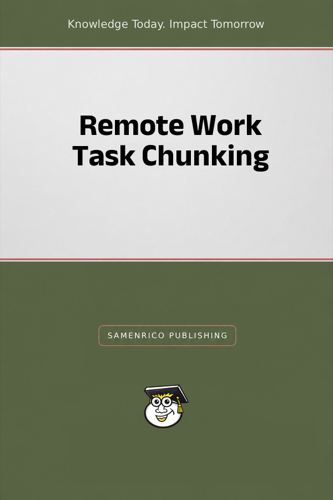
Remote Work Task Chunking eBook
Break overwhelming projects into small, doable 15
Break overwhelming projects into small, doable 15 minute pieces to reduce resistance.
Formats
Free sample
Chapter 1: The 15-Minute Lie--Let me tell you something that every productivity guru has gotten wrong.They tell you to “eat the frog”—to do the hardest thing first, to muscle through, to develop discipline. They tell you that procrastination is a character flaw, that you just need better habits, that if you could only find your “why,” the how would follow.They are wrong. Not slightly wrong. Completely, foundationally, dangerously wrong.Here’s what they don’t understand: You are not lazy. You are not undisciplined.
You are not broken.You are drowning in what this book calls The Blur—a specific, measurable phenomenon that destroys the productivity of remote workers. And the advice you’ve been given was invented in an office, where someone was watching, where social pressure provided the momentum you’re now missing.This chapter will dismantle the most damaging myth in productivity: that starting a task requires willpower. Then it will replace that myth with a single, counterintuitive number. A number so small it feels ridiculous. A number that will change everything.The Office Lie Before the pandemic, you had something you didn’t even notice.
Let’s call it social inertia.Imagine a typical office morning. You walk in, grab coffee, say hello to a colleague. You sit at your desk. Around you, people are typing, talking, clicking. The ambient noise of productivity.
Your boss might walk by. A teammate might ask a question. Even if no one is watching you, the possibility that someone might look at your screen creates a low-grade pressure to look busy.That pressure is inertia. It’s momentum you didn’t have to generate yourself. Like a gentle downhill slope, the office environment rolled you toward starting.Now imagine your home office.
It’s quiet. Too quiet. The dishes from breakfast are still in the sink. Your phone buzzes with a text from a friend. The dog wants to go out.
And that spreadsheet—the one with the complex formulas, the one you’ve been avoiding for three days—sits there, unopened.There is no social inertia. No one is watching. The downhill slope is now uphill. And that spreadsheet? It feels like it weighs a hundred pounds.Here’s the question no one is asking: Why does the same task feel heavier at home?The answer lies in a concept from behavioral science called perceived effort.The Hidden Math of Starting Your brain is not a logic machine.
It’s an energy conservation device.Every time you consider starting a task, your brain runs a rapid, unconscious calculation: How much energy will this cost me? If the perceived cost exceeds your current energy level, you avoid the task. That’s not laziness. That’s your brain doing its job—protecting you from perceived depletion.In an office, the social environment lowers the perceived cost. Colleagues provide accountability.
The physical space signals “work time.” The fear of being seen procrastinating adds just enough pressure to tip the scale.At home, all of that vanishes. The perceived cost of opening that spreadsheet skyrockets. Not because the spreadsheet is harder. Because the context is harder.This is what psychologist Piers Steel calls the procrastination equation:Motivation = (Expectancy × Value) / (Impulsiveness × Delay)Without getting lost in the math, here’s the key insight: The denominator includes delay—the time between deciding to do something and actually doing it. In an office, that delay is short because the environment pushes you.
At home, the delay stretches. You check email. You scroll social media. You get up for water. Each moment of delay increases the perceived effort.And here’s where the productivity gurus have it backwards.
They think the solution is more discipline—more willpower to overcome the delay.But willpower is a finite resource. It depletes. And in a remote environment, where the delays are constant and the distractions are endless, willpower alone will never be enough.You need something else. You need a number.The Number That Changes Everything Fifteen.That’s it. Fifteen minutes.Not thirty.
Not twenty-five (the Pomodoro standard). Not an hour. Fifteen.Here’s why fifteen minutes is the most important number in remote productivity, backed by research on task initiation thresholds (Kruglanski et al., 2012; Steel’s procrastination equation, 2007).Fifteen minutes is the point where perceived effort drops below the average person’s resistance level.Think of it as a thermostat. When you look at a task and estimate it will take two hours, your brain’s resistance thermostat clicks on. The perceived effort is high.
You avoid the task.When you look at a task and estimate it will take fifteen minutes, the thermostat clicks off. Fifteen minutes feels harmless. It feels like a coffee break. It feels like something you could do even when you’re tired, even when you’re unmotivated, even when the dishes are still in the sink.But here’s the magic: Fifteen minutes is also long enough to produce meaningful progress. You can write a hundred words.
You can clean out your inbox. You can outline a presentation. You can make a real dent in almost any task.Fifteen minutes is the sweet spot between too small to matter and too big to start.Why Not Five Minutes? Why Not Thirty?You might be thinking: “If small is good, why not go even smaller? Why not five minutes?”Fair question.
Let me answer it directly.Five minutes is too small. Here’s why: Five minutes of work rarely produces a sense of progress. You open the file, you write two sentences, and the timer goes off. You feel like you accomplished nothing. The task still looms.
The resistance doesn’t dissolve—it just gets postponed.Fifteen minutes, on the other hand, is long enough to get into the task. By minute six or seven, you’ve overcome the initial friction. You’ve found your rhythm. You’ve made visible progress. And that progress—not the timer, not the discipline—is what kills resistance.What about thirty minutes?
Or the classic Pomodoro (twenty-five minutes)?Thirty minutes triggers a different psychological response. It feels like a commitment. When you tell yourself “I’m going to work for thirty minutes,” your brain hears “I’m going to work for a long time.” The resistance thermostat clicks back on. You find reasons to delay.Twenty-five minutes is better, but it’s still just above the threshold for many people. For the distracted brain (we’ll get to that in Chapter 9), twenty-five minutes triggers anxiety.
For the overwhelmed remote worker, twenty-five minutes feels like a block of time that must be protected—and protection requires energy you don’t have.Fifteen minutes requires no protection. It requires no willpower. It requires no special environment. Anyone can do anything for fifteen minutes.That’s not a motivational slogan. That’s a psychological fact.The Boundary Promise Before we go any further, I need to make you a promise.
And I need you to make yourself a promise in return.Here’s mine: I will never ask you to work longer than fifteen minutes without a clear, conscious choice to continue.Here’s yours: You will stop when the timer ends.Not…
This is the end of the free sample. Get the eBook to keep going. Buy now
About this book
Details
- Author
- Seidel Farrah
- Publisher
- SamEnrico
- Language
- English
- Genre
- Non-Fiction, Self-Help, Chunking, Project Management
- Released
- 2026-06-11
- Pages (approx.)
- 135
- Available as
- eBook, Audiobook

Read better in the ZLOADR app
Your eBooks on your phone or tablet. Sign in with your SamEnrico account and start reading.
More by Seidel Farrah
 Gambling Addiction for RealtorsSeidel Farrah$11.99
 Flow State for Remote WorkersSeidel Farrah$11.99
 Financial Stress Parent GuideSeidel Farrah$11.99
 The Vanishing Crown: The Untold Story of the Last British Monarch Who Refused to AbdicateSeidel Farrah$11.99
 National Account DirectorSeidel Farrah$11.99
 Learn to Play the RavanahathaSeidel Farrah$11.99
 Cross Border Data Transfer GuideSeidel Farrah$12.99
 How to Start a Blackcurrant Growing Business (Beginners Guide)Seidel Farrah$11.99