
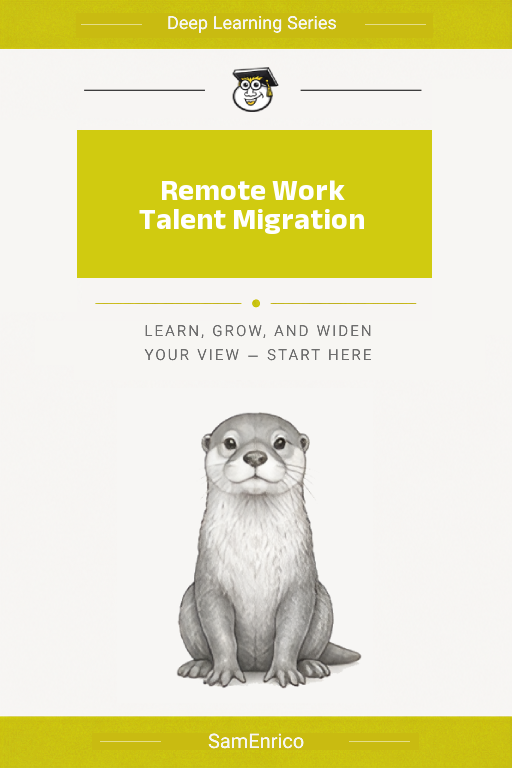
Non-FictionForecast & OutlookRemote Talent
Remote Work Talent Migration Audiobook
Analyze digital nomad visas, distributed team hiri
Analyze digital nomad visas, distributed team hiring, and talent moving from high to low cost cities.
Formats
Free sample
Chapter 1: The Commute Tax--–- The first time Sarah calculated her “Commute Tax,” she almost threw her laptop across the room. She had been sitting in her San Francisco apartment—the one that cost her 3,200amonthforastudiowithawasher−dryerthatworkedonlyhalfthetime—addingupthenumbers.Twohoursadaycommuting.Tenhoursaweek.Fourhundredhoursayear.Shemultipliedthatbyherhourlywage,thenaddedher BARTpasses,thedrycleaningforofficeclothes,the3,200 a month for a studio with a washer-dryer that worked only half the time—adding up the numbers. Two hours a day commuting. Ten hours a week. Four hundred hours a year.
She multiplied that by her hourly wage, then added her BART passes, the dry cleaning for office clothes, the 3,200amonthforastudiowithawasher−dryerthatworkedonlyhalfthetime—addingupthenumbers.Twohoursadaycommuting.Tenhoursaweek.Fourhundredhoursayear.Shemultipliedthatbyherhourlywage,thenaddedher BARTpasses,thedrycleaningforofficeclothes,the14 avocado toasts she bought because she was too exhausted to cook after a ten-hour day, and the therapy sessions she needed to manage the low-grade anxiety of watching her savings account flatline while her landlord raised rent for the fourth time in two years.The total came to $47,000 a year. That wasn't her salary. That was what she was paying for the privilege of working in an office.Her friend Miguel, who worked for the same company as a product manager, had left San Francisco eighteen months ago. He now lived in Medellín, Colombia, in a two-bedroom apartment with a balcony overlooking the mountains. He paid $800 a month.
He walked ten minutes to a coworking space with fiber optic internet. He worked the same hours, shipped the same features, attended the same Zoom meetings. His salary hadn't changed. But his savings rate had gone from 8 percent to 62 percent.Sarah loved Miguel. But when she heard that, she hated him a little.The question that kept her up that night was the same question that three million knowledge workers asked themselves in 2022 and 2023, as return-to-office mandates clashed with the lived experience of two years of productive remote work: If my output is the same, and my employer pays the same, why am I the one subsidizing a city I can barely afford?The answer, as Sarah would discover over the following months, was that she had been playing a game whose rules had just changed.
The 20th century model of career success—move to a hub city, commute to an office, pay exorbitant rent in exchange for “opportunity”—was not a law of nature. It was a system. And systems can be hacked.This book is the hack.The Myth of the Inevitable Commute For the…
This is the end of the free sample. Get the Audiobook to keep going. Buy now
About this book
Details
- Author
- Spears Toshia
- Publisher
- SamEnrico
- Language
- English
- Genre
- Non-Fiction, Forecast & Outlook, Remote Talent
- Released
- 2026-05-30
- Pages (approx.)
- 145
- Available as
- eBook, Audiobook

Listen in the VoxFlicks app
Audiobooks and audio dramas wherever you go. Sign in with your SamEnrico account and press play.
More by Spears Toshia
 Restless Leg Syndrome Medication GuideSpears Toshia$11.99
 Instagram Anxious AttachmentSpears Toshia$11.99
 Estate Plan For Second Marriages GuideSpears Toshia$11.99
 Time Blocking with TrelloSpears Toshia$11.99
 Prohibited AI Practices SummarySpears Toshia$11.99
 The Phantom of the Boardroom: How a Whistleblower Exposed Silicon Valley’s Darkest SecretSpears Toshia$11.99
 How to Start a Burglar Alarm Hire Business (Beginners Guide)Spears Toshia$11.99
 Personal Board Recruitment GuideSpears Toshia$12.99
 Understanding Kartagener SyndromeSpears Toshia$17.99
 Registered Medical AssistantSpears Toshia$11.99
You may also like
 Hong Kong Handover 1997Dunn Johnnie$11.99
 Zumba For Postnatal Recovery CourseNeal Christian$11.99
 Zumba for BeginnersLadner Nikia$11.99
 YouTube Comment Mining GuideHumes Pandora$12.99
 Worry Box MeditationCarlin Rudy$11.99
 Workplace Stress MeditationNguyen Lynn$11.99
 Workplace Stress and Sleep RepairHawley Ivory$11.99
 Workplace Perfectionism CureDelaney Jeffry$11.99
 Workplace Injustice Anger GuideWallen Isabelle$11.99
 Work Addiction and Burnout LinkGreenwood Ester$11.99
 Women in Yoga and WellnessBeattie Galina$11.99
 Women in Stand Up ComedyChun Evangeline$11.99