
Non-FictionSelf-HelpRemote Work
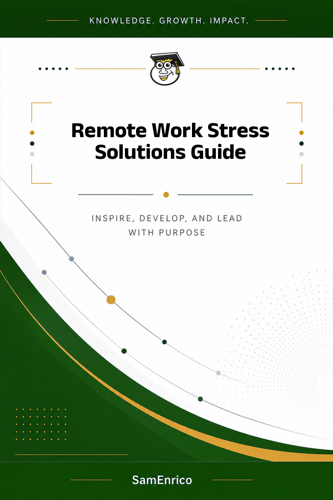
Remote Work Stress Solutions Guide eBook
Addresses isolation, blurred boundaries, and digit
Addresses isolation, blurred boundaries, and digital overload for home-based professionals.
Formats
Free sample
Chapter 1: The Gratitude Trap–- The email arrived at 11:47 PM on a Tuesday. Sarah stared at her laptop screen, the blue light painting shadows under her eyes that hadn't existed eighteen months ago—before the pandemic sent everyone home. Her manager's message was brief: "Quick question on the Johnson proposal. Sorry for the late ping!" Followed by a smiling emoji. Followed by an expectation.Sarah typed her response in under two minutes.
She always did. Because how could she complain? She hadn't battled traffic. She hadn't worn real pants. She had eaten lunch from her own refrigerator while standing in her own kitchen.
She was lucky. That's what everyone said. That's what she told herself at 11:47 PM on a Tuesday as she answered a work email from her couch, her laptop balanced on a pillow, her television playing a show she had stopped watching twenty minutes ago.She was lucky. So why did she feel so trapped?The Central Contradiction of Remote Work This is the remote paradox: the same flexibility that promises freedom often becomes a source of entrapment. You can work from anywhere, so you work everywhere.
You don't have a commute, so you never truly leave. You are trusted to manage your own time, so your time is never really your own. What was sold as liberation becomes, for millions of home-based professionals, a slow-motion psychological collapse.The numbers tell a disturbing story. According to a 2024 survey by the American Psychological Association, remote workers report rates of burnout that are 23 percent higher than their in-office counterparts—a reversal of the early pandemic narrative that working from home was a wellness miracle. The same study found that 67 percent of remote employees check work messages outside of working hours at least three times per week.
Forty-one percent admit to working while sick. Fifty-eight percent say they feel guilty when they are not actively working, even during scheduled time off.These are not lazy people. These are not unambitious people. These are people caught in a psychological trap so subtle and so culturally reinforced that most do not even know they are in it. This chapter names that trap.
It dissects its mechanisms. And it provides the first step toward escape: a clear-eyed diagnosis of exactly what kind of remote stress you are experiencing, because you cannot solve a problem you cannot name.The Gratitude Trap: How Thankfulness Becomes a Cage The gratitude trap operates through a simple but devastating psychological mechanism. When people believe they have received a gift or a privilege, they experience a powerful subconscious pressure to prove themselves worthy of that gift. In the context of remote work, the "gift" is the absence of commuting, the freedom from office politics, the ability to wear comfortable clothes, the proximity to family and pets. And the "proof of worthiness" is constant availability, overperformance, and the silent acceptance of boundary violations that would never be tolerated in a traditional office.Consider the language remote workers use to describe their situation.
"I can't complain." "I'm lucky to have this opportunity." "At least I don't have to drive an hour each way." These are not neutral observations. They are guilt-driven rationalizations that shut down the legitimate questions every remote worker should be asking: Is this sustainable? Am I being fairly compensated for my time? Where is the line between flexibility and exploitation?The gratitude trap is reinforced from multiple directions. Employers, whether intentionally or not, benefit from workers who feel indebted.
The smiling emoji on the 11:47 PM email is not merely a friendly gesture; it is a signal that the request is reasonable, even generous, because it is accompanied by performative warmth. Colleagues who respond to late-night messages create a norm that punishes those who do not. And perhaps most powerfully, remote workers internalize the message that their comfort is a privilege that can be revoked. The unspoken threat hovers over every boundary-setting conversation: if you complain, they might make us all come back to the office.This is not paranoia. It is pattern recognition.
A 2023 study from Stanford University found that 34 percent of remote workers reported that their employers had explicitly or implicitly threatened return-to-office mandates for employees who did not meet "availability expectations." The message was clear: your home office is a gift, and gifts can be taken away.The Real Cost of Gratitude The gratitude trap is not merely uncomfortable. It is expensive in ways that compound over time.First, there is the cost to physical health. Remote workers in the gratitude trap report higher rates of insomnia, tension headaches, and gastrointestinal issues—all linked to chronic cortisol elevation (a concept we will explore in depth in Chapter 2). When you never truly stop working, your body never truly recovers. The 11:47 PM email does not just steal twenty minutes of your evening; it elevates your stress hormones for hours afterward, degrading your sleep quality even if you manage to fall asleep on time.Second, there is the cost to relationships.
The gratitude trap does not only affect the remote worker. It affects everyone who shares their space. Partners report feeling like they are competing with a laptop for attention. Children learn that work interruptions are normal, even expected, at any hour. Friends stop inviting the remote worker to weekday evening events because "she's always working." The slow erosion of relationships is one of the most frequently cited regrets among long-term remote workers, yet it is almost never discussed in workplace wellness trainings.Third, there is the cost to career sustainability.
The gratitude trap creates a vicious cycle: you work more to prove you deserve the privilege of working from home, which increases your output temporarily, which raises your manager's expectations, which requires even more work to maintain the appearance of deserving the privilege. This cycle does not lead to promotion. It leads to burnout. And burned-out workers do not get promoted; they get performance improvement plans or, worse, quiet replacement.The Myth of "Social Oxygen"There is another dimension to the remote paradox that the gratitude trap obscures. Even when remote workers successfully defend their boundaries—even when they stop answering 11:47 PM emails—they often find themselves feeling strangely depleted.
This is not exhaustion from overwork. It is starvation from lack of what organizational psychologists call "social oxygen."Social oxygen is the term for the spontaneous, low-stakes, non-task-oriented interactions that sustain emotional well-being in traditional workplaces. The hallway chat about weekend plans. The coffee machine conversation about a television show. The shared eye roll during a tedious meeting.
The brief exchange about a child's soccer game. These interactions are not "work" in any formal sense, yet they are essential to the human experience of belonging.In a traditional office, social oxygen is ambient. You do not have to schedule it. You do not have to work for it. It simply exists in the spaces between工作任务.
And it serves critical psychological functions: it reduces stress, it builds trust, it creates the sense of being known, and it provides opportunities for informal learning and collaboration.Remote work, by its very structure, suffocates social oxygen. Video calls are task-oriented by default. Chat messages are efficient, not expansive. The casual hallway encounter has no…
This is the end of the free sample. Get the eBook to keep going. Buy now
About this book
Details
- Author
- Tuggle Eleonora
- Publisher
- SamEnrico
- Language
- English
- Genre
- Non-Fiction, Self-Help, Remote Work
- Released
- 2026-06-10
- Pages (approx.)
- 151
- Available as
- eBook, Audiobook

Read better in the ZLOADR app
Your eBooks on your phone or tablet. Sign in with your SamEnrico account and start reading.
More by Tuggle Eleonora
 Senior Self Compassion WorkbookTuggle Eleonora$11.99
 Loneliness for ExpatriatesTuggle Eleonora$11.99
 Dental Student Stress ReliefTuggle Eleonora$11.99
 The Icebound Gambit: Suvorov's Alpine Miracle (1799)Tuggle Eleonora$11.99
 How to Produce Baby Transport ProductsTuggle Eleonora$11.99
 How to Start a Development Planning Business (Beginners Guide)Tuggle Eleonora$11.99
 Agile Hardware Hardware GuideTuggle Eleonora$12.99
 TikTok Shop E-Commerce BusinessTuggle Eleonora$11.99
You may also like
 Hong Kong Handover 1997Dunn Johnnie$11.99
 Zumba For Postnatal Recovery CourseNeal Christian$11.99
 Zumba for BeginnersLadner Nikia$11.99
 YouTube Comment Mining GuideHumes Pandora$12.99
 Worry Box MeditationCarlin Rudy$11.99
 Workplace Stress MeditationNguyen Lynn$11.99
 Workplace Stress and Sleep RepairHawley Ivory$11.99
 Workplace Perfectionism CureDelaney Jeffry$11.99
 Workplace Injustice Anger GuideWallen Isabelle$11.99
 Work Addiction and Burnout LinkGreenwood Ester$11.99
 Women in Yoga and WellnessBeattie Galina$11.99
 Women in Stand Up ComedyChun Evangeline$11.99