
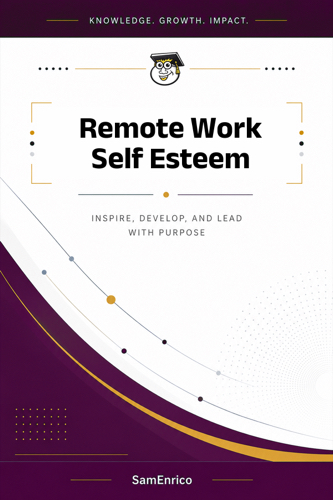
Non-FictionSelf-HelpRemote Work
Remote Work Self Esteem eBook
Stay confident and visible while working from home
by Robert Corey
Stay confident and visible while working from home without daily feedback.
Formats
Free sample
Chapter 1: The Silence That Screams...--–- On a Tuesday morning in March, a senior marketing director named Priya closed her laptop, walked ten feet to her kitchen, and burst into tears for reasons she could not name.She had just finished a presentation that her boss had called "solid." Her team had met every deadline. No one had complained. And yet, somewhere between her third Zoom call and her fifth unanswered Slack message, Priya had become convinced that she was failing.Not failing at a specific task. Failing as a person.She felt invisible. Not the peaceful invisibility of a quiet morning, but the hollow invisibility of a ghost haunting her own career.
She had worked harder remotely than she ever had in an office—longer hours, more emails, more "quick syncs"—and somehow, she felt less seen than when she used to eat lunch next to a coworker who barely spoke to her.Priya was not broken. She was not weak. She was not "bad at remote work."She was standing in the Feedback Void—and her brain was interpreting silence as danger.This chapter is about why that happens, why it is not your fault, and why the solution is not to demand more praise but to build something far more reliable: evidence you control, not applause you wait for.The Neuroscience of Uncertainty To understand why remote work erodes self-esteem, you have to go back about 200,000 years—to the savannas of prehistoric Africa, where your brain's operating system was written.Your brain is not designed for productivity. It is designed for survival. And the single most important survival mechanism is social belonging.
For early humans, being exiled from the tribe was a death sentence. No food sharing. No protection from predators. No mating opportunities. The brain evolved to treat social rejection with the same urgency as physical pain.
(In fact, f MRI studies show that social rejection activates the same neural regions as a broken bone.)This is not a metaphor. It is biology.Now let's translate that to your home office.When you worked in a physical office, your brain received a constant stream of low-grade social safety signals: a nod from a colleague as you walked by, a smile from the receptionist, a "nice work on that report" from your manager as they passed your desk. You did not consciously register most of these cues. But your amygdala—the brain's threat-detection center—did. Each micro-signal whispered: "You are safe.
You belong. Keep going."Remote work strips all of that away.In its place is The Feedback Void—an empty space where those cues used to be. The brain, designed to detect threats, does not tolerate empty space. It fills the void with the worst possible assumptions. This is called negative projection: when information is missing, the brain defaults to danger."They didn't reply to my Slack.
They must be angry.""No one commented on my document. It must be terrible.""My manager didn't say 'good job' in that meeting. I must be on thin ice."None of these assumptions are necessarily true. But they feel true because your brain is doing exactly what it evolved to do: protecting you from perceived exile.This is the central psychological trap of remote work. The Feedback Void creates anxiety.
Anxiety creates overwork (you try to earn safety through effort). Overwork creates exhaustion. Exhaustion makes you less visible. And invisibility deepens the void.It is a loop. And it is not your fault.Proximity Bias: The Invisible Injustice Before we go further, we have to name the structural reality that makes the Feedback Void worse: proximity bias.Proximity bias is the unconscious tendency for managers to reward, remember, and promote workers they see.
It is not malicious. It is not even intentional. It is a cognitive shortcut: the human brain more easily recalls and values people who are physically present.Dozens of studies confirm this. One of the most cited—a 2021 analysis of remote work at a large tech company—found that employees who worked remotely received 30% less mentorship, were promoted half as often, and received lower performance ratings despite identical output to their in-office peers. The cause was not performance.
It was visibility.Here is what proximity bias sounds like in practice, inside a manager's head (often unconsciously):"I saw Sarah in the hallway yesterday. She looked busy. She's probably working hard.""I haven't heard from Priya in a few days. She must be checked out."Notice the asymmetry. Sarah gets credit for being seen.
Priya gets penalized for not being heard from. But Priya may have been working twice as hard. She just didn't have a hallway.This is the brutal math of remote self-esteem: you can perform excellently and still be perceived as underperforming, simply because your effort is invisible.The Performance vs. Perception Gap Let me introduce a framework that will appear throughout this book: The Performance vs. Perception Gap.Performance is what you actually do: the hours you work, the problems you solve, the quality of your output, the value you create.Perception is how your effort is seen, remembered, and evaluated by others.In an office, Performance and Perception are tightly coupled.
Your manager sees you working. They overhear you solving problems. They notice you staying late. Perception naturally tracks Performance.In a remote environment, that coupling breaks. Performance can be excellent while Perception plummets—simply because no one is watching.Here is the painful truth: your manager cannot read your mind.
They cannot see your home office. They do not know that you spent two hours untangling a legacy database or that you stayed up late helping a coworker. They only know what you signal to them.Most remote workers assume that hard work speaks for itself. It does not. In the Feedback Void, silence is not golden.
Silence is erasure.The Mind-Reading Trap Let me name the specific cognitive error that keeps remote workers stuck in the Performance vs. Perception Gap. I call it The Mind-Reading Trap.The Mind-Reading Trap sounds like this:"My manager knows I'm working hard. They can tell. I don't need to say anything."This is false.
Your manager does not know. And it is not their fault.Think about your manager's reality. They are likely remote too. They have their own Feedback Void to manage. They have back-to-back meetings.
They have their own manager asking questions. They are not sitting around wondering, "I wonder how Priya is doing today."They are not ignoring you. They are not thinking about you at all—not because you don't matter, but because human attention is limited and remote work scatters it.The Mind-Reading Trap is a form of egocentric bias: we assume others see the world the way we do. Because you know you are working hard, you assume your manager knows too. But your manager does not have access to your inner experience.
They only have access to your external signals.If you send no signals, they receive no signal. That is not rejection. That is physics.So what do most remote workers do when they feel invisible?They double down on the Mind-Reading Trap. They work harder. They work…
This is the end of the free sample. Get the eBook to keep going. Buy now
About this book
Details
- Author
- Robert Corey
- Publisher
- SamEnrico
- Language
- English
- Genre
- Non-Fiction, Self-Help, Remote Work
- Released
- 2026-06-06
- Pages (approx.)
- 140
- Available as
- eBook, Audiobook

Read better in the ZLOADR app
Your eBooks on your phone or tablet. Sign in with your SamEnrico account and start reading.
More by Robert Corey
 Education Level And ExerciseRobert Corey$11.99
 School Refusal and Self EsteemRobert Corey$11.99
 Toddler Sleep Regression GuideRobert Corey$11.99
 Moroccan Talent Flow to Europe ReportRobert Corey$11.99
 The Sydney Opera House: A Dream Takes Shape (1959-2000)Robert Corey$11.99
 Zinalsite MiningRobert Corey$11.99
 Understanding Microcephaly Mental Retardation RetinopathyRobert Corey$17.99
 Just Transition Investment GuideRobert Corey$12.99
 Content Repurposing With AIRobert Corey$12.99
 How to Start a Building Cleaning Business (Beginners Guide)Robert Corey$11.99
You may also like
 Hong Kong Handover 1997Dunn Johnnie$11.99
 Zumba For Postnatal Recovery CourseNeal Christian$11.99
 Zumba for BeginnersLadner Nikia$11.99
 YouTube Comment Mining GuideHumes Pandora$12.99
 Worry Box MeditationCarlin Rudy$11.99
 Workplace Stress MeditationNguyen Lynn$11.99
 Workplace Stress and Sleep RepairHawley Ivory$11.99
 Workplace Perfectionism CureDelaney Jeffry$11.99
 Workplace Injustice Anger GuideWallen Isabelle$11.99
 Work Addiction and Burnout LinkGreenwood Ester$11.99
 Women in Yoga and WellnessBeattie Galina$11.99
 Women in Stand Up ComedyChun Evangeline$11.99