
Non-FictionSelf-HelpErgonomics
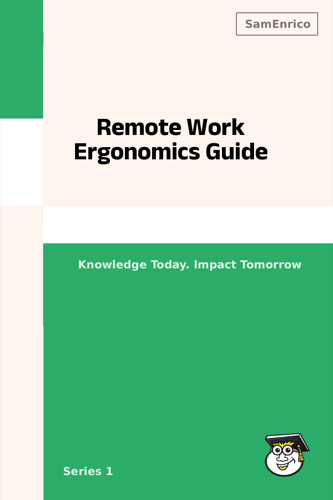
Remote Work Ergonomics Guide eBook
Sets up chair and screen for long hours.
Sets up chair and screen for long hours.
Formats
Free sample
Chapter 1: The Sitting Lie--The average remote worker will spend 1,784 hours sitting this year. That is more time than they will spend sleeping, eating, or looking at their children. It is more time than it takes to walk the entire length of the Great Wall of China three times. And almost no one is doing it correctly.You are reading this because something already hurts. Maybe it is a dull ache at the base of your skull that you have started massaging during video calls when you think the camera is off.
Maybe it is a burning sensation in your right wrist that you have been ignoring because you have deadlines. Or perhaps it is a low, grinding pain in your lower back that has become so normal that you no longer remember what it feels like to wake up without it.Here is the truth that the multi-billion-dollar office furniture industry does not want you to know: your pain is not caused by a lack of money. It is not caused by the fact that you cannot afford a twelve-hundred-dollar Aeron chair or a motorized standing desk. And it is almost certainly not caused by bad posture, at least not in the way you have been taught to think about posture.Your pain is caused by one thing and one thing only: static sitting.Not sitting itself. Humans have sat on rocks, logs, stools, and floors for hundreds of thousands of years without experiencing the epidemic of spinal degeneration, carpal tunnel syndrome, and metabolic disease that defines modern remote work.
The problem is not the act of sitting. The problem is that you are sitting like a piece of furniture rather than a living organism. You are locking your joints, freezing your spine, and holding a single position for hours at a time. And your body was never designed to do that.This chapter will dismantle everything you think you know about ergonomics. It will show you why the most expensive chair in the world will not save you if you sit in it the wrong way.
It will introduce a radical new hierarchy for thinking about your body at work. And it will give you a single, simple rule that, if followed, will prevent more pain than all the equipment in this book combined.But first, you need to understand the lie you have been sold.The Myth of Perfect Posture For decades, we have been told that there is a single, correct way to sit. Shoulders back. Spine straight. Feet flat.
Ninety-degree angles at the hips, knees, and elbows. This image of perfect posture appears in every ergonomic guide, every office safety training, and every furniture advertisement. It is the holy grail of sitting.It is also complete nonsense.Not because those positions are wrong. They are fine, as far as they go. But the assumption that there is a single ideal posture that you should maintain for hours is fundamentally at odds with how the human body actually works.
Your spine is not a steel rod. It is a flexible column of thirty-three vertebrae separated by gelatinous discs that are designed to compress, expand, twist, and bend. Your muscles are not static cables. They are dynamic engines that require constant stimulation to maintain function. And your joints are not door hinges.
They are complex systems that rely on movement to circulate synovial fluid and prevent degradation.When you hold any posture, even a theoretically perfect one, for an extended period, three things begin to happen inside your body.First, the discs between your vertebrae start to lose fluid. Spinal discs have no direct blood supply. They absorb nutrients and expel waste through a process called imbibition, which only occurs when the spine moves. When you stop moving, your discs begin to starve and shrink. This is why you are slightly shorter at the end of the day than when you woke up.
Your discs have compressed. Over years of static sitting, this compression becomes permanent.Second, your muscles begin to fatigue and then stiffen. Muscles are designed to contract and relax in rhythmic cycles. When you hold a contraction for too long, even a low-level one, the muscle fibers begin to form micro-tears. The body responds by laying down adhesions, which are essentially internal scar tissue.
These adhesions are what you feel as knots. They are not random. They are your body's desperate attempt to stabilize a joint that you have stopped moving.Third, your metabolism begins to slow. This is not a metaphor. Within minutes of becoming sedentary, an enzyme called lipoprotein lipase, which is responsible for breaking down fat in the blood, drops by more than ninety percent.
Your blood sugar regulation begins to deteriorate. Your insulin sensitivity declines. This is the mechanism behind what researchers call sedentary death syndrome, a term that sounds hyperbolic until you realize that prolonged sitting is now linked to a forty percent higher risk of all-cause mortality.None of this happens because your posture is bad. It happens because your posture is static.The Evolutionary Trap To understand why your body reacts this way, you need to rewind about two hundred thousand years.The human body evolved in an environment of almost constant movement. Your ancestors did not sit in chairs.
They squatted, knelt, leaned, and laid. They walked an average of ten to fifteen miles per day. They carried children, gathered food, and built shelter using their entire bodies. The spine, joints, and muscles that you have today were shaped by this relentless, low-intensity activity.Then, in the blink of an evolutionary eye, everything changed.The invention of the chair, which seems so natural to us now, is historically recent. For most of human history, chairs were reserved for royalty and the elderly.
Everyone else sat on the ground, on benches, or on nothing at all. The widespread use of chairs for office work only began in the nineteenth century with the rise of clerical labor. And the concept of a dedicated "ergonomic chair" designed for eight hours of continuous sitting is barely fifty years old.Your body has not caught up.This mismatch between your evolutionary hardware and your modern work habits is what scientists call an evolutionary trap. A trait that was perfectly adaptive in an environment of constant movement becomes maladaptive in an environment of enforced stillness. Your body still expects to move.
It still sends you signals to shift, stretch, and change position. But those signals have been reinterpreted by modern culture as distractions, signs of weakness, or even medical problems to be medicated away.That ache in your lower back is not a sign that your chair is wrong. It is a sign that your body is begging you to move.That stiffness in your neck is not a reason to buy a new pillow. It is a warning light on your body's dashboard telling you that you have been frozen for too long.And that fatigue you feel at three in the afternoon is not because you need more coffee. It is because your metabolism has effectively gone to sleep.The Remote Work Accelerant If office work was bad, remote work has made it significantly worse.…
This is the end of the free sample. Get the eBook to keep going. Buy now
About this book
Details
- Author
- Legg Dorothea
- Publisher
- SamEnrico
- Language
- English
- Genre
- Non-Fiction, Self-Help, Ergonomics
- Released
- 2026-06-06
- Pages (approx.)
- 126
- Available as
- eBook, Audiobook

Read better in the ZLOADR app
Your eBooks on your phone or tablet. Sign in with your SamEnrico account and start reading.
More by Legg Dorothea
 Retirement Housing Mortgage Payoff TradeoffsLegg Dorothea$11.99
 Parent Loss and HolidaysLegg Dorothea$11.99
 Lead Paint Renovation SafetyLegg Dorothea$11.99
 Asynchronous Work Time ManagementLegg Dorothea$11.99
 Aging Out of Foster CareLegg Dorothea$11.99
 Parenting Assertiveness GuideLegg Dorothea$11.99
 High Performance Without BurnoutLegg Dorothea$11.99
 The Iron Fleet: How a 19th-Century Shipping Tycoon Built an Empire on IceLegg Dorothea$11.99
 The Purple Throne: Justinian and the Last Golden AgeLegg Dorothea$11.99
 Service Providers Guide to Menu PlannersLegg Dorothea$11.99
 How to Produce Water Heater VentsLegg Dorothea$11.99
 How to Produce Lip and Cheek StainsLegg Dorothea$11.99
You may also like
 Hong Kong Handover 1997Dunn Johnnie$11.99
 Zumba For Postnatal Recovery CourseNeal Christian$11.99
 Zumba for BeginnersLadner Nikia$11.99
 YouTube Comment Mining GuideHumes Pandora$12.99
 Worry Box MeditationCarlin Rudy$11.99
 Workplace Stress MeditationNguyen Lynn$11.99
 Workplace Stress and Sleep RepairHawley Ivory$11.99
 Workplace Perfectionism CureDelaney Jeffry$11.99
 Workplace Injustice Anger GuideWallen Isabelle$11.99
 Work Addiction and Burnout LinkGreenwood Ester$11.99
 Women in Yoga and WellnessBeattie Galina$11.99
 Women in Stand Up ComedyChun Evangeline$11.99