
Non-FictionSelf-HelpBoundaries
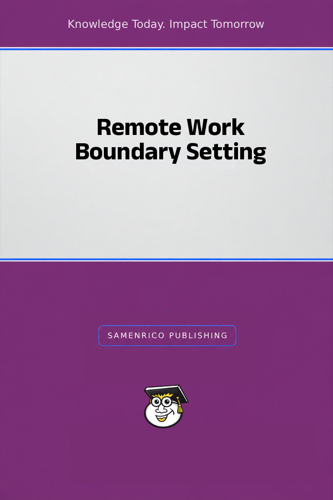
Remote Work Boundary Setting eBook
Protects personal time from late night Slack messa
Protects personal time from late night Slack messages.
Formats
Free sample
Chapter 1: The Ghost Commute--–- The first thing you lose in remote work is not productivity or collaboration or office camaraderie. It is the buffer. The quiet, boring, unproductive space between “at work” and “at home” that you never noticed until it was gone.You probably do not remember your commute fondly. Traffic jams. Crowded trains.
The same three songs on repeat. But that dead time—that 20, 30, or 60 minutes of forced transition—was doing something essential for you. It was telling your brain: You are leaving now. You are arriving later. In between, you are no one’s employee and no one’s partner.
You are just a person moving through space.When remote work eliminated the commute, it did not just save you an hour a day. It erased the psychological off switch that protected your personal time. And like most things that disappear silently, you did not notice what you had lost until you were already drowning in Slack messages at 10 PM.This chapter is about understanding that loss. Not so you can mourn the commute—no one wants that—but so you can rebuild what it gave you. Because the problem of late-night Slack messages is not really about Slack.
It is about the missing bridge between work and home. And you cannot build a bridge until you know why the old one mattered.The Invisible Ritual You Never Knew You Had Think about your old commute. Not the nightmare days—the average Tuesday. You left the office. You walked to your car or the train platform.
You sat down. For the next 20 to 60 minutes, you did something that was neither work nor home. You scrolled your phone. You stared out the window. You listened to a podcast.
You let your mind wander.What you were actually doing was something psychologists call transitional space. It is the mental zone where you are not required to perform any role. You are not “the manager” or “the parent” or “the partner.” You are just a person in a seat, moving from one version of yourself to another.That transitional space is not a luxury. It is a biological necessity. Your nervous system cannot go from high-alert work mode to relaxed home mode in zero seconds.
It needs a ramp. The commute was that ramp.Here is what happened during your commute without you realizing it:Your heart rate slowed. The act of sitting passively—not solving problems, not answering questions—allowed your sympathetic nervous system (the “fight or flight” system) to downshift.Your cortisol levels dropped. Stress hormones are not infinite. They need time to clear.
The commute gave them that time.Your brain switched modes. The prefrontal cortex—the part of your brain responsible for executive function, decision-making, and work-related thinking—gradually handed over control to the default mode network, which is associated with mind-wandering, creativity, and rest.By the time you walked through your front door, you were not the same person who had left the office. You were a slightly softer, slower, more present version of yourself. Your family got that version. Your boss had already clocked out.Now consider what happens without the commute.You close your laptop at 5:01 PM.
You stand up. You walk 15 feet to your kitchen. Your partner asks, “What’s for dinner?” Your child wants help with homework. Your phone buzzes with a Slack message from a colleague in a later time zone.You have not had a single second of transition. Your heart is still racing from the last Zoom call.
Your cortisol is still elevated. Your prefrontal cortex is still in work mode. And now you are being asked to be a partner, a parent, and an employee simultaneously—all within 60 seconds of closing your laptop.This is not a failure of willpower. It is a failure of infrastructure. You are trying to do something your brain was never designed to do: instant mode-switching.
And the result is chronic, low-grade stress that you have learned to call “being busy.”The Myth of Flexibility When remote work first became widespread, many people celebrated the end of the commute as a liberation. No more wasted hours in traffic. No more expensive train tickets. No more arriving home exhausted and irritable. You could work from anywhere, at any time.
Flexibility was the promise.But flexibility has a dark twin. And its name is boundary erosion.The logic of flexibility sounds reasonable: You can work when you are most productive. If you are a morning person, start at 6 AM and finish at 2 PM. If you are a night owl, start at 11 AM and finish at 7 PM. If you need to take a midday break for a doctor’s appointment or a school pickup, you can make up the time later.Here is what actually happens for most people:You start at 8 AM because your team expects it.
You take a 30-minute lunch at your desk while answering emails. You finish your “official” workday at 5 PM, but you check Slack while making dinner. After the kids are in bed, you open your laptop again from 8 PM to 10 PM to “catch up.” By Friday, you have worked 50 hours, but you feel like you accomplished less than when you worked 40 hours in an office.This is not a conspiracy. It is a predictable psychological trap. Researchers call it the flexibility paradox.
The more control you have over when you work, the more likely you are to work at all hours. Why? Because there is no natural stopping point. When you worked in an office, the building closed. The last train left.
Your colleagues went home. The environment told you when to stop.At home, the environment tells you nothing. Your laptop is always there. Your inbox is always open. Your Slack channel is always active.
And because you could answer that message at 9 PM, you start to feel like you should.This is not a matter of discipline. The most disciplined people in the world—surgeons, pilots, military officers—rely on external signals to tell them when to stop. Checklists, shift changes, alarms. They do not rely on willpower to decide when to put down the scalpel. They rely on systems.Remote work has taken away your external signals and replaced them with nothing.
You are being asked to build your own systems from scratch. That is what this book is for.The Slot Machine on Your Desk Slack, Teams, and other workplace messaging tools are not neutral. They were designed by some of the smartest behavioral psychologists in the world to do one thing: keep you engaged.The mechanism they use is called variable reinforcement. It is the same mechanism that makes slot machines addictive. Here is how it works.When you pull a slot machine lever, you do not know what will happen.
Most of the time, nothing. Sometimes, a small reward. Rarely, a big one. That unpredictability is what makes it compelling. If the machine paid out the same amount every time, you would get bored and walk away.
But because you never know when the next win is coming, you keep pulling.Slack works the same way. You check your messages, and you…
This is the end of the free sample. Get the eBook to keep going. Buy now
About this book
Details
- Author
- Cottrell Melissia
- Publisher
- SamEnrico
- Language
- English
- Genre
- Non-Fiction, Self-Help, Boundaries
- Released
- 2026-06-10
- Pages (approx.)
- 143
- Available as
- eBook, Audiobook

Read better in the ZLOADR app
Your eBooks on your phone or tablet. Sign in with your SamEnrico account and start reading.
More by Cottrell Melissia
 Franchising Your Local Brand Across Borders Supply ChainCottrell Melissia$11.99
 Vegan Recovery Nutrition CourseCottrell Melissia$11.99
 Disappointment in Retirement GuideCottrell Melissia$11.99
 The Driver Seat StretchCottrell Melissia$11.99
 White Gold Rush: The Untold Story of Miami's Crack KingpinsCottrell Melissia$11.99
 The Pacific Alchemist: Medieval Voyagers and the Secrets of the SeaCottrell Melissia$11.99
 How to Become a Chemical Laboratory TechnicianCottrell Melissia$11.99
 Trademark Cancellation FeesCottrell Melissia$12.99
 Demo Script for BeginnersCottrell Melissia$12.99
 Sterile Glove DonningCottrell Melissia$11.99
 Understanding Cryptogenic Organized PneumopathyCottrell Melissia$17.99
You may also like
 Hong Kong Handover 1997Dunn Johnnie$11.99
 Zumba For Postnatal Recovery CourseNeal Christian$11.99
 Zumba for BeginnersLadner Nikia$11.99
 YouTube Comment Mining GuideHumes Pandora$12.99
 Worry Box MeditationCarlin Rudy$11.99
 Workplace Stress MeditationNguyen Lynn$11.99
 Workplace Stress and Sleep RepairHawley Ivory$11.99
 Workplace Perfectionism CureDelaney Jeffry$11.99
 Workplace Injustice Anger GuideWallen Isabelle$11.99
 Work Addiction and Burnout LinkGreenwood Ester$11.99
 Women in Yoga and WellnessBeattie Galina$11.99
 Women in Stand Up ComedyChun Evangeline$11.99