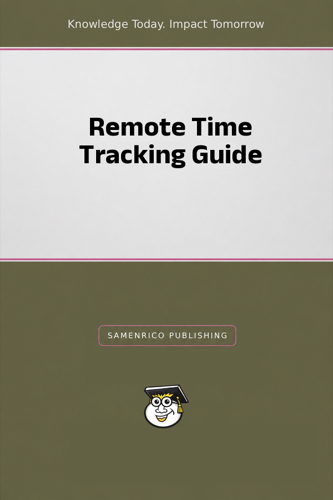
Remote Time Tracking Guide eBook
Logs hours accurately for billing or productivity.
Logs hours accurately for billing or productivity.
Formats
Free sample
Chapter 1: The Ambiguity Tax--–- Every morning, Maya opened her laptop at 8:00 AM sharp. She answered emails, joined Zoom calls, updated project boards, and by 6:00 PM, she felt exhausted. At the end of each week, her manager asked the same question: "What did you actually accomplish?" And Maya, despite working fifty hours, could not give a confident answer. She was not lazy. She was not incompetent.
She was paying a hidden cost that no one had ever named—the Ambiguity Tax.The Ambiguity Tax is the gap between the time you spend working and your ability to prove what you produced. It is the mental friction of not knowing how long a task takes, the defensive energy spent justifying your existence, and the slow erosion of trust between you and anyone who pays for your time. This tax is invisible, but it is not small. For remote workers, freelancers, and distributed teams, the Ambiguity Tax consumes an average of 12 to 15 hours per week—not in direct work, but in the overhead of uncertainty, defensiveness, and fragmented focus.This chapter introduces the single most important concept in the entire book: the Ambiguity Tax. You will learn what it is, how to calculate your personal rate, and why eliminating it is the prerequisite for everything else—accurate billing, genuine productivity, and the freedom to work less while earning more.
By the end of this chapter, you will never look at an empty timesheet the same way again.The Origins of the Ambiguity Tax The term "Ambiguity Tax" draws directly from David Allen's Getting Things Done, where he argues that the human mind is not designed to hold actionable information without creating stress. Every open loop—every task without a defined outcome, every hour without a recorded boundary—drains cognitive bandwidth. Allen called this "psychic RAM." When your brain constantly asks, "How long did that take? Am I on track? Will the client question this?" you are not working.
You are overhead.But the Ambiguity Tax is not just psychological. It is economic. Consider two freelancers: Alex and Jordan. Both bill $100 per hour. Both work forty hours per week.
Alex logs time continuously, categorizes every entry, and reviews logs weekly. Jordan estimates at the end of each day, often guessing, and never reconciles estimates with reality. On paper, both earn $4,000 per week. But Jordan loses an average of 90 minutes daily to re-estimating, correcting old entries, and defending vague invoices to confused clients. That is 7.5 hours per week of unpaid overhead.
Jordan's true hourly rate is not $100—it is $86. Alex, by contrast, spends 15 minutes per day on logging and never revisits old entries. Alex's true rate stays at $100. Over a year, Jordan loses $14,000 to the Ambiguity Tax.For employees, the tax looks different but cuts just as deep. When a manager asks, "Why did this take three hours?" and you have no log to reference, you waste another hour justifying yourself.
When you switch between Slack, email, and a spreadsheet without tracking the transitions, you lose 90 minutes daily to context switching—time that never appears on any report but absolutely drains your energy. The Ambiguity Tax is not about surveillance. It is about self-knowledge. Without it, you are flying blind.The Three Components of the Ambiguity Tax The Ambiguity Tax is not a single cost but a compound of three distinct leaks. Understanding each one is essential because they require different solutions.Component One: The Uncertainty Loop.
This is the mental cost of not knowing. When you finish a task but cannot say exactly how long it took, your brain enters a loop: "Was that two hours or three? Did I check email in between? Should I round up or down?" Each loop consumes 30 to 60 seconds of pure overhead. If you complete fifteen tasks per day, that is up to fifteen minutes of uncertainty—every day.
Over a year, that is sixty hours of unpaid mental gymnastics. The solution is not to track faster but to track at the moment of completion before the loop begins.Component Two: The Defense Tax. This is the cost of justifying vague logs to stakeholders. A client receives an invoice that says "Strategy – 5 hours." They write back: "What strategy? What did you actually do?" You spend twenty minutes writing an email that reconstructs the week from memory, calendars, and chat logs.
That twenty minutes is never billed. The defense tax grows exponentially with vagueness. A specific entry—"Competitor gap analysis for Q3 pricing review – 5 hours"—rarely triggers a defense response. A vague entry always does. The rule is simple: every minute you spend defending a log is a minute you could have spent preventing the question with better initial documentation.Component Three: The Fragmentation Tax.
This is the cost of switching between tasks without tracking the boundaries. Research from the University of California, Irvine shows that after an interruption, it takes an average of twenty-three minutes to return to the original task with full focus. When you do not log those interruptions, you cannot see the pattern. You just feel tired. The fragmentation tax is invisible because the interruptions themselves seem small—a Slack ping, a personal email, a quick check of the news.
But each interruption carries a recovery cost. By the end of the day, you have lost ninety minutes not to the interruptions themselves but to the recovery from them.Why Remote Work Magnifies the Tax Remote work did not create the Ambiguity Tax, but it magnifies every component. In an office, managers see your presence. They see you at your desk, in meetings, typing. That visual evidence substitutes for precise logs.
In remote work, visibility disappears. The only evidence of work is what you produce and what you record. This is why remote managers become obsessed with tracking tools—not because they are controlling, but because the Ambiguity Tax on their side is also enormous. When a manager cannot see you working, their brain enters its own uncertainty loop: "Is the team working? Am I failing as a leader?
Should I ask for more updates?" That manager then requests more meetings, more check-ins, and more detailed reports. Each request adds to the fragmentation tax on your side. The tax compounds.But there is an escape. The Ambiguity Tax is not a law of nature. It is a consequence of ambiguous systems.
When you implement clear, consistent logging, you eliminate the uncertainty loop for yourself and for your stakeholders simultaneously. The manager stops asking for updates because the weekly summary answers every question before it forms. The client stops disputing invoices because the narrative descriptions match their memory of the work. You stop feeling exhausted at 6:00 PM because you are no longer carrying the weight of unlogged, unproven hours.Calculating Your Personal Ambiguity Tax Rate Before you can eliminate the tax, you must measure it. This chapter provides a simple, seven-day audit that requires no special tools—just a notebook or a spreadsheet.Day One to Three: Baseline Tracking.
For three days, work as you normally would. Do not change your habits. At the end of each day, answer three questions:How many times did I ask myself, "How long did that take?" (Count each instance.…
This is the end of the free sample. Get the eBook to keep going. Buy now
About this book
Details
- Author
- Gilliam Josue
- Publisher
- SamEnrico
- Language
- English
- Genre
- Non-Fiction, Self-Help, Time Tracking
- Released
- 2026-06-06
- Pages (approx.)
- 134
- Available as
- eBook, Audiobook

Read better in the ZLOADR app
Your eBooks on your phone or tablet. Sign in with your SamEnrico account and start reading.
More by Gilliam Josue
 Overcoming Listening Barriers and DistractionsGilliam Josue$11.99
 Mindful Phone CheckGilliam Josue$11.99
 Parental Leave Expansion ReportGilliam Josue$11.99
 Fear of Failure Journal PromptsGilliam Josue$11.99
 SAD And Color TherapyGilliam Josue$11.99
 Nonviolent Crisis InterventionGilliam Josue$11.99
 Networking for Social WorkersGilliam Josue$11.99
 The Architect of Modern Football: Max Seagram and the Birth of the Premier LeagueGilliam Josue$11.99
 The Algorithm That Broke the Internet: How a Teen’s App Sparked a Global RevolutionGilliam Josue$11.99
 How to Start a Precision Screw Business (Beginners Guide)Gilliam Josue$11.99
 How to Produce Wall PanelingGilliam Josue$11.99
 Angel Investor Pooling StructuresGilliam Josue$12.99