
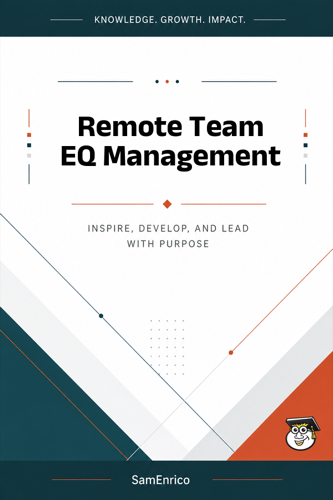
Non-FictionSelf-HelpRemote Work
Remote Team EQ Management
Builds emotional connection across distributed tea
Builds emotional connection across distributed teams with intentionality.
Formats
About this book
Free sample
Chapter 1: The Loneliest Workforce--–- Sarah had just finished her eighth Zoom call of the day when she realized she hadn't laughed with a coworker in eleven weeks. Not a real laugh—the kind where someone leans back in their chair, eyes crinkling, and says something so absurd that the meeting derails for a full minute. She was a senior product manager at a well-funded tech company with all the right tools: Slack, Teams, Miro, Figma, Jira, and a half-dozen other platforms designed to make remote work seamless. Yet here she was, at 6:47 PM, staring at her second monitor, unable to remember the last time anyone on her team had asked how she was actually doing. Not "How's the project?" Not "Are you on track for Thursday?" But genuinely: How are you?Sarah is not an outlier.
She is the new normal.The Paradox of Hyper-Connectivity In 2019, before the pandemic accelerated the remote work revolution, approximately 17 percent of employed adults in the United States worked from home five days a week. By 2024, that number had stabilized at nearly 35 percent for college-educated workers in professional services, with another 40 percent working in hybrid arrangements. The tools that enabled this shift promised liberation from commutes, flexibility for caregivers, and access to global talent pools. And in many ways, they delivered. Productivity metrics, by most accounts, remained steady or even improved.
Revenue per employee climbed. Overhead costs fell.But something else happened—something that the dashboards and OKRs failed to capture.According to a 2024 meta-analysis published in the Journal of Organizational Behavior, remote employees report feeling significantly less emotionally connected to their leaders and peers than their in-office counterparts, despite reporting equal or higher job satisfaction in terms of task autonomy and work-life balance. The disconnect is not about the work. It is about the feeling of the work. In study after study, remote workers use the same language: invisible, forgotten, on an island, a robot, a ticket in a queue.This is the paradox of hyper-connectivity.
We have more channels for communication than any workforce in history, yet those channels are optimized for information transfer, not…
This is the end of the free sample. Get the eBook to keep going. Buy now
Contents
- Chapter 1
- Chapter 2
- Chapter 3
- Chapter 4
- Chapter 5
- Chapter 6
- Chapter 7
- Chapter 8
- Chapter 9
- Chapter 10
- Chapter 11
- Chapter 12
Details
- Author
- Belanger Afton
- Publisher
- SamEnrico
- Language
- English
- Genre
- Non-Fiction, Self-Help, Remote Work
- Released
- 2026-06-07
- Pages (approx.)
- 137
- Available as
- eBook, Audiobook

Read better in the ZLOADR app
Your eBooks on your phone or tablet. Sign in with your SamEnrico account and start reading.
More by Belanger Afton
 RNA Vaccine Future ProspectsBelanger Afton$11.99
 TM And Religion Compatibility GuideBelanger Afton$11.99
 Yahoo's Oath Brand DamageBelanger Afton$11.99
 Self Esteem After Partner's SuccessBelanger Afton$11.99
 The Maestro of Medicine: Ignaz Semmelweis and the Birth of Antiseptic SurgeryBelanger Afton$11.99
 Understanding Myasthenia Gravis CongenitalBelanger Afton$17.99
 Nestle SWOT Analysis GuideBelanger Afton$12.99
 AI Financial Data Backup GuideBelanger Afton$12.99
 A 3-Part Series Each Part the Length of an Election Cycle's Final PushBelanger Afton$11.99
 How to Start a Mushroom Growing (cultivated) Business (Beginners Guide)Belanger Afton$11.99
You may also like
 Hong Kong Handover 1997Dunn Johnnie$11.99
 Zumba For Postnatal Recovery CourseNeal Christian$11.99
 Zumba for BeginnersLadner Nikia$11.99
 YouTube Comment Mining GuideHumes Pandora$12.99
 Worry Box MeditationCarlin Rudy$11.99
 Workplace Stress MeditationNguyen Lynn$11.99
 Workplace Stress and Sleep RepairHawley Ivory$11.99
 Workplace Perfectionism CureDelaney Jeffry$11.99
 Workplace Injustice Anger GuideWallen Isabelle$11.99
 Work Addiction and Burnout LinkGreenwood Ester$11.99
 Women in Yoga and WellnessBeattie Galina$11.99
 Women in Stand Up ComedyChun Evangeline$11.99