
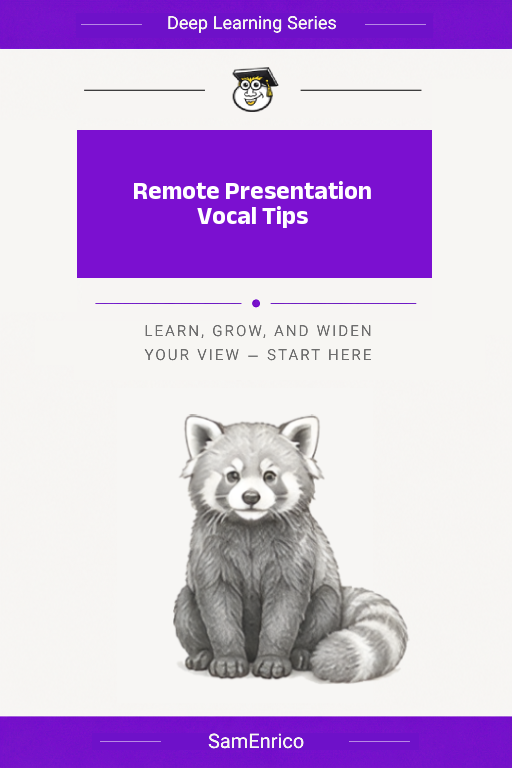
Remote Presentation Vocal Tips eBook
Improve vocal variety, pacing, and energy for remo
by Bedard Zelda
Improve vocal variety, pacing, and energy for remote presentations. Avoid monotone delivery.
Formats
Free sample
Chapter 1: Beyond Being Yourself--–- Let me begin with a confession. For fifteen years, I believed I was a good public speaker. I could walk into a boardroom, stand behind a lectern, or take the stage at a conference and feel the room lean in. I knew when to pause, when to speed up, when to drop my voice to a whisper and when to let it ring. Audiences responded.
Colleagues complimented me. I had what people called “presence.”Then the pandemic sent us all home, and I discovered that my presence did not fit through a webcam.My first few months of remote presenting were a slow-motion disaster. On Zoom, my carefully crafted pauses felt like dead air. My warm, resonant voice came through as muddy and indistinct. My natural energy, which had always read as enthusiasm in person, now looked like nervous fidgeting.
I watched recordings of myself and cringed. I sounded flat. I sounded bored. Worst of all, I sounded like someone who did not care about his own message.I was not alone. Every week, another colleague confided the same frustration.
“I feel like I’m shouting into a void.” “I can’t tell if anyone is listening.” “I hear myself on recordings and I don’t recognize that person.” Smart, accomplished, charismatic people—reduced to gray rectangles and tinny voices.This book is the result of what I learned over the next three years. It draws on hundreds of hours of research, dozens of interviews with vocal coaches and audio engineers, and my own painful trial-and-error journey from Zoom zero to remote presenter who actually enjoys being on camera. More importantly, it synthesizes the best insights from the top ten books on public speaking and vocal delivery—works by Nancy Duarte, Roger Love, Viv Groskop, Alexei Kapterev, and others—and adapts them specifically for the remote environment.Because here is the truth that none of those books will tell you, because they were written for a world that no longer exists: remote presenting is not in-person presenting with worse technology. It is a fundamentally different medium, requiring its own techniques, its own skills, and its own voice.The Lie You Have Been Told Before we can build something new, we must clear away the wreckage of old advice. And the oldest, most persistent, most damaging piece of advice is this: just be yourself.On its face, this advice seems unassailable.
Authenticity is good. Pretense is bad. Being genuine builds trust. All of this is true in the abstract. But in the specific context of remote presenting, “just be yourself” is not wisdom—it is a cop-out.
It is what people say when they do not know how to help you. It is what you tell yourself when you are too exhausted to prepare. It is the path of least resistance that leads directly to the land of muted microphones and wandering attention.Consider: do you “just be yourself” when you give a toast at a wedding? Of course not. You stand up straighter.
You speak more clearly. You choose your words more carefully. You are still yourself—you are not pretending to be someone else—but you are a heightened, focused, intentional version of yourself. The occasion demands it, and you rise to meet it.Do you “just be yourself” when you leave a voicemail for an important client? No.
You slow down. You enunciate. You leave your phone number twice. You are still you, but you have adapted to the medium.Remote presenting is an occasion. It is a medium.
It demands adaptation. The person who appears on your screen should be you—but you amplified, you clarified, you optimized for the rectangle. Think of it as your professional camera voice, distinct from your casual Zoom voice (the one you use for team check-ins) and your voicemail voice (the one you use for recorded messages). All three are authentically you. All three serve different purposes.The science backs this up.
Studies in communication psychology have consistently found that audiences prefer speakers who modulate their delivery—varying pace, pitch, and volume—even when those modulations are consciously chosen rather than spontaneously occurring. In other words, intentionality sounds more authentic than spontaneity, because intentionality signals that you care enough to prepare.The “just be yourself” advice persists because it feels kind. But kindness without accuracy is not kindness—it is condescension. You deserve better than a platitude. You deserve practical, specific, actionable techniques that actually work through a Logitech webcam and a pair of headphones.Three Scientific Reasons Your Natural Voice Fails Online Let us get specific.
Why does your perfectly good in-person voice sound flat and lifeless on video calls? The answer lies in three scientific realities that most remote presenters never consider.Reason One: Audio Compression Strips Your Vocal Overtones Here is something your microphone does not want you to know: it is lying to you. Not intentionally, but inevitably. Every video conferencing platform uses audio codecs—compression algorithms—that prioritize speech intelligibility over vocal quality. These codecs are designed to make sure your words are understandable, not to preserve the richness of your voice.What do they strip away?
High-frequency overtones, which give your voice its “sparkle” and convey enthusiasm. Low-frequency resonance, which gives your voice its “warmth” and conveys authority. Mid-range frequencies, which carry most of your vocal energy, are preserved. The result is a flattened, narrowed version of your voice that sounds thinner, smaller, and less emotionally varied than the voice your colleagues hear across a conference table.This is not a defect in your microphone or your internet connection. It is a feature of the technology.
Codecs are designed to save bandwidth, not to make you sound beautiful. The same compression that allows forty people to watch your presentation on a mediocre hotel Wi-Fi is the same compression that drains the life from your voice.Reason Two: The Absence of Spatial Audio Increases Listener Fatigue When you speak to someone in a physical room, your voice reaches their ears through two pathways: direct sound (traveling straight from your mouth to their ears) and reflected sound (bouncing off walls, ceilings, furniture, and other bodies). These reflections create spatial cues that help the brain separate your voice from background noise, track your movement, and anticipate your next words. They also create a sense of presence—the feeling that you are actually in the room.On a video call, all of that disappears. Your voice arrives through a single, compressed stream, delivered directly into headphones or tinny laptop speakers.
The brain, deprived of spatial cues, must work harder to perform the same listening tasks. Researchers at Stanford’s Virtual Human Interaction Lab have measured this effect: listening to compressed audio requires approximately twenty percent more cognitive energy than listening to live, spatially rich audio.Twenty percent. That means for every five minutes you speak, your listeners are expending six minutes worth of mental effort. By the ten-minute mark of your presentation, they are mentally exhausted—not because your content is boring, but because their brains are running a marathon just to process your words.Reason Three: The Fixed Frame Disrupts Natural Attention Anchoring Human attention is not…
This is the end of the free sample. Get the eBook to keep going. Buy now
About this book
Details
- Author
- Bedard Zelda
- Publisher
- SamEnrico
- Language
- English
- Genre
- Non-Fiction, Professional's Cheat Sheet, Virtual Communication
- Released
- 2026-05-30
- Pages (approx.)
- 141
- Available as
- eBook, Audiobook

Read better in the ZLOADR app
Your eBooks on your phone or tablet. Sign in with your SamEnrico account and start reading.
More by Bedard Zelda
 Stress Perfectionism Health CostBedard Zelda$11.99
 Framing Techniques for InfluenceBedard Zelda$11.99
 Problem Statement WorkbookBedard Zelda$11.99
 Sexual Sobriety Affirmations AudioBedard Zelda$11.99
 Embers of the First Flame: How Fire Shaped HumanityBedard Zelda$11.99
 Learn to Play the Irish BouzoukiBedard Zelda$11.99
 Manager Financial Planning & AnalysisBedard Zelda$11.99
 How to Become a MailerBedard Zelda$11.99
You may also like
 Remote Public Speaking GuideBelk Valene$12.99
 Remote Presentation Tech ChecklistGist Hunter$12.99
 Remote Presentation Setup GuideSwart Jannette$12.99
 Remote Presentation Nervousness GuideKang Cheri$12.99
 Remote Presentation Eye ContactBriggs Clint$12.99
 Remote Presentation Slide DesignSwain Tory$12.99
 Remote Presentation Q&A GuideHoover Elidia$12.99
 Engaging Remote Audiences GuideMallen Theda$12.99
 Remote Presentation Body LanguageHowell Rosemarie$12.99