
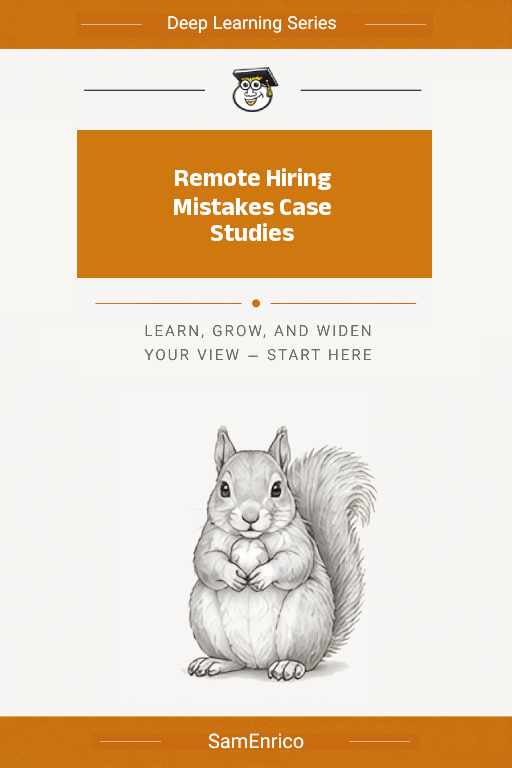
Non-FictionBusiness BriefCase Studies
Remote Hiring Mistakes Case Studies eBook
Learn from real remote hiring failures in each cou
Learn from real remote hiring failures in each country and how to avoid them.
Formats
Free sample
Chapter 1: The Billion-Dollar Blindspot--–- The email arrived at 4:47 PM on a Friday, which should have been my first warning. Nothing good ever arrives at 4:47 PM on a Friday.I was Maya Chen, thirty-four years old, three years into my role as Head of People at Cloud Scale, a fast-growing Saa S company that had just crossed two hundred employees. We were the darling of our niche—enterprise workflow automation—and investors were throwing money at us like confetti. My job was to hire the best talent on the planet, and I was good at it. Or so I believed.The email was from the FBI.Not a generic alert.
Not a forwarded advisory. A direct message from Special Agent James Kelleher, Cyber Division, San Francisco field office. The subject line read: "Urgent: Request for Call Regarding Identity Fraud Investigation."I read it three times. Then I called our general counsel, Marcus, who told me not to respond until he could review. Then I ignored Marcus and called the number anyway."Ms.
Chen," Agent Kelleher said, his voice flat and tired, like someone who had made this call a hundred times before. "I need to ask you about a remote employee you hired approximately four months ago. Name: Alex Rutherford. Title: Senior Backend Engineer."My stomach dropped. Alex Rutherford was my star hire.
He had come to us through a rigorous process—four technical interviews, a take-home project, a culture fit session with the engineering team. His resume was impeccable: Carnegie Mellon computer science, five years at a FAANG company, glowing references from former managers. He was charming on video calls, articulate about distributed systems, and had turned down two other offers to join Cloud Scale."What about him?" I asked."Alex Rutherford doesn't exist," Kelleher said. "Or rather, he exists—he's a fifty-seven-year-old retired accountant living in Ohio who has never written a line of code in his life. But the person you hired is not Alex Rutherford.
The person you hired is a North Korean IT worker operating from a laptop farm in China, using Mr. Rutherford's stolen identity to collect a paycheck from your company."The numbers hit me like a physical blow. Over four months, Cloud Scale had paid Alex Rutherford—or whoever he really was—$87,000. That money, Agent Kelleher explained, had been routed through a series of shell companies and ultimately transferred to accounts controlled by the Democratic People's Republic of Korea. I had not just hired a fraud.
I had inadvertently funded a hostile foreign power."Ms. Chen," Kelleher continued, "your company is one of more than three hundred we've identified. Total fraudulent payments exceed seven and a half million dollars. We're building a case. But I need your help."I sat in my office for an hour after the call ended, staring at the wall.
The sun set outside my window. The cleaning crew came and went. I thought about the video interviews with Alex—four of them, each lasting at least an hour. I remembered his face, his voice, his easy laugh. I remembered thinking, This is the kind of person who will change our company.None of it was real.The Hidden World of Remote Fraud The scheme that ensnared Cloud Scale was not the work of a lone hacker in a basement.
It was a sophisticated, state-sponsored operation with infrastructure, payroll, and quality control. Agent Kelleher would later walk me through the architecture of the fraud over a series of recorded interviews, and what I learned shattered every assumption I had about remote hiring.The core of the operation was the "laptop farm." In cities across China and Russia, North Korean IT workers would gather in shared apartments or office spaces, sometimes dozens at a time, each sitting at a workstation equipped with high-speed internet, VPN routers, and multiple monitors. Each worker would assume the identity of a real American citizen—usually someone whose personal data had been stolen in a previous breach, often unaware that their identity was being used to defraud American companies.The workers were not amateurs. Many had received technical training from North Korean universities and had years of experience in software development. They were fluent in English, though often with accents that required voice modulation software to mask.
They studied American workplace culture—how to make small talk, how to ask about weekend plans, how to laugh at a manager's joke. They knew which questions to ask during interviews (questions about company culture, about growth opportunities, about the team's workflow) and which questions to avoid (questions about local geography, about sports teams, about anything requiring real-time knowledge of American life).The operation had layers of management. There were "recruiters" who identified job postings and submitted applications. There were "identity specialists" who maintained a database of stolen identities, complete with fake Linked In profiles, fake Git Hub repositories, and fake social media accounts. There were "trainers" who coached workers on interview techniques and cultural norms.
And there were "payroll specialists" who ensured that payments were routed through shell companies and cryptocurrency exchanges before reaching North Korean accounts."The level of sophistication is remarkable," Kelleher told me. "These aren't kids guessing their way through a coding interview. These are professionals who have studied the American hiring process and figured out exactly how to exploit it."The red flags, in retrospect, were everywhere. But I had missed them because I had been looking for competence, not deception. I had assumed that anyone who could pass our technical interviews must be legitimate.
I had assumed that identity verification was someone else's job—legal, compliance, security. I had assumed that the FBI's warnings about North Korean cyber operations were relevant to defense contractors and banks, not to a mid-sized Saa S company in San Francisco.I had been wrong about all of it.How We Fooled Ourselves Let me walk you through the interview that fooled me, because understanding what I missed is the first step toward making sure you never miss it.Alex Rutherford's resume arrived through a standard inbound application. Nothing remarkable about the submission—no cover letter, just a PDF attached to a Linked In message. But the resume itself was remarkable. Carnegie Mellon.
Google. A stint at a well-known startup that had been acquired. Contributions to open-source projects I recognized. A blog about distributed systems that included posts I had actually read.I passed the resume to our engineering manager, Tom, who was responsible for technical screening. Tom ran Alex through our standard process: a thirty-minute phone screen, followed by a ninety-minute technical interview with live coding, followed by a system design interview with two senior engineers.
Alex passed all three with flying colors."I've never seen anyone solve the rate limiter problem that fast," Tom told me after the second round. "And his explanations were crystal clear. This guy knows his stuff."I conducted the final round—a culture fit interview designed to assess communication style, collaboration, and values alignment. On the video call, Alex was warm and self-deprecating. He talked about his love for hiking (specific trails near Boulder, Colorado, where he claimed to live).
He asked thoughtful questions about our product roadmap and our approach to technical debt. He laughed at my jokes. When…
This is the end of the free sample. Get the eBook to keep going. Buy now
About this book
Details
- Author
- Eckert Astrid
- Publisher
- SamEnrico
- Language
- English
- Genre
- Non-Fiction, Business Brief, Case Studies
- Released
- 2026-05-30
- Pages (approx.)
- 143
- Available as
- eBook, Audiobook

Read better in the ZLOADR app
Your eBooks on your phone or tablet. Sign in with your SamEnrico account and start reading.
More by Eckert Astrid
 Exercise Memory Boost GuideEckert Astrid$11.99
 B1 Lancer PilotEckert Astrid$11.99
 Citation Rules for Primary Sources CourseEckert Astrid$11.99
 Job Loss Shame Recovery GuideEckert Astrid$11.99
 Fiverr Order Cancellation GuideEckert Astrid$11.99
 UK VAT Partial Exemption First Month ManualEckert Astrid$11.99
 Signs of Caregiver BurnoutEckert Astrid$11.99
 Nutrition For Busy ProsEckert Astrid$11.99
 Ford MustangEckert Astrid$11.99
 The Romanovs: Jewels of the Tsars and the Golden Age of Russian CultureEckert Astrid$11.99
 Echoes of the Iron Curtain: A Cold War Divided in SoundEckert Astrid$11.99
 The Silk Road’s Secret Cure: Medieval Medicine and the Birth of AntibioticsEckert Astrid$11.99
You may also like
 Hong Kong Handover 1997Dunn Johnnie$11.99
 Zumba For Postnatal Recovery CourseNeal Christian$11.99
 Zumba for BeginnersLadner Nikia$11.99
 YouTube Comment Mining GuideHumes Pandora$12.99
 Worry Box MeditationCarlin Rudy$11.99
 Workplace Stress MeditationNguyen Lynn$11.99
 Workplace Stress and Sleep RepairHawley Ivory$11.99
 Workplace Perfectionism CureDelaney Jeffry$11.99
 Workplace Injustice Anger GuideWallen Isabelle$11.99
 Work Addiction and Burnout LinkGreenwood Ester$11.99
 Women in Yoga and WellnessBeattie Galina$11.99
 Women in Stand Up ComedyChun Evangeline$11.99