
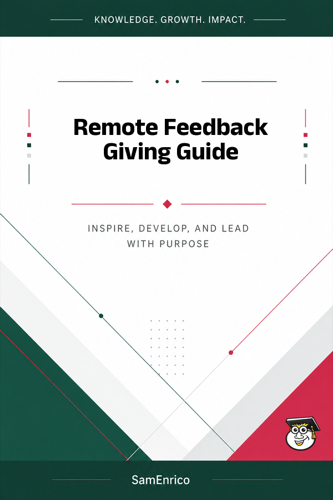
Non-FictionSelf-HelpFeedback Skills
Remote Feedback Giving Guide eBook
Deliver constructive criticism and praise effectiv
Deliver constructive criticism and praise effectively through digital channels.
Formats
Free sample
Chapter 1: The Radical Candor Trap--–- Kim Scott’s famous framework changed how managers think about feedback. She gave us the language of “care personally” and “challenge directly” – two axes that create four quadrants ranging from Radical Candor (high care, high challenge) to Obnoxious Aggression (low care, high challenge) to Ruinous Empathy (high care, low challenge) to Manipulative Insincerity (low care, low challenge). The goal, of course, is to live in Radical Candor: to care enough about someone that you’re willing to tell them the hard truth, and to challenge them directly enough that they actually improve.That framework works beautifully in person. I’ve used it. You’ve probably used it.
When you’re sitting across from someone, when you can see their eyes soften or tense, when you can reach out and touch their arm if they start to cry – Radical Candor is the gold standard.But here’s the problem nobody is talking about.Radical Candor crashes the moment you move it to digital channels. Not because the framework is wrong. Because the assumptions it makes about human connection don’t survive the journey from the conference room to the Zoom room.I learned this the hard way.Three years ago, I was managing a distributed team of fourteen people across six time zones. I had read Radical Candor cover to cover. I had dog-eared the pages.
I had preached its gospel to anyone who would listen. And when one of my best engineers started missing deadlines, I decided to practice what I preached.I sent him a Slack message.“Hey, I’ve noticed you’ve missed the last two sprint commitments. I need you to be more transparent about your capacity. Let me know what’s going on.”I thought I was being radically candid. I thought I was challenging him directly because I cared personally.
I had even added a smiley face at the end. A smiley face!He didn’t respond for six hours. When he did, it was a single sentence: “Noted. I’ll do better.”Three weeks later, he resigned. In his exit interview, he said something I will never forget: “I thought you were building a case to fire me.
Every message felt like documentation, not coaching.”That was the moment I realized: Radical Candor assumes non-verbal communication. Without it, your “caring challenge” looks exactly like “preparing for termination.”This chapter is about why that happens – and how to fix it. We’re going to break down the Radical Candor matrix, identify exactly where it breaks in remote environments, and build a new set of rules that work when you can’t read someone’s face.The Four Quadrants, Revisited Before we can understand why Radical Candor breaks, we need to understand what it’s supposed to do.Kim Scott’s framework is deceptively simple. Two questions determine where any feedback falls:Do you care personally about this person? (The vertical axis)Do you challenge them directly?
(The horizontal axis)The answers create four quadrants.Radical Candor (High Care + High Challenge) – This is the goal. You care about the person as a human being, and you’re willing to tell them the hard truth because that’s what caring actually looks like. Example: Pulling a direct report aside after a presentation and saying, “You’re better than that deck. The data was solid, but your delivery was flat. Let me help you practice for the next one.”Ruinous Empathy (High Care + Low Challenge) – This is what happens when you care too much to tell the truth.
You don’t want to hurt anyone’s feelings, so you say nothing while they fail. Example: Watching an employee struggle for months, telling yourself they’ll figure it out, and then being “surprised” when they get put on a performance improvement plan.Obnoxious Aggression (Low Care + High Challenge) – This is the bully’s quadrant. You challenge people, but you don’t care how it lands. You think you’re being “direct” and “honest,” but you’re actually being cruel. Example: Publicly announcing in a team meeting, “That was the worst analysis I’ve ever seen.
Do it again.”Manipulative Insincerity (Low Care + Low Challenge) – This is the office politician’s quadrant. You don’t care about people, and you won’t challenge them directly. Instead, you gossip behind their backs, give passive-aggressive feedback, and build paper trails to cover yourself. Example: Saying “Great work” to someone’s face and then telling their manager they’re failing behind closed doors.In person, the goal is clear: move everyone toward Radical Candor. Build relationships so you care personally.
Practice directness so you can challenge honestly.But here’s what Scott doesn’t tell you – because she couldn’t have predicted the pandemic-era remote work explosion.The quadrants shift when you move online.Why Caring Personally Gets Harder on Screens Let’s start with the vertical axis: caring personally.In an office, caring personally happens automatically in small ways. You notice when someone looks tired and ask if they’re okay. You grab coffee with a new hire to learn about their life outside work. You hear someone mention their kid’s soccer game on Monday, and on Wednesday you ask how it went. You see a team member sitting alone at lunch and invite them to join.These micro-interactions build the bank account of trust.
They signal “I see you as a human, not just a role.”Remote work strips almost all of them away.You don’t see tired eyes on Zoom unless someone’s lighting is terrible. You don’t grab virtual coffee unless you schedule it – and scheduled coffee feels like a meeting, not a connection. You don’t overhear personal details because there’s no open-plan office to overhear in. You don’t see someone sitting alone because the only way to know they’re alone is if they tell you.The result is what I call the Visibility Gap. Your team members become smaller on your screen than they would be in your peripheral vision.
Their humanity becomes something you have to deliberately remember, not something you absorb by simply being near them.This isn’t anyone’s fault. It’s a feature of the medium. But it has devastating consequences for feedback.When an employee perceives that you care less about them personally (even if you actually care just as much), two things happen. First, they become more sensitive to criticism. A comment that would feel like coaching in person feels like condemnation online.
Second, they become less likely to ask for help or admit mistakes. If you don’t care about them, why would they be vulnerable with you?I saw this play out with a manager I was coaching. Let’s call her Priya. Priya managed a designer named Marcus. Marcus’s work was good, but he was consistently late on deadlines.
In person, Priya would have walked over to Marcus’s desk and said, “Hey, I’m noticing the timing thing. What’s going on?” And Marcus would have said, “Honestly, I’m struggling with the new project management tool. I keep losing track of tickets.” And they would have…
This is the end of the free sample. Get the eBook to keep going. Buy now
About this book
Details
- Author
- Blevins Lurlene
- Publisher
- SamEnrico
- Language
- English
- Genre
- Non-Fiction, Self-Help, Feedback Skills
- Released
- 2026-06-10
- Pages (approx.)
- 118
- Available as
- eBook, Audiobook

Read better in the ZLOADR app
Your eBooks on your phone or tablet. Sign in with your SamEnrico account and start reading.
More by Blevins Lurlene
 Immigration Detention Dream TraumaBlevins Lurlene$11.99
 Sexual Sobriety Circle Plan WorkbookBlevins Lurlene$11.99
 PMS Social Withdrawal WorkbookBlevins Lurlene$11.99
 Dreams After Vicarious TraumaBlevins Lurlene$11.99
 The Navigator and the Storm: A Love Lost in the PacificBlevins Lurlene$11.99
 Scorched Earth: The Great Fire That Forged a KingdomBlevins Lurlene$11.99
 Creative ProducerBlevins Lurlene$11.99
 Understanding Heart Tumor of The ChildBlevins Lurlene$17.99
 Dubai International Student HandbookBlevins Lurlene$12.99
 How to Start a Celestine Pit Business (Beginners Guide)Blevins Lurlene$11.99
You may also like
 Hong Kong Handover 1997Dunn Johnnie$11.99
 Zumba For Postnatal Recovery CourseNeal Christian$11.99
 Zumba for BeginnersLadner Nikia$11.99
 YouTube Comment Mining GuideHumes Pandora$12.99
 Worry Box MeditationCarlin Rudy$11.99
 Workplace Stress MeditationNguyen Lynn$11.99
 Workplace Stress and Sleep RepairHawley Ivory$11.99
 Workplace Perfectionism CureDelaney Jeffry$11.99
 Workplace Injustice Anger GuideWallen Isabelle$11.99
 Work Addiction and Burnout LinkGreenwood Ester$11.99
 Women in Yoga and WellnessBeattie Galina$11.99
 Women in Stand Up ComedyChun Evangeline$11.99