
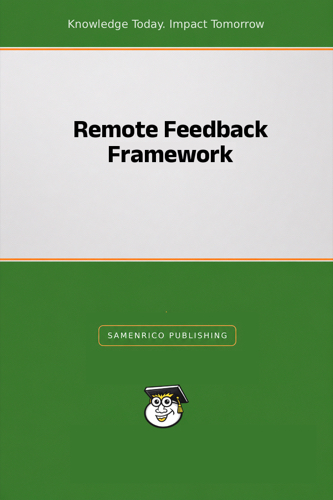
Remote Feedback Framework eBook
Give constructive criticism and receive feedback e
Give constructive criticism and receive feedback effectively through screens.
Formats
Free sample
Chapter 1: The 11 PM Slack--–- Maya’s hands were shaking. Not from caffeine, not from cold, but from three sentences on her laptop screen. The message had arrived at 10:47 PM on a Tuesday, sandwiched between an automated server notification and a calendar reminder for a team meeting she had forgotten to accept. Her manager, David, had written: “Hey, quick question. Can we hop on a call tomorrow about the Q3 forecast?
Nothing urgent, just want to align on a few things. Thanks.”On the surface, the message was harmless. Polite, even. David had said “nothing urgent.” He had said “thanks.” He had used a period instead of an exclamation point, which in the unspoken grammar of Slack usually indicated calm professionalism. And yet, Maya’s heart was pounding.
Her stomach had dropped as if she had just missed a step on a staircase. She stared at the words for ninety seconds, rereading them in seven different tones: Was it a trap? Was “align” code for “you messed up”? Was “quick question” code for “I’ve been documenting your failures for six weeks”?She did not sleep well that night. She replayed every Q3 forecast conversation from the previous month, searching for the mistake she must have made.
She drafted four different defensive explanations in her head, each one more elaborate than the last. By the time the video call started at 9 AM, she had already concluded that she was probably being put on a performance improvement plan, that David had lost confidence in her, and that she should update her resume over the weekend.The call lasted eleven minutes. David wanted to adjust a single assumption about seasonal demand. That was it. “Great work on the forecast, by the way,” he added as they were wrapping up.
“Just needed to tweak that one input.”Maya smiled, said “no problem,” and ended the call. Then she closed her laptop and cried.Not because she was sad. Because she was exhausted. Her brain had spent nine hours preparing for a catastrophe that never came. And the cruelest part?
She knew it was irrational. She knew David was a reasonable person. She knew “nothing urgent” probably meant nothing urgent. But knowing did not stop the cortisol. Knowing did not stop the 10:47 PM spiral.
Knowing did not turn off the alarm bells that had been installed in her nervous system long before she had ever heard the word “Slack.”Maya is not weak. She is not anxious by nature. She is not a person who cries in the office bathroom or obsesses over email tone. She is a high-performing senior analyst with seven years of experience and consistently excellent reviews. And she is also the rule, not the exception.The 93 Percent A 2023 study by the Workforce Institute at UKG surveyed 3,400 remote and hybrid workers across ten countries.
The headline finding was so startling that the researchers ran the analysis twice: 93 percent of remote workers reported higher anxiety over written feedback than face-to-face criticism. Not “slightly higher.” Not “sometimes higher.” Overwhelmingly, consistently, across cultures and industries and job levels, the same pattern emerged. A critical message on a screen felt worse than a critical conversation in person.Let that sink in. The vast majority of people would rather be criticized to their face than read criticism on a screen. That is not intuitive.
In person, someone can raise their voice. In person, someone can loom over you. In person, there is real physical presence and real social stakes. And yet, given the choice between a difficult conversation in the same room and a difficult message on a screen, nine out of ten people choose the room.Why? The answer is not about the content of the feedback.
It is about the absence of context.When you receive criticism in person, your brain has access to a flood of unconscious data. You see the other person’s posture. Are they leaning forward (engagement) or leaning back (distance)? You see their face. Are their eyebrows slightly raised (curiosity) or furrowed (anger)?
You hear their voice. Is it lower than usual (serious) or higher than usual (nervous)? You feel the room. Is the door open (transparency) or closed (secrecy)?Your brain processes all of this information in milliseconds, long before your conscious mind has even registered the words being spoken. This is not a skill you learned at work.
This is evolution. For hundreds of thousands of years, human survival depended on accurately reading the intentions of other humans. Is that person approaching with a weapon or a gift? Is that tone a warning or a welcome? Your brain is a prediction engine, constantly scanning for threat, constantly updating its model of the social world based on every tiny cue.On a screen, most of those cues disappear.The Distortion Mirror Think of your laptop screen as a kind of funhouse mirror.
It does not reflect reality. It reflects a distorted version of reality, one that strips away warmth and amplifies ambiguity. When David wrote “Can we hop on a call tomorrow?” Maya could not see his face. She could not hear his voice. She could not see the stack of papers on his desk or the coffee cup in his hand or the calendar full of back-to-back meetings that had left him no time to write a longer message.
All she saw were twelve words on a white background. And her brain, desperate for context, invented its own.This is the first and most important truth of remote feedback: The screen does not transmit information neutrally. It actively distorts it.In psychology, this is known as the “negativity bias in text-based communication.” (We will explore the full science in Chapter 2.) For now, understand this simple mechanism: when your brain encounters ambiguous social information, it defaults to the most threatening possible interpretation. This is not pessimism. This is protection.
Your brain would rather prepare for a threat that never arrives than be caught off guard by a threat it did not see coming. From an evolutionary perspective, false positives (assuming danger when there is none) are cheap. False negatives (assuming safety when there is danger) can be fatal.On a screen, almost all social information is ambiguous. The person who writes “OK” could be agreeing, dismissing, or seething. The person who writes “Thanks for sharing” could be grateful, sarcastic, or simply out of things to say.
The person who writes “Let’s chat tomorrow” could be excited about your idea or preparing to fire you. Your brain does not know. So your brain assumes the worst.This is not a flaw in your character. It is a feature of your biology. And it is the single biggest obstacle to effective remote feedback.The Four Pillars This entire book is built on a foundation of four principles, each one designed to counteract a specific distortion caused by the screen.
Think of these pillars as the operating system for every technique, script, and framework that follows. If you forget everything else, remember these four.Pillar One: Intentionality over Habit In an office, feedback often happens by accident. Someone stops by your desk on the way to the printer. You ride the…
This is the end of the free sample. Get the eBook to keep going. Buy now
About this book
Details
- Author
- Traylor Johnathon
- Publisher
- SamEnrico
- Language
- English
- Genre
- Non-Fiction, Self-Help, Feedback Skills
- Released
- 2026-06-07
- Pages (approx.)
- 150
- Available as
- eBook, Audiobook

Read better in the ZLOADR app
Your eBooks on your phone or tablet. Sign in with your SamEnrico account and start reading.
More by Traylor Johnathon
 Hal Sutton Challenger MemoirTraylor Johnathon$11.99
 TM Siddhi Program BasicsTraylor Johnathon$11.99
 Mayor of the Tech HubTraylor Johnathon$11.99
 Small Talk for ReunionsTraylor Johnathon$11.99
 Crowns & Consequences: The Royal Scandals That Shook the 21st CenturyTraylor Johnathon$11.99
 The Bone Hunters of the Dordogne: Uncovering Europe's First AncestorsTraylor Johnathon$11.99
 Takt Time Scheduling GuideTraylor Johnathon$12.99
 Kuda Bank YC Application TipsTraylor Johnathon$12.99
 Spacecraft Telemetry AnalysisTraylor Johnathon$11.99
 Understanding Cleft Palate Colobomata Radial Synostosis DeafnessTraylor Johnathon$17.99
 How to Become a Chain-testing-machine OperatorTraylor Johnathon$11.99
You may also like
 The Feedback Delivery HandbookShepherd Lorilee$11.99
 Remote Feedback Giving GuideBlevins Lurlene$11.99
 Feedback Reception ConfidenceStack Kasi$11.99
 Presentation Feedback IntegrationDunbar Maple$11.99
 Giving and Receiving FeedbackMallory Oda$11.99
 Teen Criticism AcceptanceJacobsen Emery$11.99
 Small Talk for Performance ReviewsBarry January$11.99
 Delivering Negative FeedbackVail Kelle$11.99
 Assertive Feedback Delivery GuideCallaway Merrilee$11.99
 The Feedback ConversationMccray Phyliss$11.99
 Remote Feedback Delivery GuideDodge Billy$11.99
 EQ Feedback Reception GuideBethel Monnie$11.99