
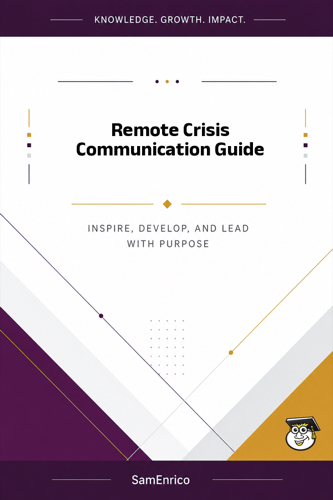
Non-FictionSelf-HelpCrisis Management
Remote Crisis Communication Guide
Respond quickly and clearly to emergencies when te
Respond quickly and clearly to emergencies when teams are scattered.
Formats
About this book
Free sample
Chapter 1: The Scattered Sentinel...--–- The 2:14 AM notification arrives not as a ringing phone but as a vibration against a nightstand, a Slack ping on a silenced laptop, or worst of all—nothing at all. Somewhere in a data center, a server has overheated. Somewhere in a supply chain, a shipment has been contaminated. Somewhere on social media, a video is going viral that will cost the company millions. The crisis has begun, but the team meant to respond is scattered across seventeen time zones, six continents, and an unknowable number of coffee shops, home offices, and commuter trains.
The physical war room—that reliable, if chaotic, hub of traditional crisis management—does not exist. In its place is a digital architecture of apps, alerts, and anxious silence. This is the new reality of remote crisis communication, and most organizations are dangerously unprepared for it.The traditional crisis communication model was built for a world where employees arrived at the same building, sat in the same conference rooms, and could be assembled within minutes by a raised voice or a shouted name across an open floor plan. That world no longer exists for a growing number of organizations. Remote and hybrid work have transformed not just where people work but how information flows, how decisions are made, and how emergencies escalate or dissipate.
The conference call after the meeting—that familiar sequence where dispersed employees first hear about a crisis through informal channels, then wait for a scheduled update, then scramble to catch up—is a failure mode, not a plan. By the time the call happens, rumors have already spread, stakeholders have already called, and the organization has already lost control of its own narrative.This chapter introduces the foundational concepts that will guide every subsequent chapter of this book. It begins by examining why remote crisis communication is fundamentally different from its traditional counterpart, not merely a digital overlay on an analog process. It then presents the four pillars of remote crisis communication—Speed, Verification, Visibility, and Transparency—each of which will be explored in depth throughout the following chapters. Finally, it…
This is the end of the free sample. Get the eBook to keep going. Buy now
Contents
- Chapter 1
- Chapter 2
- Chapter 3
- Chapter 4
- Chapter 5
- Chapter 6
- Chapter 7
- Chapter 8
- Chapter 9
- Chapter 10
- Chapter 11
- Chapter 12
Details
- Author
- Flanagan Shana
- Publisher
- SamEnrico
- Language
- English
- Genre
- Non-Fiction, Self-Help, Crisis Management
- Released
- 2026-06-11
- Pages (approx.)
- 139
- Available as
- eBook, Audiobook

Read better in the ZLOADR app
Your eBooks on your phone or tablet. Sign in with your SamEnrico account and start reading.
More by Flanagan Shana
 Dreams After Religious TraumaFlanagan Shana$11.99
 Sexual Addiction Withdrawal Symptoms HandbookFlanagan Shana$11.99
 PMS And Alcohol SensitivityFlanagan Shana$11.99
 Hypnotic Dream Rehearsal GuideFlanagan Shana$11.99
 The Brain Scouts of Lake Turkana: Unlocking Africa's Cognitive SecretsFlanagan Shana$11.99
 Silicon Shoguns: The Tech Tycoons Who Redefined JapanFlanagan Shana$11.99
 Renewable Energy Cybersecurity OutlookFlanagan Shana$12.99
 Australian PR For International Students HandbookFlanagan Shana$12.99
 A Beginners Guide to Caribbean Poker (Volume 1)Flanagan Shana$11.99
 Understanding Hellp SyndromeFlanagan Shana$17.99
 Director of Cyber SecurityFlanagan Shana$11.99
You may also like
 Hong Kong Handover 1997Dunn Johnnie$11.99
 Zumba For Postnatal Recovery CourseNeal Christian$11.99
 Zumba for BeginnersLadner Nikia$11.99
 YouTube Comment Mining GuideHumes Pandora$12.99
 Worry Box MeditationCarlin Rudy$11.99
 Workplace Stress MeditationNguyen Lynn$11.99
 Workplace Stress and Sleep RepairHawley Ivory$11.99
 Workplace Perfectionism CureDelaney Jeffry$11.99
 Workplace Injustice Anger GuideWallen Isabelle$11.99
 Work Addiction and Burnout LinkGreenwood Ester$11.99
 Women in Yoga and WellnessBeattie Galina$11.99
 Women in Stand Up ComedyChun Evangeline$11.99