
Non-FictionSelf-HelpCreativity
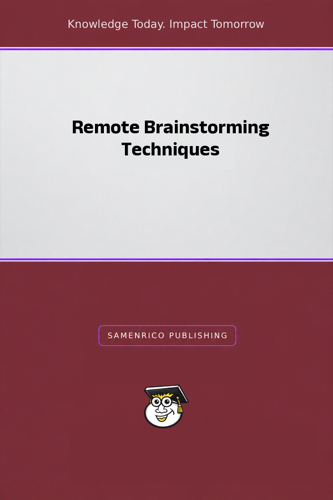
Remote Brainstorming Techniques eBook
Facilitates creative digital collaboration.
Facilitates creative digital collaboration.
Formats
Free sample
Chapter 1: The Three D's...--–- The Zoom call had been running for forty-seven minutes. Fourteen people stared into their cameras—or, more accurately, stared slightly below their cameras, at their own faces, at their email inboxes, at the Slack notification that just pinged. The facilitator, a well-intentioned director of product named Marcus, had started with high hopes. "Let's brainstorm some solutions to the Q3 retention problem," he'd said. He'd shared a blank Miro board.
He'd said the magic words: "No bad ideas."Then came the silence.Not the productive kind. Not the thoughtful, contemplative silence of minds at work. This was the hollow, anxious silence of fourteen people waiting for someone else to go first. Marcus filled the void by offering his own idea. Three other senior leaders followed.
A junior designer typed "I like that" in the chat and never spoke again. Forty-seven minutes later, they had exactly four ideas—all variations of Marcus's first suggestion—and a shared, unspoken agreement never to do that again.This actually happened. I've changed the names and the company, but the scene is real. I know because I was Marcus.For years, I believed that creativity was about freedom. Remove constraints, lower the stakes, tell people "no bad ideas," and the magic would happen.
I ran dozens of brainstorms exactly like the one above, and when they failed—as they almost always did—I blamed the team. "Not creative enough." "Too risk-averse." "Remote work just doesn't work for brainstorming."I was wrong. The problem wasn't my teams. The problem was my complete misunderstanding of how creativity works in a distributed environment. And after studying the science, testing dozens of techniques across hundreds of sessions, and interviewing facilitators at companies ranging from startups to Fortune 50s, I've learned a hard truth: the traditional unstructured brainstorm is not just ineffective remotely—it's actively destructive.
It trains teams to disengage. It reinforces hierarchy. And it leaves everyone feeling less creative than when they started.This chapter is about why that happens. We'll dismantle the myths that have infected remote collaboration for the past five years. We'll name the real enemies—the Three D's of Remote Failure—and we'll draw a critical distinction that will underpin every technique in this book: the difference between Bad Silence and Good Silence.
By the end of this chapter, you'll understand why your past brainstorms have failed, and you'll be ready for the solution that the rest of the book delivers.The Great Misconception: Freedom Creates Creativity The myth is seductive in its simplicity. Put smart people in a room—or on a Zoom call—give them an open-ended problem and a blank whiteboard, and step back. Ideas will emerge like flowers from fertile soil. This is the "release the pressure valve" theory of creativity, and it has dominated corporate practice for decades.It's also catastrophically wrong.The scientific literature on creativity tells a different story. In study after study, researchers have found that unstructured brainstorming groups perform worse than individuals working alone.
A meta-analysis published in the Journal of Applied Psychology reviewed fifty years of brainstorming research and found that the "traditional brainstorming group" was the least productive condition tested—less productive than individuals working in isolation, less productive than groups given specific constraints, and less productive than groups using structured turn-taking protocols.Why? Because creativity doesn't emerge from the absence of structure. It emerges from the right kind of structure. Constraints force cognitive novelty. Time limits create urgency.
Turn-taking rules prevent dominance. Visual frameworks externalize thinking. When you remove all structure, you don't get freedom—you get social anxiety, production blocking, and evaluation apprehension.The remote environment amplifies every single one of these problems. In person, a skilled facilitator can read the room, make eye contact, and use physical presence to coax participation. On a Zoom call, those tools vanish.
What remains is a flat grid of faces, a laggy connection, and the siren song of the second monitor.This is why my early brainstorms failed. I was trying to replicate the in-person experience—with all its implicit structure—on a platform that stripped away every implicit cue. I thought I was giving my teams freedom. In reality, I was giving them a vacuum.The Three D's of Remote Failure After analyzing dozens of failed remote brainstorms and interviewing facilitators who had run hundreds more, I identified three recurring failure modes. I call them the Three D's: Distance, Distraction, and Disinhibition.
Each one is a predictable byproduct of remote collaboration, and each one must be explicitly managed. Left unaddressed, they will kill any brainstorm before it starts.D #1: Distance – The Proximity Problem Physical proximity is not just about convenience. It's about a phenomenon called "emotional contagion"—the automatic transfer of mood and energy between people through facial expressions, posture, and tone of voice. In a physical room, when one person leans forward with excitement, others unconsciously mirror that posture. When someone laughs, laughter spreads.
This contagion happens in milliseconds, below the level of conscious awareness.On a Zoom call, emotional contagion is severely blunted. You can't see most people's bodies. You can't tell if someone is leaning in or slouching back. The grid of faces is small and uniform, stripping away the subtle cues that communicate enthusiasm, confusion, or doubt. The result is a flattening of emotional energy.
Excitement doesn't spread. Neither does urgency. The group's collective emotional temperature drifts toward neutral—which, in a brainstorming context, feels like apathy.Worse, distance removes the social accountability that comes from being physically present. In a conference room, it's awkward to check your phone while someone is speaking. On a Zoom call, it's trivial.
The camera might be off, or pointed at your forehead, or replaced by a profile picture. The cost of disengagement is near zero.This is the first D: Distance doesn't just make collaboration harder—it makes caring harder. And brainstorming without emotional investment is just people typing words on sticky notes.D #2: Distraction – The Partial Attention Epidemic The average knowledge worker switches tasks every three minutes, according to research from the University of California, Irvine. Each switch costs about twenty-three minutes to fully recover focus. Now consider what happens during a remote brainstorm.
One participant is muted, scanning email. Another is typing in Slack. A third is responding to a text message. A fourth—the most honest one—has admitted to me in a post-session interview that they were loading the dishwasher.This isn't a moral failing. It's a design flaw in the remote work environment.
The physical office, for all its flaws, provided a container for attention. When you were in the conference room, you were in the conference room. Your phone might buzz, but the social cost of checking it was high. On Zoom, that container disappears. Your workspace is also your kitchen, your living room, your bedroom.
The boundaries between "meeting" and "everything else" are porous.I call this the Partial Attention Epidemic, and it's the second D. In a remote brainstorm, no one is fully present—not because they don't want to be, but because the environment actively fragments attention. And here's the cruel irony: the more fragmented your attention, the more anxious…
This is the end of the free sample. Get the eBook to keep going. Buy now
About this book
Details
- Author
- Fusco Merrill
- Publisher
- SamEnrico
- Language
- English
- Genre
- Non-Fiction, Self-Help, Creativity
- Released
- 2026-06-06
- Pages (approx.)
- 153
- Available as
- eBook, Audiobook

Read better in the ZLOADR app
Your eBooks on your phone or tablet. Sign in with your SamEnrico account and start reading.
More by Fusco Merrill
 Rower Self Hypnosis GuideFusco Merrill$11.99
 Group Creative Momentum GuideFusco Merrill$11.99
 Canva Brand Kit Creation GuideFusco Merrill$11.99
 Self Hypnosis for Post Surgical PainFusco Merrill$11.99
 Phobia Exposure Therapy GuideFusco Merrill$11.99
 Nap Before Presentation GuideFusco Merrill$11.99
 Acupuncture for Elderly HealthFusco Merrill$11.99
 The Star of Alexandria: Hypatia's Legacy of LightFusco Merrill$11.99
 The Burning of the Biltmore: Colombia's Prohibition-Era Arson Conspiracy (1928)Fusco Merrill$11.99
 How to Produce PiñatasFusco Merrill$11.99
 Squirrel Monkeys: Small PrimateFusco Merrill$11.99
 How to Produce Deodorant and Anti-perspirantFusco Merrill$11.99
You may also like
 Hong Kong Handover 1997Dunn Johnnie$11.99
 Zumba For Postnatal Recovery CourseNeal Christian$11.99
 Zumba for BeginnersLadner Nikia$11.99
 YouTube Comment Mining GuideHumes Pandora$12.99
 Worry Box MeditationCarlin Rudy$11.99
 Workplace Stress MeditationNguyen Lynn$11.99
 Workplace Stress and Sleep RepairHawley Ivory$11.99
 Workplace Perfectionism CureDelaney Jeffry$11.99
 Workplace Injustice Anger GuideWallen Isabelle$11.99
 Work Addiction and Burnout LinkGreenwood Ester$11.99
 Women in Yoga and WellnessBeattie Galina$11.99
 Women in Stand Up ComedyChun Evangeline$11.99