
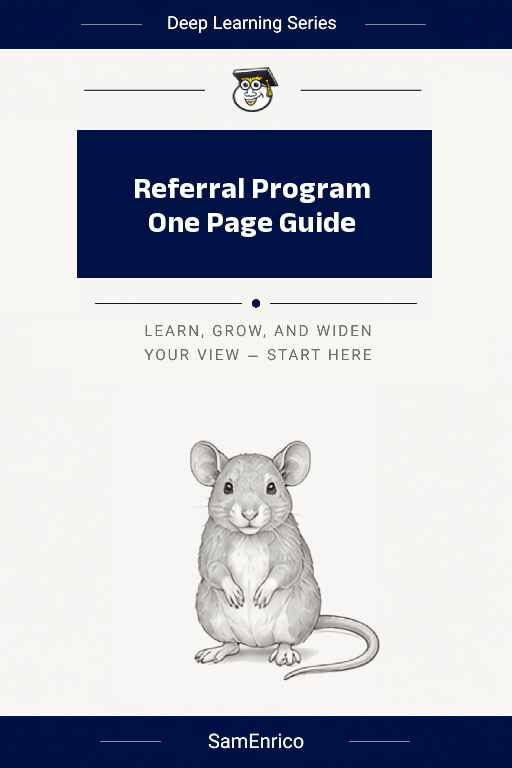
Non-FictionBusiness BriefReferral Marketing
Referral Program One Page Guide eBook
Design customer referral program on one sheet cove
Design customer referral program on one sheet covering incentives mechanics and tracking. Launch with email to top ten percent of customers first.
Formats
Free sample
Chapter 1: The Complexity Trap--–- In 2018, a mid-sized B2B software company called Swift Stack did something that most entrepreneurs would consider rational. They had a product that customers loved. Their Net Promoter Score was 72, which put them in the same league as Apple and Costco. Their churn rate was below 3 percent. By every conventional metric, they had achieved the dream: happy customers who stayed for years.So they decided to build a referral program.The head of marketing, a Yale MBA named Sarah, approached the project with the same rigor she would apply to any major initiative.
She created a cross-functional team. She interviewed twenty customers. She benchmarked against fifteen competitors. She wrote a forty-seven page requirements document that specified six reward tiers, three different sharing mechanisms, a points-based gamification system, and a manual approval process for high-value referrals.The engineering team spent four months building it. The design team created a twelve-page PDF explaining the rules.
The legal team wrote eight hundred words of terms and conditions. The total investment, including salaries and software licenses, was just over two hundred thousand dollars.The program launched on a Tuesday. By Friday, exactly three customers had used it. Two of those three had referred people who were already customers. The third had referred his own alternate email address to claim the reward twice.Six months later, the program had generated seven net new customers at a cost of roughly twenty-eight thousand dollars each.
Swift Stack quietly shut it down. Sarah left the company three months after that. In her exit interview, she said something that should haunt every marketer who reads this book: "I guess referrals just don't work for our industry."She was wrong. Referrals work for every industry. What does not work is complexity.This book exists because of a simple observation I have made across more than two hundred referral program audits: the programs that fail are almost never the ones with bad products or unhappy customers.
They are the ones with too many rules, too many options, and too many pages. The programs that succeed can fit on a single sheet of paper.The Paradox of Choice in Referral Marketing Let us begin with a story that every reader of this book already knows in their bones. You have been to a restaurant with a menu that spans six pages. There are appetizers, small plates, entrees, chef specials, market selections, and a separate gluten-free menu. There are twelve types of salad.
There are twenty-seven pasta dishes. By the time the waiter arrives, you cannot remember what you wanted. You order the same thing you always order. The restaurant spent enormous energy creating options that you ignored.Barry Schwartz, a psychologist at Swarthmore College, spent two decades studying this phenomenon. His book, The Paradox of Choice, makes a counterintuitive argument that most people initially resist but eventually accept: more choice does not make people happier.
It makes them paralyzed, anxious, and less likely to choose at all. In one famous study, shoppers at a gourmet food store were offered a display of twenty-four exotic jams. Sixty percent of shoppers stopped to look. But only three percent bought anything. On another day, the same store offered a display of six jams.
Forty percent of shoppers stopped, and thirty percent bought. Six jams outsold twenty-four jams by a factor of ten.This is not a quirk of jam shoppers. It is a feature of human cognition. When presented with too many options, the brain enters what Schwartz calls "choice overload." The energy required to evaluate options exceeds the perceived benefit of making a choice. So the brain does the most efficient thing available: it chooses nothing.Now apply this to referral programs.A typical "sophisticated" referral program might offer the following: refer one friend and get ten dollars off your next purchase.
Refer three friends and get twenty dollars off. Refer five friends and get a free product. Refer ten friends and get a year of free shipping. Your best customers, the ones you most want to refer, receive an email explaining all of this across five paragraphs. They have to remember which tier they are in.
They have to track their own progress. They have to decide whether to send one link or three or five or ten.What do they do? Most of them do nothing. Not because they do not love your product. Not because they do not want to help their friends.
But because the program itself is a cognitive burden they did not ask for and do not have time to solve.The Swift Stack program had six reward tiers. The highest tier offered a twelve hundred dollar credit for referring twenty customers. Sarah thought this was motivating. In reality, it was paralyzing. Every customer who saw that email had to do a mental calculation: Am I the kind of person who can refer twenty people?
Probably not. So why bother with any of it?The winning referral programs understand a truth that the losing programs reject: simplicity scales. Complexity kills.The Core Finding from Made to Stick If you have ever wondered why some ideas spread and others die, you could do worse than to study the Heath brothers' book, Made to Stick. Chip and Dan Heath analyzed hundreds of successful ideas - urban legends, advertising campaigns, political slogans, product designs - and asked a simple question: what do the sticky ones have in common?Their answer came in six principles. But for the purpose of this book, one principle matters above all others: Simplicity.The Heaths argue that every sticky idea has a "core" - a single, stripped-down, irreducible message that can survive the journey from one brain to another.
Finding that core is not about dumbing down. It is about prioritizing. It is about asking: If I could only communicate one thing, what would it be?For Southwest Airlines, the core is: "We are the low-fare airline." Everything else - no meals, no assigned seats, quick turnarounds - flows from that core. For the United States Marine Corps, the core is: "Improvise, adapt, overcome." For the referral programs that work, the core is something like this: "Share a link. Your friend saves.
You save. Done."Notice what that core does not include. It does not include tiered rewards. It does not include points. It does not include gamification badges.
It does not include a leaderboard. It does not include a long explanation of terms and conditions. It does not include a comparison of reward options.All of those things can be added later, after the core habit is established. But if you add them before the habit exists, you are not building a referral program. You are building a puzzle.
And most people do not want to solve puzzles when they are trying to help their friends.The minimalist e-commerce program that generated thirty-four percent of all new customers did not have tiers, badges, or leaderboards. It had one reward: ten dollars off for the referrer when a friend made a purchase, and ten dollars off for the friend immediately. The entire program was explained in two sentences. The sharing mechanism was…
This is the end of the free sample. Get the eBook to keep going. Buy now
About this book
Details
- Author
- Hutcheson William
- Publisher
- SamEnrico
- Language
- English
- Genre
- Non-Fiction, Business Brief, Referral Marketing
- Released
- 2026-06-01
- Pages (approx.)
- 138
- Available as
- eBook, Audiobook

Read better in the ZLOADR app
Your eBooks on your phone or tablet. Sign in with your SamEnrico account and start reading.
More by Hutcheson William
 Vegan Social Media ComparisonHutcheson William$11.99
 Children's Dream ResearchHutcheson William$11.99
 Paint Fumes and VOC PreventionHutcheson William$11.99
 Chair Based Sarcopenia WorkoutHutcheson William$11.99
 Arthritis Support GroupsHutcheson William$11.99
 Mindful Driving MBSRHutcheson William$11.99
 Public Defender StressHutcheson William$11.99
 Bipolar JournalHutcheson William$11.99
 The Silent Depths: First Descent into the Mariana Trench’s Abyss (1521)Hutcheson William$11.99
 The Unbreakable Streak: How a College Pitcher Dominated the DiamondHutcheson William$11.99
 The Golden Voices: Black Opera's Divine TriumphHutcheson William$11.99
 The Dancer's Guide to Tranky DooHutcheson William$11.99
You may also like
 Hong Kong Handover 1997Dunn Johnnie$11.99
 Zumba For Postnatal Recovery CourseNeal Christian$11.99
 Zumba for BeginnersLadner Nikia$11.99
 YouTube Comment Mining GuideHumes Pandora$12.99
 Worry Box MeditationCarlin Rudy$11.99
 Workplace Stress MeditationNguyen Lynn$11.99
 Workplace Stress and Sleep RepairHawley Ivory$11.99
 Workplace Perfectionism CureDelaney Jeffry$11.99
 Workplace Injustice Anger GuideWallen Isabelle$11.99
 Work Addiction and Burnout LinkGreenwood Ester$11.99
 Women in Yoga and WellnessBeattie Galina$11.99
 Women in Stand Up ComedyChun Evangeline$11.99