
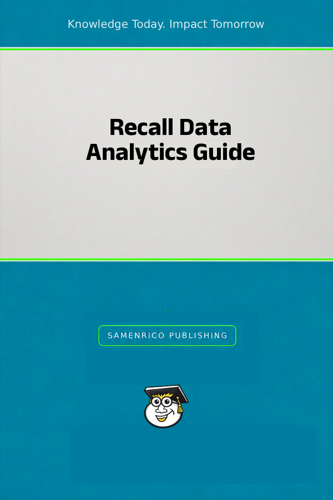
Recall Data Analytics Guide eBook
Use statistical methods to identify recall trends
by Sosa Tisha
Use statistical methods to identify recall trends and predict high risk categories.
Formats
Free sample
Chapter 1: The Hindsight Tax--–- On a crisp March morning in 2014, a senior quality manager at a major automotive supplier named Elena Vasquez stared at a spreadsheet that would forever change how she thought about product safety. The spreadsheet contained 47 warranty claims describing the same strange symptom: a faint grinding noise from the left front wheel assembly on vehicles manufactured during a specific seven-week period. The claims were buried among 12,000 other warranty filings that month—noise complaints, cosmetic issues, routine maintenance gripes. Her team had flagged them, as required, but no action was taken. The defect rate was still below the regulatory threshold.
Three months later, a family of four walked away from a highway rollover with minor injuries. Two weeks after that, another family was not so lucky.The part that haunted Elena was not the accident itself. It was that the data had tried to warn her. The 47 complaints represented a failure rate three standard deviations above the historical mean—a statistical signal that any control chart would have caught. But her department operated on thresholds, not trends.
They waited for failure rates to cross 1% before investigating. The grinding noise complaints never reached 0.8%. By the time the first wheel assembly separated from its hub on a wet interstate, the signal had been screaming for 114 days.This chapter is about why that happens—why organizations that excel at building physical products so often fail at reading the data those products generate. It is about the difference between looking backward and looking forward, between counting corpses and predicting the epidemic. And it introduces the central concept that will drive every subsequent chapter of this book: the Hindsight Tax.The Anatomy of a Preventable Catastrophe Every major recall carries within it a hidden arithmetic.
The direct costs—legal settlements, regulatory fines, replacement parts, logistics—are staggering. In 2014, General Motors spent over $4.1 billion on recall-related costs for the ignition switch defect that killed at least 124 people. Takata's airbag recall, the largest in automotive history, pushed the company into bankruptcy with liabilities exceeding $25 billion. In the food industry, the 2009 Peanut Corporation of America recall cost over $1 billion and resulted in federal criminal charges, including a 28-year prison sentence for the CEO.But these numbers, however large, are not the Hindsight Tax. They are simply the cost of failure.
The Hindsight Tax is something more insidious: it is the difference between what a company spends on reactive compliance and what it would have spent on predictive analytics, multiplied by the opportunities lost while waiting for failure to become undeniable.Consider the following thought experiment, which will appear throughout this book in various forms. Company A spends $10 million annually on traditional quality assurance: end-of-line testing, supplier audits, and a compliance team that tracks regulatory report deadlines. When a recall occurs—and statistically, it will—they spend an additional $50 million on legal fees, brand repair, and operational chaos. Over a decade, their total recall-related expenditure averages $15 million per year.Company B spends $12 million annually: the same $10 million on QA plus $2 million on a predictive analytics function staffed by three data scientists and a dedicated data engineer. Their recall costs drop to $10 million per event because they catch problems earlier, and events occur half as often.
Their ten-year average is $11 million per year. The $4 million annual difference is the Hindsight Tax. Over a decade, that is $40 million. Over an industry, it is billions.The tragedy is that most companies pay this tax without ever realizing it exists. They treat recalls as unavoidable actuarial events rather than as failures of prediction.
They invest in faster root cause analysis—which only tells you what you already know after the fact—instead of investing in early warning systems. They mistake compliance for safety. And they do this because their incentives are misaligned. Regulators punish failure to report. They do not punish failure to predict.Reactive Compliance vs.
Proactive Prediction The distinction between reactive compliance and proactive prediction is not merely semantic. It reflects two fundamentally different philosophies of risk management, and understanding this distinction is the first prerequisite for building a recall analytics capability.Reactive compliance is the dominant paradigm in most manufacturing industries. Under this model, organizations define acceptable quality limits (AQLs), conduct periodic sampling, and wait for defect rates to cross regulatory or contractual thresholds before taking action. The mental model is linear: produce, test, ship, monitor complaints, react if thresholds are exceeded. This approach has the virtue of simplicity and the vice of latency.
By the time a defect rate crosses a threshold, the problem has often been propagating through the production system for weeks or months.Proactive prediction inverts this logic. Instead of waiting for failure rates to become statistically significant, proactive systems continuously monitor leading indicators—not just defect counts, but the precursors to defects. A shift in supplier raw material composition. A recurring phrase in customer service transcripts. A temperature anomaly on a single production line.
These signals are often too weak to trigger a reactive threshold but, when aggregated and modeled, can predict recalls with surprising accuracy weeks or months in advance.The difference is best illustrated by a case study from the medical device industry, which we will revisit in Chapter 6. A manufacturer of implantable cardiac monitors noticed a subtle trend: complaints mentioning "intermittent signal loss" had increased from 0.3% to 0.7% of all customer contacts over six months. Under their reactive system, this was a non-event—the absolute numbers were tiny, and the percentage was still below their 1% alert threshold. However, a predictive model trained on three years of historical data flagged this as a high-risk pattern. The model had learned that intermittent signal loss complaints, when combined with a specific supplier batch of lithium batteries, preceded full device failure by an average of 84 days.
The company proactively recalled 15,000 devices. Seventeen patients were later found to have experienced early symptoms. Zero died. The reactive alternative—waiting for the 1% threshold—would have resulted in an estimated 120 serious adverse events.This is the promise of proactive prediction. It does not eliminate recalls entirely, nor should it.
Some failure modes are genuinely novel and unpredictable. But it dramatically reduces the severity of recalls by catching them in the tail of the distribution, before they become epidemics.The Probabilistic Mindset To shift from reactive to proactive, you must first shift how you think about uncertainty. Most engineers and quality professionals are trained in deterministic thinking. They want yes/no answers: Is this part within spec? Does this batch pass or fail?
This binary orientation is useful for manufacturing execution but disastrous for risk prediction.Probabilistic thinking, as Nate Silver articulated in The Signal and the Noise, accepts that all measurements contain uncertainty and that the best we can do is assign probabilities to different outcomes. A proactive recall system does not ask "Will this product fail?" It asks "What is the probability that this product fails within the next 90 days?" A 95% probability and a 5% probability demand different responses—but both demand a response.This shift is harder than it sounds. Human cognition is poorly adapted to probabilistic reasoning. We crave certainty. When a data scientist says "there is a 12% chance that this batch causes a Class…
This is the end of the free sample. Get the eBook to keep going. Buy now
About this book
Details
- Author
- Sosa Tisha
- Publisher
- SamEnrico
- Language
- English
- Genre
- Non-Fiction, Compliance & Risk Archive, Data Science
- Released
- 2026-06-09
- Pages (approx.)
- 144
- Available as
- eBook, Audiobook

Read better in the ZLOADR app
Your eBooks on your phone or tablet. Sign in with your SamEnrico account and start reading.
More by Sosa Tisha
 Self Hypnosis For Anxiety Trance GuideSosa Tisha$11.99
 Body Image Journal PromptsSosa Tisha$11.99
 Musician Dream Journal MethodSosa Tisha$11.99
 Rohingya Boat EscapeSosa Tisha$11.99
 Estonian Health Tech ExpansionSosa Tisha$11.99Estonian Health Tech ExpansionSosa Tisha$11.99
 Fiber Glucose Buffer GuideSosa Tisha$11.99
 London Pop Up Footfall AnalysisSosa Tisha$11.99
 Pete Buttigieg Mayor PeteSosa Tisha$11.99
 Neon Mirage: The AI That Predicted the 2008 CrashSosa Tisha$11.99
 The Silent Majority Speaks: How a Single Protest Ignited a RevolutionSosa Tisha$11.99
 The Last Pharaoh's DebtSosa Tisha$11.99