
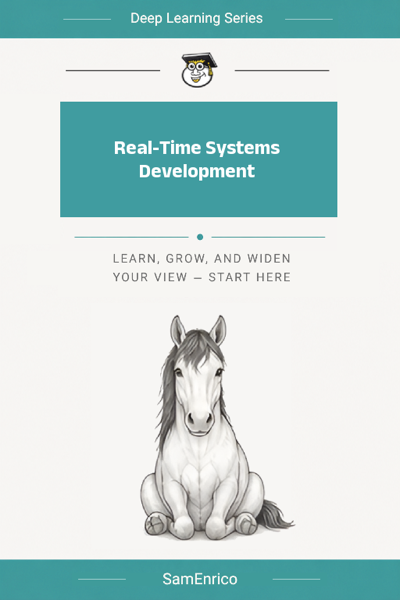
Real-Time Systems Development Audiobook
A Coursebook on Real-Time Systems Development
by Crow Moon
A Coursebook on Real-Time Systems Development
Formats
Free sample
Chapter 1: The Deadline Fallacy–- The young engineer stared at the oscilloscope, bewildered. His code was fast—blazingly fast, in fact. The processor finished all its work in under a millisecond, leaving 99% of the CPU idle. Yet the system had just failed catastrophically. A sensor reading was missed.
A control output arrived 500 microseconds too late. A motor overheated. The project manager’s question echoed in his ears: “How can a system that’s 99% idle miss a deadline?”That engineer was me, early in my career. And that question—innocent as it sounds—reveals the single most misunderstood concept in real-time systems development. It is the fallacy this chapter exists to dismantle.The Great Misconception Ask ten software engineers what “real-time” means, and nine will say “fast.” The tenth might say “low latency.” All ten would be wrong.Real-time does not mean fast.
It never has. A real-time system can be glacially slow by modern standards—a temperature sensor that samples once per second, a chemical plant controller that computes a new valve setting every hundred milliseconds, an automotive brake-by-wire system that reacts within ten milliseconds. None of these are “fast” in the way a 5 GHz gaming PC is fast. Yet all are real-time systems.What separates a real-time system from a general-purpose computing system is not speed. It is predictability.
More precisely, it is the ability to guarantee that a system will respond to an event within a specified deadline, every single time, under all legitimate operating conditions.Let that sink in. The defining characteristic of a real-time system is not how quickly it responds. It is the certainty that its response will never exceed a known upper bound. A slow but predictable system is real-time. A fast but occasionally jittery system is not.This distinction matters enormously because it changes everything about how we design, implement, and test software.
In a general-purpose system, we optimize for average-case performance. We want the UI to feel snappy, the database query to return quickly, the video to stream smoothly most of the time. A 99th percentile latency spike is acceptable.In a real-time system, average-case performance is almost irrelevant. The only metric that matters is the worst-case execution time—the longest possible time a piece of code could take to run, accounting for interrupts, cache misses, pipeline stalls, memory contention, and every other unpredictable aspect of modern computer architecture. If your worst-case time exceeds…
This is the end of the free sample. Get the Audiobook to keep going. Buy now
About this book
Details
- Author
- Crow Moon
- Publisher
- SamEnrico
- Language
- English
- Genre
- Non-Fiction, Informative, Educational
- Released
- 2026-05-11
- Pages (approx.)
- 146
- Available as
- eBook, Audiobook

Listen in the VoxFlicks app
Audiobooks and audio dramas wherever you go. Sign in with your SamEnrico account and press play.
More by Crow Moon
 Metta for a MiscarriageCrow Moon$11.99
 Guna Philosophy GuideCrow Moon$11.99
 Opioid Withdrawal Safety ManualCrow Moon$11.99
 Calm Driving Road Rage GuideCrow Moon$11.99
 Desert Dream SymbolCrow Moon$11.99
 The Automotive Engineer CreativityCrow Moon$11.99
 Yakuza Waste DisposalCrow Moon$11.99
 SEAL Sniper RecordCrow Moon$11.99
 Dubai Student Shopping GuideCrow Moon$12.99
 Vladimir Kara MurzaCrow Moon$11.99
 The Quantum Tide: How a Forgotten Ocean Voyage Unlocked the Secrets of the UniverseCrow Moon$11.99
 The Golden Scrolls of Timbuktu: Where Scholars Wrote the FutureCrow Moon$11.99