
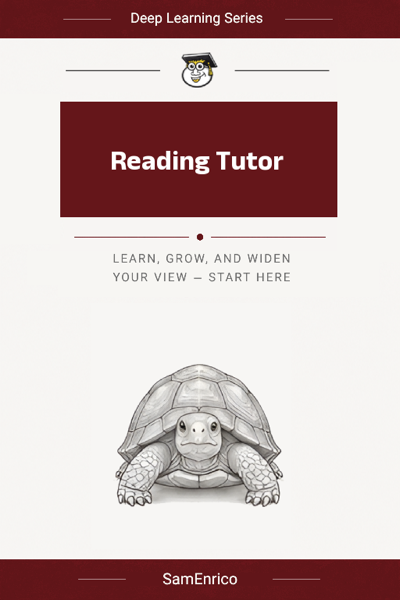
Non-FictionInformativeEducational
Reading Tutor eBook
A Coursebook on Reading Tutor
A Coursebook on Reading Tutor
Formats
Free sample
Chapter 1: The Bridge Not Built--–- On a Tuesday evening in March, a mother named Sarah watched her eight-year-old son, Leo, stare at a single sentence for forty-seven seconds. The sentence was “The dog ran fast.” Leo had read it yesterday. He had read it the day before. He had read it six times in the past week during their nightly homework ritual, a ritual that had become so painful that Sarah had started keeping a box of cheap wine in the pantry specifically for 7:15 PM. Leo was not a child with a diagnosed disability.
He was not “non-verbal” or “cognitively impaired” in any way that the school’s screening tests could detect. In fact, when the kindergarten teacher read aloud to the class, Leo could answer every comprehension question perfectly. He could retell the plot of a three-chapter book with the precision of a lawyer presenting evidence. But when Leo looked at print—black squiggles on a white page—something between his eyes and his brain failed to connect. His reading tutor, a well-meaning college sophomore named Brittany who had been hired through an online platform for thirty-five dollars an hour, had taught him one strategy and one strategy only.
When Leo got stuck, Brittany said three words. She said them brightly, cheerfully, as if she were offering a lollipop after a vaccine. She said: “Sound it out.”Forty-seven seconds. Leo sat there, mouth slightly open, index finger hovering under the word “fast.” He knew the letter F. He knew the letter A.
He knew the letters S and T. But the space between knowing letters and knowing a word—that space was not an inch. It was a canyon. And “sound it out” was not a bridge. It was a command to jump.This chapter is for every Brittany.
It is for every parent who has heard “sound it out” and watched their child’s eyes glaze over with shame. It is for every volunteer tutor in a church basement, every college student fulfilling service hours, every retired teacher coming back to the classroom because the crisis is real and no one else is showing up. This chapter is about why tutoring is different from teaching, why relationships are the soil in which reading skills grow, and why the most important thing you will ever do for a struggling reader has nothing to do with phonics. It has to do with trust, with shame, and with the radical act of becoming unnecessary.The Matthew Effect in Reading The sociologist Robert K. Merton coined the term “Matthew Effect” in 1968, drawing from the Gospel of Matthew: “For to every one who has will more be given, and he will have abundance; but from him who has not, even what he has will be taken away.” In reading science, the Matthew Effect describes a brutal and well-documented phenomenon: children who crack the code early read more, which makes them better readers, which makes them read even more, which makes them better readers still.
Children who do not crack the code early read less, fall behind, develop negative attitudes toward reading, and then read even less than that. The gap does not stay the same. It widens. By second grade, a struggling reader has already experienced thousands of moments of frustration, humiliation, and avoidance. By fourth grade, that same child has begun to identify as “not a reader,” an identity that can persist for decades even after the underlying decoding skill is eventually taught.The tutoring world is full of people who want to fix reading.
They buy flashcards. They download apps. They print worksheets from Teachers Pay Teachers. But most of them do not understand the Matthew Effect. They do not understand that when a fourteen-year-old boy slumps in his chair, crosses his arms, and says “I don’t care about reading,” he is not telling the truth.
He is showing you his scar tissue. That boy cared deeply about reading in first grade. He cared when he saw other kids finishing their books while he was still on page two. He cared when the teacher called on him and he mispronounced a word and five kids laughed. He cared when his mother looked at his report card with a face he could not interpret—was that disappointment?
Pity? Exhaustion? He cared so much that caring became unbearable. So he stopped. Not because he was lazy.
Not because he was defiant. Because caring, for him, had become synonymous with failure, and no human being can sustain that indefinitely.The Tutor vs. The Teacher Before we discuss a single instructional strategy, we must distinguish between the role of a classroom teacher and the role of a tutor. These roles are not the same. They share vocabulary and goals, but their constraints, freedoms, and responsibilities diverge in ways that fundamentally shape what is possible.A classroom teacher manages twenty-five to thirty-five students simultaneously.
She must follow a district-mandated pacing guide. She must administer standardized assessments. She must differentiate instruction across multiple ability levels with the same forty-five-minute block. She must manage behavior, collect data, attend meetings, respond to emails, and call parents—often all before lunch. When a teacher tells a struggling reader to “sound it out,” it is often not because she believes that is sufficient.
It is because she has twenty-four other children waiting and no other strategy that she can deploy in the five seconds available.A tutor has none of these constraints. You have one student. You have no pacing guide except the contours of that student’s brain. You have no standardized assessments to administer except the ones you choose. You have no behavioral crowd to manage.
You have the rarest and most precious commodity in education: time, and the attention that fills it.But freedom is not the same as effectiveness. Many tutors squander their advantage. They replicate the classroom at the kitchen table. They drill flashcards. They assign worksheets.
They say “sound it out” because that is what they heard teachers say, and because no one ever taught them the alternative. This chapter is that alternative, delivered at the level of identity, relationship, and stance before we ever touch a single phoneme.The Learner’s Bubble: Creating a Shame-Free Zone Struggling readers do not need more pressure. They have had pressure. They have had pressure from teachers who called on them, from parents who sighed, from peers who finished first, from the voice inside their own heads that says “you’re dumb” in a tone so familiar it might as well be their own. What they need is the opposite of pressure.
They need what we will call, throughout this book, the Learner’s Bubble.The Learner’s Bubble is a psychological container. Inside it, mistakes are not failures. Mistakes are data. Mistakes are the raw material of learning. When a student misreads a word inside the Learner’s Bubble, you do not say “try again” with an edge of frustration.
You do not say “sound it out” as if that were the obvious solution and the student were foolish for not seeing it. You say something like: “Interesting. That wasn’t the word on the page.…
This is the end of the free sample. Get the eBook to keep going. Buy now
About this book
Details
- Author
- Rickard Frida
- Publisher
- SamEnrico
- Language
- English
- Genre
- Non-Fiction, Informative, Educational
- Released
- 2026-06-02
- Pages (approx.)
- 151
- Available as
- eBook, Audiobook

Read better in the ZLOADR app
Your eBooks on your phone or tablet. Sign in with your SamEnrico account and start reading.
More by Rickard Frida
 TM Transcending Process HandbookRickard Frida$11.99
 Floating in SpaceRickard Frida$11.99
 Flu Shot Seasonal GuideRickard Frida$11.99
 Gacy's Involvement with Democratic PoliticsRickard Frida$11.99
 Exercise Motivation AffirmationsRickard Frida$11.99
 The Poisoned Chalice of Madagascar: The Infanticide That Shocked a KingdomRickard Frida$11.99
 How to Become a Dividing-machine OperatorRickard Frida$11.99
 Remote Onboarding Conflict PreventionRickard Frida$12.99
 AI Video Quality ControlRickard Frida$12.99
 Understanding Müllerian AplasiaRickard Frida$17.99
You may also like
 Hong Kong Handover 1997Dunn Johnnie$11.99
 Zumba For Postnatal Recovery CourseNeal Christian$11.99
 Zumba for BeginnersLadner Nikia$11.99
 YouTube Comment Mining GuideHumes Pandora$12.99
 Worry Box MeditationCarlin Rudy$11.99
 Workplace Stress MeditationNguyen Lynn$11.99
 Workplace Stress and Sleep RepairHawley Ivory$11.99
 Workplace Perfectionism CureDelaney Jeffry$11.99
 Workplace Injustice Anger GuideWallen Isabelle$11.99
 Work Addiction and Burnout LinkGreenwood Ester$11.99
 Women in Yoga and WellnessBeattie Galina$11.99
 Women in Stand Up ComedyChun Evangeline$11.99