
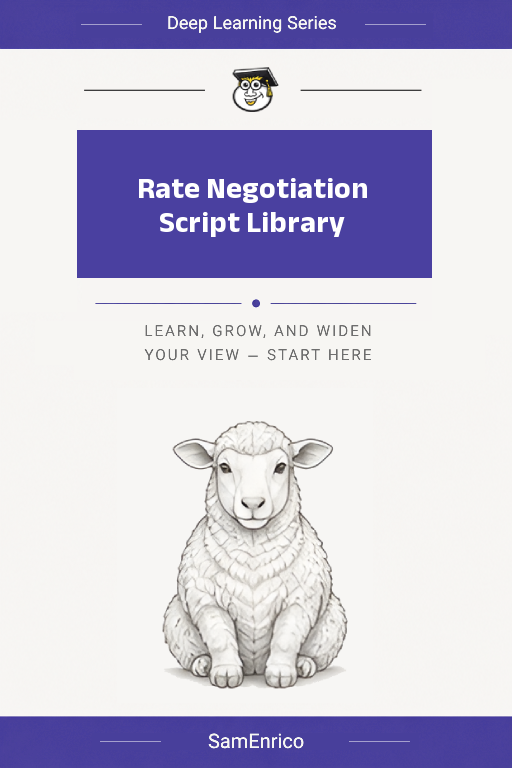
Rate Negotiation Script Library eBook
Provides scripts for small business owners to nego
by Becnel Hoa
Provides scripts for small business owners to negotiate lower interest rates with existing or prospective lenders.
Formats
Free sample
Chapter 1: The Borrowing Lie--You are losing money right now. Not because your business is failing. Not because your credit is bad. Not because you chose the wrong lender. You are losing money because you believe a lie that has been sold to you by every bank, every loan officer, and every well-meaning financial advisor who told you that interest rates are "non-negotiable."That lie is simple: The lender has all the power.Walk into any bank in America and watch what happens.
A small business owner sits across from a loan officer. Their shoulders are hunched. Their voice is tentative. They say things like "I hope you can help me" or "I understand if this isn't possible" or "What rate do you think I qualify for?" They have already lost before the first number is spoken. They have handed the lender a weapon and asked to be shot with it gently.This book exists because that posture is expensive.
How expensive? Let me show you.Take a 250,000businessloanoverfiveyears.Ata10250,000 business loan over five years. At a 10% interest rate, you will pay approximately 250,000businessloanoverfiveyears.Ata1068,000 in interest. At 7%, you will pay approximately 47,000.Thedifferenceis47,000. The difference is 47,000.Thedifferenceis21,000.
That is not a rounding error. That is a new vehicle. That is a part-time employee for a year. That is breathing room.And here is the secret the banking industry has spent decades hiding: That $21,000 difference is determined less by your credit score than by your negotiation skill.I have watched a business owner with a 680 credit score negotiate a 7.5% rate while a business owner with a 780 credit score accepted 11% because he "didn't want to be difficult." The difference was not risk. The difference was words.
The difference was posture. The difference was a script.This chapter is going to dismantle the Borrowing Lie. By the time you finish reading, you will never again walk into a bank negotiation as a supplicant. You will walk in as a peer. You will walk in as someone who understands that you are not asking for a favor.
You are offering a bank the opportunity to deploy capital profitably. And that is a very different conversation.The Psychology of the Supplicant Let me describe a scene that happens ten thousand times a day in bank branches across the country.A small business owner needs money. Maybe it is for inventory. Maybe it is to bridge a slow season. Maybe it is to take advantage of an opportunity that requires cash upfront.
They have done the responsible thing. They have prepared their tax returns. They have printed their profit and loss statements. They have dressed nicely. They arrive at the bank on time.The loan officer invites them into a small office.
There is a desk between them. That desk is not furniture. That desk is a psychological barrier. On one side sits the banker, who sees loan applications all day and has been trained to say no politely. On the other side sits the owner, who has been awake since 3 AM worrying about whether they will be approved.The loan officer asks the first question: "So tell me about your business."And the owner begins to apologize.
"I know last year was a little slow. We had some issues with a supplier. My personal credit took a hit because of some medical bills. But I'm working on it."Stop. Right there.
The negotiation is over. The owner has just told the banker that they are risky, that they are damaged, that they should be grateful for whatever they receive. The banker now holds all the cards. The rate will be high. The fees will appear.
The terms will be tight. And the owner will sign anyway, because they are terrified of hearing the word "no."This is the psychology of the supplicant. It is expensive. And it is completely unnecessary.The Root of the Problem Where does this psychology come from? It comes from a lifetime of being told that banks are powerful and borrowers are weak.
It comes from movies where the villain is a banker who forecloses on the family farm. It comes from a cultural narrative that says debt is dangerous and lenders are doing you a favor by extending credit.But think about this differently. A bank is a business. Its product is money. It needs to sell that product to stay in business.
When a bank has too much cash on hand and not enough loans on its books, it actually loses money because it has to pay interest to depositors without earning interest from borrowers. Banks need you as much as you need them. Sometimes more.The difference is that banks have been trained to hide this dependency. Loan officers are taught to project authority, to act as gatekeepers, to make the process feel like a privilege rather than a transaction. They want you to feel grateful because gratitude reduces your willingness to negotiate.The Cost of Gratitude Let me give you a specific example from a business owner I worked with several years ago.
Let us call her Sarah. Sarah owned a small manufacturing company that made custom furniture. She needed $150,000 to buy a new CNC router that would double her production capacity. She went to her local bank, where she had kept her business checking account for eight years.The loan officer told her the rate would be 11.5%. Sarah was disappointed but felt she had no choice.
She had a good relationship with the bank. She trusted them. She signed the papers.Three months later, Sarah mentioned this loan to a friend who was a former banker. The friend asked one question: "Did you ask for a lower rate?" Sarah said no. She had not even considered it.
The friend made a single phone call to a competing bank. Within a week, Sarah had a refinancing offer at 7.9%. She took it back to her original bank. They matched it immediately.Think about that. The original bank was willing to charge Sarah 11.5% simply because she did not ask.
The moment she had an alternative, the rate dropped by more than three percentage points. That is not a negotiation. That is a tax on silence.Sarah paid that tax for three months. Thousands of dollars. Money that could have gone into her business, into her employees, into her family.
All because no one told her that the Borrowing Lie was a lie.Reframing: You Are Not a Beggar. You Are a Yield.If the Borrowing Lie is that lenders have all the power, the antidote is a single reframe. It is simple enough to fit on a sticky note. Here it is:You are not asking for money. You are selling a yield.Let me explain what that means.Every time a bank makes a loan, they are deploying capital.
That capital has a cost. The bank pays interest to depositors or pays dividends to shareholders or borrows from the Federal Reserve. They need to earn more on their loans than they pay for their capital. The difference is their profit.When you borrow money, you are offering the bank an opportunity to earn that profit. You are promising to make…
This is the end of the free sample. Get the eBook to keep going. Buy now
About this book
Details
- Author
- Becnel Hoa
- Publisher
- SamEnrico
- Language
- English
- Genre
- Non-Fiction, Annual Checkup, Negotiation
- Released
- 2026-06-01
- Pages (approx.)
- 140
- Available as
- eBook, Audiobook

Read better in the ZLOADR app
Your eBooks on your phone or tablet. Sign in with your SamEnrico account and start reading.
More by Becnel Hoa
 Postmates Availability TrapBecnel Hoa$11.99
 Freight Five Year OutlookBecnel Hoa$11.99
 The Arthritis Posture GuideBecnel Hoa$11.99
 Reading Morning RoutineBecnel Hoa$11.99
 The Student Self Talk GuideBecnel Hoa$11.99
 The Great Melbourne Zoo Break: Smugglers, Spies, and SpeakeasiesBecnel Hoa$11.99
 Asian American ContractingBecnel Hoa$12.99
 How to Become a Police Officer IiBecnel Hoa$11.99
 Understanding Shwachman SyndromeBecnel Hoa$17.99
 Sound EditorBecnel Hoa$11.99