
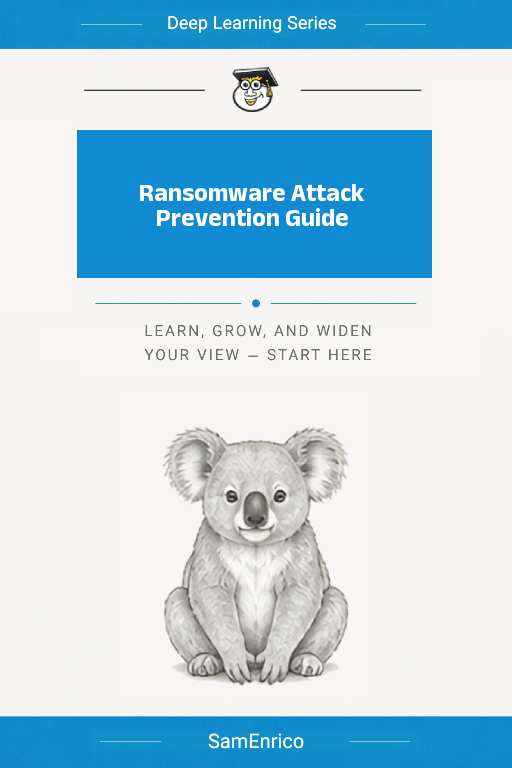
Non-FictionCrisis ManagementPrevention
Ransomware Attack Prevention Guide eBook
Implement email filtering, endpoint detection, and
by Post Ivory
Implement email filtering, endpoint detection, and offline backups to avoid being encrypted.
Formats
Free sample
Chapter 1: The Extortion Economy...-- In the early hours of May 7, 2021, a cybersecurity analyst at Colonial Pipeline stared at her screen in disbelief. What began as a single compromised password—a Virtual Private Network account that did not require multi-factor authentication—had spiraled into the shutdown of 5,500 miles of pipeline carrying nearly half of the East Coast's fuel supply. Gas stations from Georgia to Virginia ran dry. Panic buying erupted. The federal government issued an emergency declaration.
And the cause? A ransomware group called Dark Side had encrypted the company's billing and operational systems, demanding nearly $5 million.What made this attack particularly chilling was not the sophistication of the malware. The encryption itself was crude. The true weapon was the business model behind it. Dark Side did not write all of their own code.
They operated as a franchise, renting their ransomware platform to affiliates who did the dirty work of breaching networks. In return, Dark Side took a cut of every ransom paid. This was not cyber vandalism. It was Ransomware-as-a-Service—a multi-billion-dollar industry with customer support, negotiation teams, press releases, and even a code of conduct forbidding affiliates from attacking hospitals in certain countries.The Colonial Pipeline attack became a watershed moment, not because it was the first major ransomware incident, but because it revealed a terrifying truth to the general public: the global economy now operates at the mercy of criminal enterprises that have professionalized extortion. The attackers understood something that many defenders still fail to grasp.
Ransomware is not a technical problem. It is an economic one. And as long as paying the ransom remains cheaper than prevention, the attacks will continue to accelerate.This chapter establishes the foundational reality of modern ransomware. It traces the evolution from opportunistic, scatter-shot malware to a sophisticated criminal industry. It draws from real-world case studies to demonstrate why paying ransoms often leads to repeated attacks.
It argues that relying solely on detection tools is a losing strategy. And it introduces the book's core framework—the Prevention Triad—which will guide every subsequent chapter. By the time you finish this chapter, you will understand why prevention is not just a technical preference but an economic imperative.The Accidental Epidemic: Ransomware's Humble Beginnings To understand where ransomware is going, you must first understand where it came from. The first known ransomware attack occurred in 1989, long before the internet as we know it existed. A biologist named Dr.
Joseph Popp distributed 20,000 floppy disks labeled "AIDS Information—Introductory Diskette" to attendees of the World Health Organization's AIDS conference. The disks contained a questionnaire about HIV risk factors. But they also contained a hidden payload.After the user rebooted their computer ninety times, the malware encrypted the filenames on the hard drive and displayed a message demanding $189 to be sent to a post office box in Panama. The encryption was laughably weak—easily reversible by security researchers. The payment method was essentially untraceable cash sent through the mail.
And yet, the template was set. Someone had figured out that you could lock data and demand money for its return.For the next two decades, ransomware remained a niche annoyance. Early variants spread through floppy disks, then email attachments, then malicious websites. They were crude, often broken, and typically distributed by lone hackers seeking notoriety or small paydays. The encryption was sometimes reversible.
The payment systems were clunky. Most importantly, the scale was limited because the attackers had to manage everything themselves—the distribution, the encryption, the payment collection, and the decryption key management.Then three technological shifts collided, transforming ransomware from a nuisance into a catastrophe.First, the rise of cryptocurrencies, particularly Bitcoin, gave attackers a pseudonymous, borderless, and irreversible payment system. Suddenly, a ransomware gang could demand payment in Bitcoin, receive it within hours, and convert it to cash through a network of exchanges with varying levels of regulatory oversight. The problem of collecting ransom without being traced was largely solved.Second, the proliferation of always-on, high-speed internet connections meant that nearly every business had an attack surface. Remote desktop protocols, virtual private networks, cloud applications, and email systems created countless entry points.
A single unpatched server or a single employee clicking a single link could give an attacker a foothold.Third, and most critically, the emergence of the dark web and encrypted messaging platforms allowed cybercriminals to collaborate at scales previously impossible. Forums like Exploit.in and ransomware-specific marketplaces became meeting grounds where malware developers could sell their code to distributors, where stolen credentials could be bought and sold, and where attackers could hire professional negotiators to handle ransom communications.These three shifts did not just make ransomware more common. They changed the fundamental economics of the attack. A lone hacker no longer needed to be a programmer, a social engineer, a negotiator, and a money launderer. They could specialize.
And specialization, as Adam Smith noted two centuries ago, is the engine of economic growth.The Birth of Ransomware-as-a-Service Around 2015, a new model emerged that would permanently alter the threat landscape. Ransomware-as-a-Service, or Raa S, inverted the traditional malware distribution model. Instead of attackers writing their own code and managing their own infrastructure, Raa S operators created polished, user-friendly ransomware platforms and leased them to affiliates.Think of it as a franchise model for crime. The Raa S developer provides the ransomware executable, the command-and-control infrastructure, the payment portal, the decryption key management, and often even customer support for victims. The affiliate provides only the access—the breached network, the stolen credentials, the foothold.
When a ransom is paid, the proceeds are split, typically with the affiliate receiving 60-80% and the Raa S operator taking the remainder.This model transformed ransomware from a technical challenge into a business opportunity. A technically unskilled attacker could now simply purchase access to a breached network from an initial access broker, rent a Raa S platform, deploy the ransomware, and collect a payout. The barrier to entry dropped from years of programming experience to a few thousand dollars and a dark web browser.Dark Side, the group behind the Colonial Pipeline attack, operated exactly this model. Their ransomware was sleek, efficient, and well-documented. They maintained a press release page where they announced new victims and justified their actions.
They had a code of conduct prohibiting attacks on hospitals, educational institutions, and non-profit organizations—not out of morality, but because they understood that killing the golden goose would bring down law enforcement attention. They even ran a bug bounty program, paying security researchers who found vulnerabilities in their infrastructure.Dark Side was not unique. Lock Bit, Conti, REvil, Ryuk—these names have become infamous not because they are particularly sophisticated, but because they are particularly professional. Lock Bit 3.0, released in 2022, included features like automatic network propagation, deletion of volume shadow copies, and even a "safe mode" reboot that allowed the ransomware to encrypt files before the operating system fully loaded. The user manual for Lock Bit ran over forty pages and included troubleshooting guides for affiliates.The Raa S model has two profound implications for defenders.
First, the volume of attacks has exploded because the supply of potential attackers has exploded. Anyone with a few thousand dollars…
This is the end of the free sample. Get the eBook to keep going. Buy now
About this book
Details
- Author
- Post Ivory
- Publisher
- SamEnrico
- Language
- English
- Genre
- Non-Fiction, Crisis Management, Prevention
- Released
- 2026-06-01
- Pages (approx.)
- 155
- Available as
- eBook, Audiobook

Read better in the ZLOADR app
Your eBooks on your phone or tablet. Sign in with your SamEnrico account and start reading.
More by Post Ivory
 Cognitive Therapy for SmokingPost Ivory$11.99
 Name Recall For SeniorsPost Ivory$11.99
 Ramirez Death Penalty AppealsPost Ivory$11.99
 Gacy Trolling for VictimsPost Ivory$11.99
 Book Buying Generational SplitPost Ivory$11.99
 Libyan Gaddafi EscapePost Ivory$11.99
 Potassium Blood Pressure GuidePost Ivory$11.99
 Dining Out With IBSPost Ivory$11.99
 Moana’s First Voyage: The Birth of the NavigatorPost Ivory$11.99
 The Silent Poisoner: Victorian England's Deadly DeceptionPost Ivory$11.99
 How to Produce Genuine Leather BeltsPost Ivory$11.99
 How to Become a Manual-plate FillerPost Ivory$11.99
You may also like
 Hong Kong Handover 1997Dunn Johnnie$11.99
 Zumba For Postnatal Recovery CourseNeal Christian$11.99
 Zumba for BeginnersLadner Nikia$11.99
 YouTube Comment Mining GuideHumes Pandora$12.99
 Worry Box MeditationCarlin Rudy$11.99
 Workplace Stress MeditationNguyen Lynn$11.99
 Workplace Stress and Sleep RepairHawley Ivory$11.99
 Workplace Perfectionism CureDelaney Jeffry$11.99
 Workplace Injustice Anger GuideWallen Isabelle$11.99
 Work Addiction and Burnout LinkGreenwood Ester$11.99
 Women in Yoga and WellnessBeattie Galina$11.99
 Women in Stand Up ComedyChun Evangeline$11.99