
Non-FictionInformativeEducational
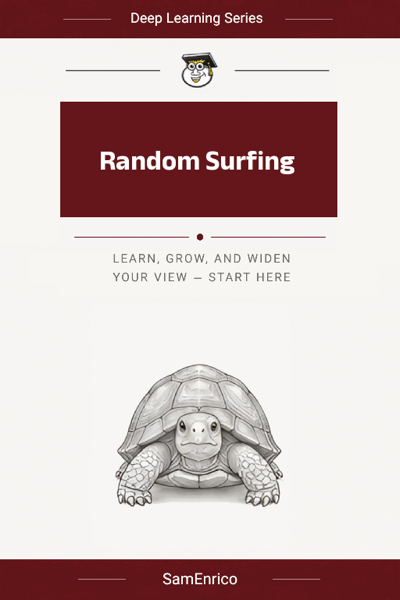
Random Surfing eBook
A Coursebook on Random Surfing
A Coursebook on Random Surfing
Formats
Free sample
Chapter 1: Beyond Stubborn Certainty...–- The most dangerous words in the English language are not “I don’t know.” They are “I already know.”–- Consider the story of General George Custer, a man who knew exactly what would happen at the Battle of the Little Bighorn. He had studied his enemy. He had superior firepower. He had battlefield experience. His plan was meticulous: divide his forces, surround the Native American camp, and crush them before they could organize.
Custer was so certain of victory that he refused reinforcements. When his scouts reported a massive encampment—far larger than his intelligence had suggested—he dismissed the information. His plan was already in motion. Changing course would have required admitting that he might be wrong.–- Two days later, Custer and every soldier under his direct command were dead.–- The tragedy of Custer is not that he made a mistake. Everyone makes mistakes.
The tragedy is that his certainty made him incapable of updating his beliefs in the face of contradictory evidence. He had fallen into what psychologists call the certainty trap—the seductive belief that your current understanding of the world is complete and correct, and that deviations from your plan are threats rather than information.–- This chapter is about the certainty trap and its antidote: random surfing. We will explore why the human mind craves certainty even when certainty is impossible, how this craving leads to systematic failures in planning and decision-making, and why embracing strategic randomness—not as a surrender but as a superior strategy—can free you from the trap that killed Custer and continues to derail careers, companies, and lives every single day.The Certainty Trap: A Universal Human Vulnerability–- The certainty trap is not a character flaw. It is a feature of how human brains evolved. Your brain is a prediction engine.
It constantly takes in sensory information and generates expectations about what will happen next. When predictions match reality, you feel calm and safe. When predictions fail, you feel surprise, anxiety, or fear—signals that something is wrong.–- This system worked beautifully on the savannas of Africa, where patterns were relatively stable. Predators behaved predictably. Seasons followed predictable cycles.
Social dynamics in small tribes were knowable. In that environment, the brain’s drive toward certainty was adaptive. It conserved energy. It enabled rapid decision-making. It kept you alive.–- But the modern world is not the African savanna.
The systems we navigate today—global markets, technological change, organizational dynamics, social media algorithms, career trajectories—are fundamentally unpredictable in ways that our stone-age brains never evolved to handle. They are what complexity scientists call complex adaptive systems: networks of interacting agents whose collective behavior emerges from local interactions in ways that cannot be predicted from the individual components alone.–- Here is the cruel joke: the very mechanism that helped your ancestors survive now leads you systematically astray. Your brain craves certainty. It wants neat stories, simple explanations, and clear cause-effect relationships. But the world resists these simplifications.
So your brain does something remarkable: it constructs certainty even where none exists. It fills gaps. It ignores anomalies. It retrofits narratives to maintain the illusion that you understand what is happening.–- This is the certainty trap in action. You believe you know more than you do.
You treat your models of the world as if they were the world itself. You mistake your maps for the territory.The Three Faces of the Certainty Trap–- The certainty trap manifests in three distinct ways, each of which will be a recurring theme throughout this book. Understanding these three faces is essential for recognizing when you have fallen into the trap.–- Face One: Overconfidence in Prediction. The first face of the certainty trap is the belief that you can predict the future with reasonable accuracy. This is the Custer error.
It is also the error made by financial analysts who consistently fail to beat the market, political pundits who are wrong more often than they are right, and executives who make five-year plans in industries that will be unrecognizable in eighteen months.–- Overconfidence in prediction is not about being wrong. Everyone is wrong sometimes. It is about being systematically overconfident—assigning higher probabilities to your predictions than the evidence warrants. In study after study, when people say they are “90 percent confident” in a prediction, they are correct about 70 to 75 percent of the time. The gap between perceived certainty and actual accuracy is the measure of overconfidence.–- Face Two: Anchoring to Past Success.
The second face of the certainty trap is the tendency to generalize from past success in ways that blind you to changed circumstances. This is the “what worked before will work again” fallacy. It is why Kodak, despite inventing the digital camera, went bankrupt. It is why Blockbuster passed on buying Netflix for fifty million dollars. It is why Nokia, once the dominant force in mobile phones, became irrelevant almost overnight.–- Past success feels like validation.
It feels like proof that your understanding of the world is correct. But past success can also be a trap. The conditions that produced that success may no longer exist. Your competitors have learned your strategies. Markets have shifted.
Technology has advanced. The only thing past success reliably predicts is that you were successful. What it means for the future is unknown.–- Face Three: The Narrative Fallacy. The third face of the certainty trap is the human tendency to construct coherent stories from random or incomplete information. The narrative fallacy was identified by the statistician and former Wall Street trader Nassim Nicholas Taleb, who observed that we find it almost impossible to accept that things just happen.
We need reasons. We need causes. We need stories.–- The problem is that the stories we tell are almost always simpler and more linear than reality. A company succeeds, and we construct a narrative about visionary leadership and brilliant strategy. A movie bombs, and we construct a narrative about creative missteps and marketing failures.
These stories feel satisfying. They feel like explanations. But they are usually post-hoc rationalizations that ignore the role of luck, randomness, and complex interactions that no narrative can capture.Why Your Brain Resists Randomness–- If the certainty trap is so harmful, why does evolution not eliminate it? The answer lies in the nature of randomness itself—or rather, in our inability to perceive it accurately.–- Your brain is a pattern-recognition machine. It is designed to find signals in noise, to detect threats and opportunities in ambiguous environments.
This pattern-recognition ability is extraordinary. It enabled human civilization. But it comes with a cost: false pattern recognition. Your brain sees patterns even when none exist.–- Consider a simple experiment. Imagine flipping a fair coin ten times and recording the sequence of heads and tails.
Most people expect a sequence like H-T-H-T-H-H-T-H-T-T—something that looks “random.” But in fact, a sequence like H-H-H-H-H-T-T-T-T-T is equally likely. The difference is that the second sequence contains a pattern that your brain cannot ignore. You see something meaningful in what is actually pure noise.–- This tendency to see patterns in randomness is…
This is the end of the free sample. Get the eBook to keep going. Buy now
About this book
Details
- Author
- Kauffman Deanne
- Publisher
- SamEnrico
- Language
- English
- Genre
- Non-Fiction, Informative, Educational
- Released
- 2026-05-08
- Pages (approx.)
- 154
- Available as
- eBook, Audiobook

Read better in the ZLOADR app
Your eBooks on your phone or tablet. Sign in with your SamEnrico account and start reading.
More by Kauffman Deanne
 LinkedIn Job Title HierarchyKauffman Deanne$11.99
 Time Blocking with ToddlersKauffman Deanne$11.99
 Active Listening Influence GuideKauffman Deanne$11.99
 The Menopause Tinnitus Relief WorkbookKauffman Deanne$11.99
 High Risk AI Systems ChecklistKauffman Deanne$11.99
 Shirō the Lute’s Last Serenade: The Yokai’s Melancholic BalladKauffman Deanne$11.99
 How to Start a Burglar and Fire Alarms for Household Use (wholesale) Business (Beginners Guide)Kauffman Deanne$11.99
 Southeast Asia Talent GuideKauffman Deanne$12.99
 Imposter Before Podium WorkbookKauffman Deanne$12.99
 Understanding Kaposiform HemangioendotheliomaKauffman Deanne$17.99
You may also like
 Hong Kong Handover 1997Dunn Johnnie$11.99
 Zumba For Postnatal Recovery CourseNeal Christian$11.99
 Zumba for BeginnersLadner Nikia$11.99
 YouTube Comment Mining GuideHumes Pandora$12.99
 Worry Box MeditationCarlin Rudy$11.99
 Workplace Stress MeditationNguyen Lynn$11.99
 Workplace Stress and Sleep RepairHawley Ivory$11.99
 Workplace Perfectionism CureDelaney Jeffry$11.99
 Workplace Injustice Anger GuideWallen Isabelle$11.99
 Work Addiction and Burnout LinkGreenwood Ester$11.99
 Women in Yoga and WellnessBeattie Galina$11.99
 Women in Stand Up ComedyChun Evangeline$11.99