
Non-FictionForecast & OutlookQuantum
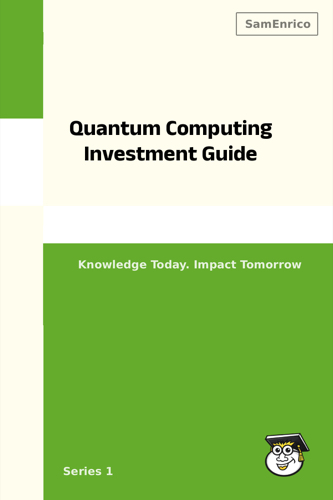
Quantum Computing Investment Guide eBook
Stage capital deployment from research to commerci
Stage capital deployment from research to commercial quantum advantage.
Formats
Free sample
Chapter 1: The $10 Trillion Blindspot...--–- In 2027, a 34-year-old software engineer in Nebraska will likely make more money from quantum computing than most Silicon Valley venture capitalists will. Not because she is smarter, or better connected, or luckier. Because she will understand something that the majority of professional investors still get wrong: the quantum industry has already exited the pure-research phase, but the capital markets have not yet caught up.The engineer’s name is fictional, but her opportunity is not. By 2027, the first genuine commercial quantum advantage will have arrived—not in the form of a headline-grabbing “quantum supremacy” stunt, but in the quiet, profitable world of battery materials simulation. A midsize pharmaceutical company will have used a hybrid quantum-classical algorithm to shave eighteen months off a drug discovery timeline.
A logistics firm will have rerouted a national supply chain in real time, saving hundreds of millions of dollars. And the investors who positioned themselves three to five years earlier—at the precise moment when most of Wall Street was still calling quantum a “20-year problem”—will have captured returns that make even the best AI bets look pedestrian.This book is the roadmap for those investors. It is not a physics textbook. It is not a cheerleading manifesto for “the next big thing.” It is a stage-by-stage capital deployment guide for an industry that has quietly crossed the threshold from science experiment to commercial reality—but only for those who know where to look and, more importantly, how to value what they see.The Great Misunderstanding: Why Most Investors Are Already Late Walk into any venture capital conference in 2025 or 2026, and you will hear the same refrain: “Quantum is too early. The physics isn’t ready.
Ask me again in five years.” This consensus is so widespread, so unchallenged, that it has become a self-fulfilling prophecy for everyone except a small minority of investors who have done the homework.Here is what the consensus gets wrong. The question is no longer whether quantum computing will work. The five leading qubit modalities—superconducting, trapped-ion, neutral-atom, photonic, and silicon-spin—have all demonstrated, in laboratory settings, that they can perform computations impossible for classical computers on specific problem classes. The scientific feasibility debate ended around 2022, when the last credible “maybe this never works” paper was published and promptly refuted.What replaced that debate is a different problem entirely: a quality mismatch in capital deployment.Early-stage funding—pre-seed and seed—is abundant. University spin-outs with a working prototype and a charismatic Ph D founder can raise $1 million to $3 million with relative ease.
There are dozens of such funds writing small checks, and the result is a crowded, noisy, and increasingly expensive seed market. At the other end of the spectrum, sovereign wealth funds and defense-focused institutional investors are placing massive bets on later-stage companies (Series C and beyond) that have already demonstrated manufacturing scale.But in the middle—the Series A and Series B range, where companies need $5 million to $20 million to transition from a laboratory prototype to a scalable manufacturing process—there is a gaping hole. Not because the money does not exist. According to industry estimates, there is approximately $15 billion in dry powder earmarked for quantum-related investments as of early 2026. The problem is that less than $2 billion of that is managed by teams with the technical competence to distinguish between a real breakthrough and a clever simulation, between a startup that can scale and one that will die in the valley of death.This is the Competent Capital Gap.
And it is the single largest inefficiency in the quantum investment landscape today.Consider the numbers. Between 2020 and 2025, the number of quantum startups grew from approximately 80 to over 350 globally. Of those, roughly 60 percent have raised seed funding. But only 15 percent have successfully raised a Series A. Only 5 percent have made it to Series B.
The attrition is not primarily scientific—most of these companies still have working prototypes and credible technical roadmaps. The attrition is financial. They run out of cash before they can build the manufacturing infrastructure required to turn a laboratory curiosity into a product that customers can actually buy.Every failed Series A is not a failure of physics. It is a failure of capital allocation. And for the investor who can deploy competent capital into that gap, the opportunity is staggering.The Four Futures: Stress-Testing Your Portfolio Against Uncertainty No one has a crystal ball.
Quantum computing will not follow a predictable, linear path. But ignoring uncertainty is not a strategy; it is negligence. This chapter introduces a framework—adapted from strategic foresight literature and refined through interviews with two dozen quantum fund managers—to help investors stress-test their portfolios across four plausible futures for the next five to seven years.Future One: The Surprise An unexpected modality leapfrogs all others. Today, superconducting qubits (the approach favored by IBM and Google) and trapped-ion qubits (the approach favored by Ion Q and Honeywell) dominate the headlines and the capital. But there are half a dozen other approaches, ranging from topological qubits (Microsoft’s long-shot bet) to neutral-atom arrays (a quiet but increasingly credible contender) to silicon-spin qubits (the dark horse with the semiconductor supply chain advantage).In the Surprise scenario, one of these underdog modalities suddenly demonstrates a decisive advantage—perhaps a breakthrough in error correction that reduces overhead by an order of magnitude, or a room-temperature architecture that eliminates the need for expensive cryogenics.
The result: capital rotates violently toward the winning modality, and startups built on losing architectures see their valuations collapse, regardless of their technical merit.Investment implication: Do not place concentrated bets on a single modality unless you have insider-level technical diligence capabilities. The safe approach is modality-agnostic portfolio construction—but as we will see in Chapter 2, agnosticism without criteria is just guesswork.Future Two: The Quandary Technical progress stalls. Error rates plateau at levels insufficient for fault tolerance. The much-hyped “quantum advantage” remains perpetually five years away. Corporate customers, tired of pilot programs that never convert to production contracts, pull back.
Venture capital, burned by write-downs, retreats to safer bets in AI and biotech. Only the best-capitalized startups—those with multi-year runways and defense contracts—survive.This is the nightmare scenario for quantum optimists. But it is also a scenario where disciplined, stage-appropriate capital deployment can still generate returns. In the Quandary, the value shifts from hardware (too capital-intensive, too risky) to software and services—hybrid quantum-classical platforms, error mitigation services, and quantum-inspired classical algorithms that can run on today’s noisy machines. The companies that survive are not the ones with the most qubits; they are the ones with the most paying customers, even if those customers are only paying for modest improvements over classical alternatives.Investment implication: Prioritize revenue over roadmaps.
Horizon 1 companies (see Chapter 3) that are already generating cash flow from quantum sensing or quantum random number generation become safe havens. Horizon 3 moonshots become almost uninvestable.Future Three: The Explosion Rapid hybrid classical-quantum adoption, driven by the integration of quantum algorithms with classical AI systems, creates commercial advantage far earlier than expected—not in fault-tolerant computing, but in niche problem classes where hybrid approaches outperform purely classical methods by…
This is the end of the free sample. Get the eBook to keep going. Buy now
About this book
Details
- Author
- Odom Pearlene
- Publisher
- SamEnrico
- Language
- English
- Genre
- Non-Fiction, Forecast & Outlook, Quantum
- Released
- 2026-06-09
- Pages (approx.)
- 126
- Available as
- eBook, Audiobook

Read better in the ZLOADR app
Your eBooks on your phone or tablet. Sign in with your SamEnrico account and start reading.
More by Odom Pearlene
 Wholesaling Craigslist GuideOdom Pearlene$11.99
 Loneliness After Abuse GuideOdom Pearlene$11.99
 Recurring Nightmares Breakthrough GuideOdom Pearlene$11.99
 Wholesaling Cold Calling GuideOdom Pearlene$11.99
 Breath for Addiction CravingOdom Pearlene$11.99
 Parking Lot Anger GuideOdom Pearlene$11.99
 Zumba Family Party WorkoutOdom Pearlene$11.99
 The Grand Canyon ConspiracyOdom Pearlene$11.99
 Nefertiti’s Shadow: The Forbidden Love of a Pharaoh’s WifeOdom Pearlene$11.99
 The Oscar That Shocked the World: The Day France Stole the Show (1963)Odom Pearlene$11.99
 Love, Lies, and Lattes: The Starbucks Heiress Divorce ScandalOdom Pearlene$11.99
 The Mineral Guide to SpessartiteOdom Pearlene$11.99
You may also like
 Hong Kong Handover 1997Dunn Johnnie$11.99
 Zumba For Postnatal Recovery CourseNeal Christian$11.99
 Zumba for BeginnersLadner Nikia$11.99
 YouTube Comment Mining GuideHumes Pandora$12.99
 Worry Box MeditationCarlin Rudy$11.99
 Workplace Stress MeditationNguyen Lynn$11.99
 Workplace Stress and Sleep RepairHawley Ivory$11.99
 Workplace Perfectionism CureDelaney Jeffry$11.99
 Workplace Injustice Anger GuideWallen Isabelle$11.99
 Work Addiction and Burnout LinkGreenwood Ester$11.99
 Women in Yoga and WellnessBeattie Galina$11.99
 Women in Stand Up ComedyChun Evangeline$11.99