
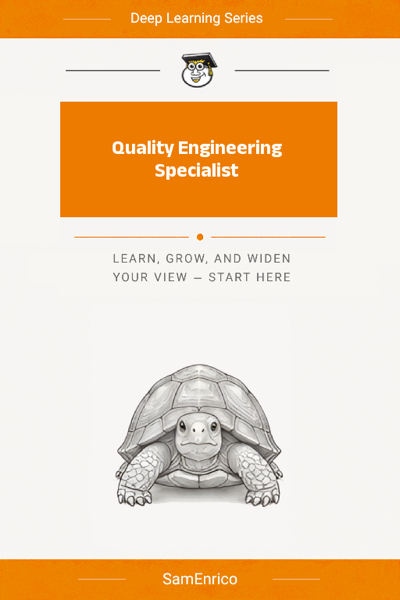
Non-FictionInformativeEducational
Quality Engineering Specialist eBook
A Coursebook on Quality Engineering Specialist
by Bryant Robin
A Coursebook on Quality Engineering Specialist
Formats
Free sample
Chapter 1: The Silent Epidemic--–- The dashboard was green. Every single metric on the production manager’s weekly report showed “on target” or “exceeding goal.” Scrap was under 1 percent. Rework was negligible. Customer complaints had been stable for six months. The plant manager was so pleased that he approved bonuses for the entire quality team.Then the recall hit.Eighty thousand units.
Three months of production. A small, seemingly insignificant dimensional deviation that caused intermittent failure in the field. The cost: 47millionindirectreplacement,47 million in direct replacement, 47millionindirectreplacement,12 million in freight and logistics, 8millioninovertimetoexpeditenewproduction,andanestimated8 million in overtime to expedite new production, and an estimated 8millioninovertimetoexpeditenewproduction,andanestimated30 million in lost future sales from damaged customer relationships.The dashboard had been green right up until the moment it wasn’t.This is the silent epidemic of modern quality management. Organizations everywhere are measuring the wrong things, celebrating the wrong metrics, and discovering their mistakes only when the damage is already irreversible. The Quality Engineering Specialist exists to prevent this exact scenario.If you picked up this book, you have seen it happen.
Perhaps not a $47 million recall, but a smaller version: a defect that should have been caught, a problem that was “solved” only to return, a metric that looked good until someone looked underneath it. You suspect that your organization’s quality system is not as robust as it appears. You are right.This chapter establishes your professional identity as a Quality Engineering Specialist—not a police officer, not a paper-pusher, not a glorified inspector, but a data-driven architect of operational excellence who moves beyond defect detection to process prediction and prevention. You will learn what quality actually means (it is not what most managers think), how the role evolved from post-World War II inspection lines to the modern synthesis of Lean Six Sigma, the critical distinction between Quality Control, Quality Assurance, and Quality Engineering, and finally the economics of quality—why investing in prevention is the single most profitable decision any organization can make.By the end of this chapter, you will understand why 94 percent of quality problems belong to the system, not the worker. You will know how to calculate the true cost of a defect, including the hidden costs that never appear on any spreadsheet.
And you will be able to explain, in financial terms that executives understand, why your role as a Quality Engineering Specialist is not a cost center but a profit driver.The Eight Dimensions of Quality: Beyond Pass/Fail Most people think quality means “not broken.” A part passes inspection or it fails. A product works or it doesn’t. This binary thinking is the first thing the Quality Engineering Specialist must unlearn.David Garvin, a Harvard Business School professor who studied quality management in the 1980s, identified eight dimensions of quality that go far beyond simple functionality. These dimensions are not theoretical abstractions—they are the criteria your customers use, consciously or unconsciously, to judge whether your product or service is “quality.”Performance is the primary operating characteristic of the product. For a car, performance means acceleration, braking, and handling.
For a hospital, performance means successful treatment rates and low infection rates. For a smartphone, performance means processor speed, battery life, and camera resolution. Performance is usually measurable and often specified in product requirements. However, high performance does not automatically equal high quality. A car that goes two hundred miles per hour may perform brilliantly but still be low quality if it breaks down constantly.Reliability is the probability that a product will function without failure for a specified time under specified conditions.
A luxury car with exquisite paint and leather seats that breaks down every three months has low reliability, even if its performance is excellent. Reliability is measured in MTBF (Mean Time Between Failures) for repairable systems and MTTF (Mean Time To Failure) for non-repairable systems. Later in this book, we will dedicate an entire chapter to reliability engineering because it requires specialized statistical tools like Weibull analysis and accelerated life testing.Conformance is the degree to which a product’s design and operating characteristics match established standards. This is what most people think of when they hear “quality control.” If the specification says the part must be 100 millimeters plus or minus 1 millimeter, conformance means every part measures between 99 and 101 millimeters. Conformance is measured by defect rates, capability indices (Cpk), and yield percentages.
It is the dimension that statistical process control was designed to monitor.Durability is the amount of use a product provides before it deteriorates and requires replacement. A washing machine that lasts fifteen years has higher durability than one that lasts five years, even if both function perfectly during their lifetimes. Durability is different from reliability. Reliability measures time between failures; durability measures total useful life before the product is no longer worth repairing. For many consumer products, durability has decreased over time not because manufacturers cannot make durable products but because customers have demonstrated they will replace products before they wear out.Serviceability is the speed, courtesy, and competence of repair when the product fails.
Two cars might have identical reliability and durability, but if one brand has dealers who fix problems the same day and the other takes two weeks to schedule an appointment, the first has higher serviceability. Serviceability is measured by mean time to repair (MTTR), availability of spare parts, and customer satisfaction with service interactions. In business-to-business markets, serviceability often matters more than initial quality because downtime has direct financial consequences.Aesthetics is how the product looks, feels, sounds, tastes, or smells. This dimension is inherently subjective but critically important. A smartphone that performs flawlessly but has an ugly case and a scratchy speaker will not sell.
A hospital room that is clinically perfect but cold and intimidating will generate lower patient satisfaction scores. Aesthetics can be measured through customer surveys, focus groups, and conjoint analysis, but it cannot be reduced to a simple pass/fail specification.Perceived quality is the customer’s impression of quality based on brand, reputation, advertising, and indirect evidence. A watch from a luxury brand may keep time no better than a cheap digital watch, but the customer perceives it as higher quality because of the brand’s reputation. Perceived quality matters because it drives purchasing decisions and customer loyalty. It is built through consistent conformance over time, effective marketing, and managing customer expectations.Safety is the risk of injury or harm associated with product use.
Safety is often regulated by government agencies (FDA, FAA, NHTSA, OSHA) and carries legal liability beyond normal quality concerns. A defect that would normally be a minor annoyance becomes a crisis if it creates a safety risk. The Quality Engineering Specialist must understand the safety implications of every defect and prioritize corrective actions accordingly.These eight dimensions interact in complex ways. Improving one dimension may degrade another. A more durable product may be less serviceable because it is harder to disassemble.
A more aesthetically pleasing design may be less safe because sharp edges look good but cut fingers. The Quality Engineering Specialist must balance these trade-offs based on customer priorities, regulatory requirements, and business strategy.The Historical Evolution: From Inspection to Integration The…
This is the end of the free sample. Get the eBook to keep going. Buy now
About this book
Details
- Author
- Bryant Robin
- Publisher
- SamEnrico
- Language
- English
- Genre
- Non-Fiction, Informative, Educational
- Released
- 2026-05-25
- Pages (approx.)
- 158
- Available as
- eBook, Audiobook

Read better in the ZLOADR app
Your eBooks on your phone or tablet. Sign in with your SamEnrico account and start reading.
More by Bryant Robin
 Parental Screen Time Balance GuideBryant Robin$11.99
 The HGH Molecular BiologyBryant Robin$11.99
 The Colombian Immigrant SuccessBryant Robin$11.99
 AI Flipped Classroom DesignerBryant Robin$11.99
 Fiverr Level System Achievement GuideBryant Robin$11.99
 The Big Guns of Verdun: How Artillery Shaped the Battle That Defined World War IBryant Robin$11.99
 Financial Analysis Skills GuideBryant Robin$12.99
 Asana Automation For Project ManagersBryant Robin$12.99
 Understanding Meinecke SyndromeBryant Robin$17.99
 Ultimate Handbook Guide to Xinyi : (China) Travel GuideBryant Robin$11.99
You may also like
 Hong Kong Handover 1997Dunn Johnnie$11.99
 Zumba For Postnatal Recovery CourseNeal Christian$11.99
 Zumba for BeginnersLadner Nikia$11.99
 YouTube Comment Mining GuideHumes Pandora$12.99
 Worry Box MeditationCarlin Rudy$11.99
 Workplace Stress MeditationNguyen Lynn$11.99
 Workplace Stress and Sleep RepairHawley Ivory$11.99
 Workplace Perfectionism CureDelaney Jeffry$11.99
 Workplace Injustice Anger GuideWallen Isabelle$11.99
 Work Addiction and Burnout LinkGreenwood Ester$11.99
 Women in Yoga and WellnessBeattie Galina$11.99
 Women in Stand Up ComedyChun Evangeline$11.99