
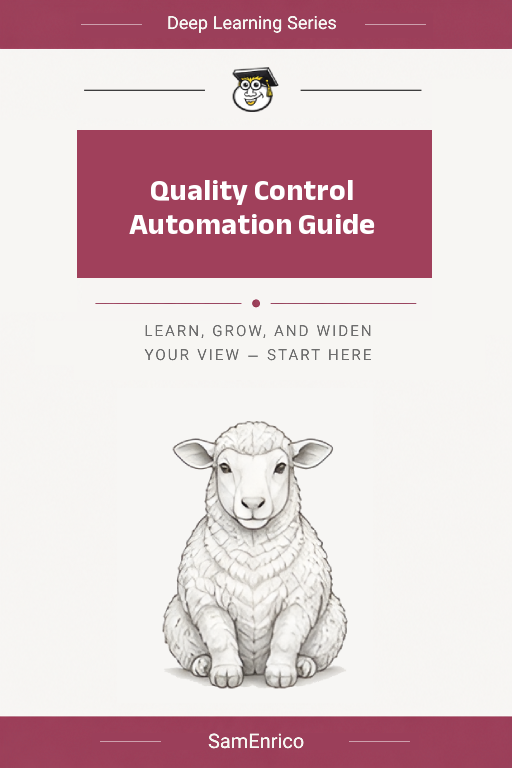
Quality Control Automation Guide
Implement AI workflows that flag quality issues in
Implement AI workflows that flag quality issues in production or service delivery for ops review.
Formats
About this book
Free sample
Chapter 1: The Silent Crisis--–- The production line hummed at 120 units per minute. Sixteen human inspectors stood at eight stations, each watching the same assembly point for the same three defects. In an eight-hour shift, each inspector would blink approximately 28,800 times. Each blink lasted one-tenth of a second. During those blinks, 120 units passed uninspected.
Multiply that by sixteen inspectors, and the math becomes terrifying: over 2,000 units per minute, every minute of every shift, escaped visual inspection simply because humans blinked.This is not a story about lazy workers or bad processes. This is a story about biology. The human eye was never designed for modern production speeds. It was designed to spot a predator in a savanna—a once‑every‑few‑minutes task, not a 120‑units‑per‑minute marathon. And yet, for over a century, we have asked human eyes to do exactly that.
We have built quality systems on a biological foundation that is fundamentally mismatched to the task.The result is a silent crisis. Not the kind of crisis that makes headlines—no factory explosion, no product recall that wipes out a quarter’s profits. The silent crisis is the slow, steady erosion of quality that happens every day, on every line, in every service center, because the tools we use to catch defects were designed for a world that no longer exists.The Great Disconnect: What We Inspect vs. What We Produce Walk into any manufacturing plant built before 2015, and you will find the same quality control pattern. An inspector stands at the end of a line, visually checking a sample of what just came off the line.
Maybe one part in fifty. Maybe one in a hundred. If the defect rate is low—say, 0.5 percent—that sampling strategy misses the vast majority of defects. At a 0.5 percent defect rate and a 2 percent sample rate, the probability of catching a specific defective unit is approximately 0.01 percent. Put differently: ninety‑nine defective units out of every hundred will sail past the inspector and into the hands of customers.This is not hypothetical.
A global automotive manufacturer studied their final inspection process across three plants. They found that human inspectors, working under realistic…
This is the end of the free sample. Get the eBook to keep going. Buy now
Contents
- Chapter 1
- Chapter 2
- Chapter 3
- Chapter 4
- Chapter 5
- Chapter 6
- Chapter 7
- Chapter 8
- Chapter 9
- Chapter 10
- Chapter 11
- Chapter 12
Details
- Author
- Crider Weldon
- Publisher
- SamEnrico
- Language
- English
- Genre
- Non-Fiction, AI Operator, Quality Assurance
- Released
- 2026-06-01
- Pages (approx.)
- 155
- Available as
- eBook, Audiobook

Read better in the ZLOADR app
Your eBooks on your phone or tablet. Sign in with your SamEnrico account and start reading.
More by Crider Weldon
 Navigating Pregnancy Loss DiscussionsCrider Weldon$11.99
 MBSR for Athletes CourseCrider Weldon$11.99
 The Loving Kindness MBSR IntegrationCrider Weldon$11.99
 Teen Self Esteem and ExerciseCrider Weldon$11.99
 Ayurvedic Meditation GuideCrider Weldon$11.99
 The Bard and the King: Taliesin and the Birth of Welsh MythCrider Weldon$11.99
 Ghana Dropshipping Legal RequirementsCrider Weldon$12.99
 How to Start a Central Greasing Systems Business (Beginners Guide)Crider Weldon$11.99
 Understanding Methylcobalamin Deficiency Cbl G TypeCrider Weldon$17.99
 Tree Planting (Machine-aided)Crider Weldon$11.99
You may also like
 Contract Abstraction Quality ControlMcelroy Hui$11.99
 AI Code Smell Detection GuideIrwin Shenita$12.99
 Prompt Validation for Business RulesThibodeaux Elane$12.99
 AI for Test Failure DebuggingCrider Garret$12.99
 AI for Security Vulnerability DetectionIrby Maya$12.99
 AI for Performance Issue DetectionMaurer Tawanda$12.99
 AI for Code Review AutomationLundy Vada$12.99
 AI Debugging Assistant GuideIrizarry Laronda$12.99
 AI Code Review Checklist GenerationCaron Glinda$12.99
 Content Quality Review AI GuideOrosco Nery$12.99
 AI for Log Analysis & DebuggingBoudreaux Shelby$12.99
 AI for Automated Code Fix SuggestionsIbarra Laurena$12.99