
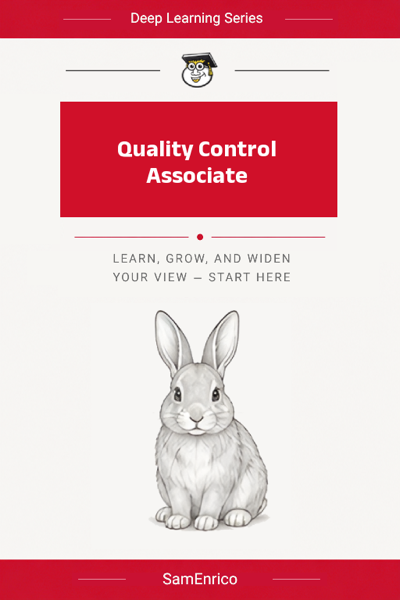
Non-FictionInformativeEducational
Quality Control Associate eBook
A Coursebook on Quality Control Associate
by Mock Larry
A Coursebook on Quality Control Associate
Formats
Free sample
Chapter 1: The Silent Guardians--–- Every minute of every day, somewhere in the world, a product fails. A pacemaker stops pacing. A brake caliper cracks. A child’s toy releases a toxic dye. And long before any of those failures reached a customer, someone had the chance to stop it.
That someone is you—or someone in a role very much like the one you are about to learn. This book is not about abstract theories of quality. It is about the hard, precise, often thankless work of being the last pair of eyes, the final measurement, the ultimate verdict between “ship” and “scrap.” You are about to become a silent guardian.The title Quality Control Associate sounds modest, even bureaucratic. In practice, it is one of the most leverage-intensive jobs in any industry. A single correct measurement can save a company millions in recalls.
A single overlooked burr can ground an aircraft. This chapter answers the most important question you can ask at the start of this journey: What exactly does a Quality Control Associate do, and why does it matter so much? We will tear down the myths—that QC is boring, that it is just checking boxes, that anyone can do it. Then we will rebuild the role from first principles: the philosophy of quality, the critical distinction between quality control and its cousins (assurance and management), the daily battlefield of incoming, in-process, and final inspection, and finally, the career path that turns a checkpoint into a calling.The Philosophy of Quality: Three Voices, One Truth Before you pick up a caliper or fill out a non-conformance report, you need to understand what “quality” actually means. The word is used so loosely in everyday life—“quality shoes,” “quality time”—that it loses its edge.
In manufacturing, pharma, aerospace, and every other industry that employs QC Associates, quality has three precise, competing, and complementary definitions. Each comes from a towering figure in the field. You do not need to memorize their biographies, but you must internalize their logic.Philip Crosby argued that quality is simply conformance to requirements. Not elegance. Not luxury.
Conformance. If the specification says a shaft must be 10.00 mm ± 0.05 mm, then a shaft measuring 10.04 mm is quality; a shaft measuring 10.06 mm is not. Period. Crosby’s definition is brutally efficient—it removes subjective judgment. But it also has a weakness: garbage requirements produce garbage “quality.” If the spec is wrong, conformance becomes a lie.Joseph Juran offered a more customer-centric view: fitness for use.
A product has quality if it actually does what the user needs it to do. A shaft can conform perfectly to a bad spec and still be unfit for use. Juran forces you to ask: “Fit for whose use? Under what conditions?” This introduces context, which is both a strength (realism) and a complication (subjectivity).W. Edwards Deming took a third path: quality is continuous reduction of variation.
Any process, no matter how good today, can be made more consistent tomorrow. Deming’s view is the engine behind statistical process control (which you will master in Chapter 7). For Deming, quality is not a destination; it is a direction.A good QC Associate uses all three lenses depending on the situation. When you inspect an incoming lot against a purchase order, you are a Crosby disciple. When you question whether a barely-within-tolerance part will survive field conditions, you become a Juran pragmatist.
When you chart measurement data and see a trend toward the upper limit, you turn into a Deming diagnostician. None of these views cancel the others. They form a toolkit.The Critical Distinction: QC vs. QA vs. QMOne of the most persistent confusions in the industry is the difference between Quality Control (QC), Quality Assurance (QA), and Quality Management (QM).
You will hear people use the terms interchangeably. They are wrong. Understanding the distinction is not pedantry—it determines your daily work, your authority, and your career ceiling.Quality Control is detection. You are the inspector. You measure, test, and judge.
You do not change the process (that is engineering). You do not design the system (that is QA). Your job is to answer one question: Does this unit conform to the requirement right now? QC is reactive, but do not mistake reactive for unimportant. Without detection, prevention is blind.Quality Assurance is prevention.
QA engineers design the process so that defects are less likely to occur in the first place. They write procedures, validate equipment, train operators, and audit systems. QA asks: How can we make it impossible to produce a bad part? If QC is the safety net, QA is the harness.Quality Management is strategy. QM is the system that oversees both QC and QA.
It sets policy, allocates resources, defines metrics, and drives continuous improvement at the organizational level. A Quality Manager might never touch a part. But they decide how many QC Associates to hire, what gages to buy, and what escalation path non-conformances follow.As a QC Associate, you operate squarely in the detection space. But you must understand QA and QM because your work feeds into both. Every non-conformance you document becomes a data point for QA to prevent recurrence.
Every trend you spot becomes a signal for QM to reallocate resources. You are not alone. You are the eyes of a larger body.The Daily Battlefield: Incoming, In-Process, and Final Inspection Your typical day will be organized around three inspection gates. Every product, in every industry, passes through these gates—though the specific methods differ wildly between, say, a pharmaceutical cleanroom and an automotive stamping plant.Incoming Inspection is the first line of defense. Raw materials, components, subassemblies—everything that arrives from a supplier—lands on your table (or CMM, or vision system).
Your job is to verify that what was ordered is what was delivered. Dimensional tolerances. Material certifications. Packaging integrity. Lot numbers.
You are not trusting the supplier’s certificate of analysis; you are verifying it. The stakes are simple: if a bad component gets past incoming inspection, every downstream process is wasted. Rework, scrap, and delays all trace back to that first missed measurement.In-Process Inspection happens while the product is being made. This is the most varied gate. In a machining line, you might check a critical diameter after the third operation.
In a PCB assembly plant, you might inspect solder paste deposition before reflow. In a pharmaceutical plant, you might test in-process blend uniformity before tableting. The common thread: you are catching defects early, when rework is cheap. Waiting until final inspection to find a problem means scrapping or reworking an almost-finished product—expensive and demoralizing.Final Inspection is the last gate before shipping. This is the QC Associate as border guard.
Every requirement that matters to the customer is checked here. Some industries call it “final release.” Others call it “shipping inspection.” Whatever the name, it carries legal weight. In medical devices, a final inspection signature is a declaration that the device meets its regulatory requirements. In food production, it is a statement that the batch is safe. Never sign a final inspection release lightly.Each of these inspection gates has its own sampling plans, measurement tools…
This is the end of the free sample. Get the eBook to keep going. Buy now
About this book
Details
- Author
- Mock Larry
- Publisher
- SamEnrico
- Language
- English
- Genre
- Non-Fiction, Informative, Educational
- Released
- 2026-05-04
- Pages (approx.)
- 157
- Available as
- eBook, Audiobook

Read better in the ZLOADR app
Your eBooks on your phone or tablet. Sign in with your SamEnrico account and start reading.
More by Mock Larry
 Prison Dream Symbolism CourseMock Larry$11.99
 Parenting Without Wine A HandbookMock Larry$11.99
 OKRs for Marathon TrainingMock Larry$11.99
 Meth Employment Return GuideMock Larry$11.99
 The Duke and the Dancer: A Forbidden Waltz in WartimeMock Larry$11.99
 Understanding Idiopathic Dilation CardiomyopathyMock Larry$17.99
 Drone Crop Spraying GuideMock Larry$12.99
 Cross Border Duty Minimization HandbookMock Larry$12.99
 Ultimate Handbook Guide to Toluca : (Mexico) Travel GuideMock Larry$11.99
You may also like
 Hong Kong Handover 1997Dunn Johnnie$11.99
 Zumba For Postnatal Recovery CourseNeal Christian$11.99
 Zumba for BeginnersLadner Nikia$11.99
 YouTube Comment Mining GuideHumes Pandora$12.99
 Worry Box MeditationCarlin Rudy$11.99
 Workplace Stress MeditationNguyen Lynn$11.99
 Workplace Stress and Sleep RepairHawley Ivory$11.99
 Workplace Perfectionism CureDelaney Jeffry$11.99
 Workplace Injustice Anger GuideWallen Isabelle$11.99
 Work Addiction and Burnout LinkGreenwood Ester$11.99
 Women in Yoga and WellnessBeattie Galina$11.99
 Women in Stand Up ComedyChun Evangeline$11.99