
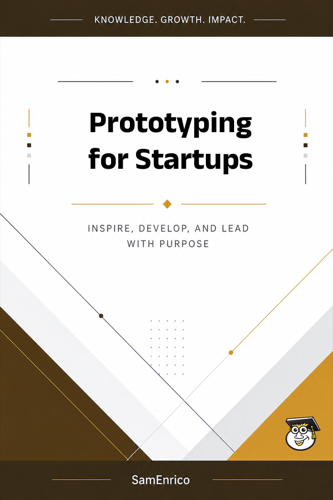
Prototyping for Startups eBook
Rapid validation of business ideas.
by Caswell Mica
Rapid validation of business ideas.
Formats
Free sample
Chapter 1: The Graveyard of Good Intentions--–- The first thing you need to understand about failure is that it does not arrive with a crash. It arrives with a whisper. A slow leak. The gradual realization, six months and sixty thousand dollars into a project, that the thing you are building has become a religion rather than a business. You stop asking "should this exist?" and start asking "how do I convince people this should exist?" That shift—from curiosity to advocacy—is the moment your startup dies.
Most founders never notice the funeral.Let me tell you about the graveyard.It is not a physical place, though it could be. Imagine a vast, empty warehouse filled with servers running code that no one ever asked for. On those servers are apps for dog owners who never downloaded them, platforms for freelancers who never signed up, and marketplaces for buyers and sellers who never met. The code is elegant. The architecture is scalable.
The logos are beautiful. And the only user is the founder, refreshing their analytics dashboard at 2am, hoping that today will be different.I know this graveyard because I built a monument in it.My monument was a smart fridge app. This was during the gold rush of connected devices, when every venture capitalist believed that the refrigerator was the next frontier of e-commerce. The idea was simple: a camera inside your fridge would recognize when you were low on milk, eggs, or butter, and automatically reorder them from your local grocery store. No more sticky notes.
No more emergency runs. Just abundance, automated.I spent nine months building it. Not nine months of nights and weekends—nine months of full-time, burn-through-your-savings, ignore-your-friends, tell-your-parents-you're-doing-something-important building. I hired designers. I hired engineers.
I negotiated API access with three grocery chains. I filed for a patent. I named the company. I designed the logo. I rehearsed the pitch.The app worked perfectly.
On the day of launch, I opened my own refrigerator, watched the camera detect my low milk supply, and received a notification that my order had been placed. I felt like a god.Then I showed it to seven other people.Seven strangers, recruited through a combination of Facebook ads and desperate pleas to friends of friends. I sat across from them in a coffee shop, my laptop open, my heart pounding, as they opened the app for the first time. I watched their faces. I watched their fingers.
I watched them tap the buttons I had designed, navigate the flows I had architected, and experience the magic I had created.Four of them could not figure out how to connect the app to their refrigerator. Two of them asked why they would need automatic ordering when they lived two blocks from a grocery store. One of them said, "This feels like a solution in search of a problem."That was the kindest response.The app died three months later. Not because the code was buggy. Not because the marketing was weak.
Not because the grocery partners backed out. It died because seven people in a coffee shop looked at it and felt nothing. They did not need it. They did not want it. They did not care.Ninety percent of new products suffer the same fate.
Not a slow decline into irrelevance, but a sudden, brutal realization: no one asked for this. The statistic comes from Alberto Savoia, a former Google engineer who analyzed over one hundred thousand new products across multiple industries. His finding was consistent regardless of sector, team size, or investment level. Nine out of ten ideas fail not because of poor execution, but because of a lack of market demand.Let me repeat that, because it is the single most important sentence in this book: Most products fail because nobody wants them, not because they are built poorly.This is what I call the Law of Market Failure. It is the gravity of entrepreneurship.
You cannot negotiate with it. You cannot outsmart it. You cannot hire a growth marketer to fix it. The only thing you can do is detect it early, before you have spent nine months and sixty thousand dollars building a monument to your own ego.The Fallacy That Kills Startups There is a myth that circulates through startup culture like a virus. It appears in blog posts, podcast interviews, and the origin stories of successful founders.
The myth goes like this: a visionary entrepreneur sees a future that no one else can see, ignores the skeptics, builds their product in secrecy and defiance, and emerges to a world that suddenly recognizes the brilliance that was there all along.This is the "Field of Dreams" fallacy. It takes its name from the 1989 film in which a voice whispers to an Iowa farmer, "If you build it, he will come." The farmer builds a baseball diamond in his cornfield, and sure enough, the ghost of Shoeless Joe Jackson arrives to play.Entrepreneurs love this story. They love it because it replaces the messy, uncertain work of customer discovery with the clean, heroic work of solitary creation. The farmer did not interview baseball fans. He did not run a smoke test on his cornfield.
He simply believed, and belief was enough.In movies, belief is enough. In real life, belief is a liability.The most dangerous sentence a founder can utter is not "we are running out of money." The most dangerous sentence is "I just know people will want this." That sentence is dangerous because it sounds like confidence, feels like conviction, and acts as a shield against evidence. Once you have decided that you know, you stop looking. You stop testing. You stop learning.
You start building.Consider the cautionary tale of Webvan, a grocery delivery startup that raised eight hundred million dollars in the late 1990s. Eight hundred million dollars. They built massive automated warehouses, purchased a fleet of delivery vans, and expanded to twenty-six cities before they had validated whether customers actually wanted groceries delivered. They assumed that convenience would win. They assumed that the future was obvious.
They were wrong. Webvan filed for bankruptcy in 2001, having burned through every dollar. Customers did not care enough to change their behavior.Or consider the Segway. Before its launch, the device was code-named "Ginger" and surrounded by such secrecy that pundits speculated it would change the shape of cities, replace the automobile, and revolutionize human transportation. The inventor, Dean Kamen, believed so deeply in his creation that he dismissed early skeptics as lacking vision.
The Segway launched to enormous fanfare. And then? It solved a problem that almost no one had. Walking was fine. Bicycles were fine.
Cars were fine. The Segway found a niche in tours, security patrols, and mall cops, but it never came close to the revolution its inventor imagined.These are not stories of bad engineering. Webvan's warehouses were marvels of automation. The Segway's gyroscopic stabilization was a genuine breakthrough. They failed because they were answers to questions no one was asking.Buildability vs.
Desirability: The Critical Distinction Here is a framework that will save you years of wasted effort. Draw a line down the…
This is the end of the free sample. Get the eBook to keep going. Buy now
About this book
Details
- Author
- Caswell Mica
- Publisher
- SamEnrico
- Language
- English
- Genre
- Non-Fiction, Self-Help, Startup
- Released
- 2026-06-05
- Pages (approx.)
- 142
- Available as
- eBook, Audiobook

Read better in the ZLOADR app
Your eBooks on your phone or tablet. Sign in with your SamEnrico account and start reading.
More by Caswell Mica
 Nose Touching DeceptionCaswell Mica$11.99
 TRIZ Problem Solving GuideCaswell Mica$11.99
 Self Hypnosis for Tension HeadachesCaswell Mica$11.99
 Remote Work Tax GuideCaswell Mica$11.99
 Self Esteem for MinoritiesCaswell Mica$11.99
 Conversation Starters for ConcertsCaswell Mica$11.99
 Parental Anger After AdoptionCaswell Mica$11.99
 The Sultan's Stolen Steeds: The Crime That Sparked Ottoman ReformCaswell Mica$11.99
 The Unseen Playbook: How Bill Belichick’s Obsession with Film Changed Football ForeverCaswell Mica$11.99
 WindsurfingCaswell Mica$11.99
 Launching A Youtube Channel For Your Brand FoundationsCaswell Mica$12.99
 Belgian ARES Scholarships GuideCaswell Mica$12.99
You may also like
 Hong Kong Handover 1997Dunn Johnnie$11.99
 Zumba For Postnatal Recovery CourseNeal Christian$11.99
 Zumba for BeginnersLadner Nikia$11.99
 YouTube Comment Mining GuideHumes Pandora$12.99
 Worry Box MeditationCarlin Rudy$11.99
 Workplace Stress MeditationNguyen Lynn$11.99
 Workplace Stress and Sleep RepairHawley Ivory$11.99
 Workplace Perfectionism CureDelaney Jeffry$11.99
 Workplace Injustice Anger GuideWallen Isabelle$11.99
 Work Addiction and Burnout LinkGreenwood Ester$11.99
 Women in Yoga and WellnessBeattie Galina$11.99
 Women in Stand Up ComedyChun Evangeline$11.99