
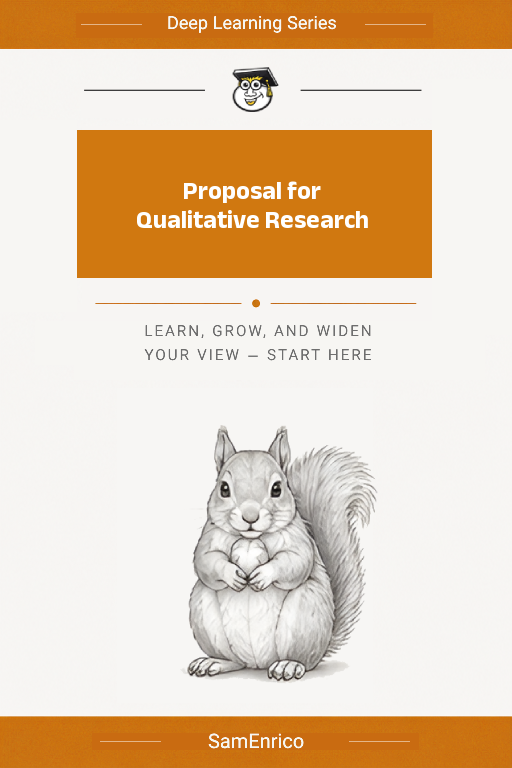
researchStudent's ShortcutQualitative Methods
Proposal for Qualitative Research
Frame interview, ethnographic, or case study propo
by Gale Janine
Frame interview, ethnographic, or case study proposals with trustworthiness strategies and analytic approaches.
Formats
About this book
Free sample
Chapter 1: The Design Mindset--–- Every year, thousands of dissertation proposals and funding applications are rejected not because the research idea lacks merit, but because the proposal fails to convince reviewers that the findings will be trustworthy. The tragedy is that most of these rejections could have been prevented if the researcher had understood one fundamental shift in thinking: trustworthiness is not something you check at the end of a study; it is something you design into the proposal from the very first page.This opening chapter dismantles the most pervasive and damaging misconception in qualitative proposal writing: the belief that trustworthiness strategies—member checking, triangulation, audit trails—are post-data-collection activities. This chapter reframes trustworthiness as a design problem, introduces the concept of the Audit Trail Mindset, and provides the foundational tools that will be used throughout every subsequent chapter of this book.By the end of this chapter, you will understand why most qualitative proposals fail before a single interview is conducted, you will be able to distinguish quantitative validity from qualitative trustworthiness, and you will complete a Trustworthiness Planning Table that will become the backbone of your entire proposal.The Hidden Failure Mode of Qualitative Proposals Let us begin with a scene that plays out in committee rooms and funding agencies every month. A doctoral student submits a proposal for a qualitative interview study. The research question is interesting.
The literature review is thorough. The methods section describes semi-structured interviews with fifteen participants. Then, buried near the end, the student writes: "Data will be analyzed using thematic analysis. Trustworthiness will be ensured through member checking and triangulation."The committee member sighs. The proposal is rejected.
Why?Because the student has treated trustworthiness as an incantation—a magic word spoken at the end to ward off criticism. The proposal never explains how member checking will be conducted (Will participants review transcripts? Themes? Both? What if they disagree?
What if they request redactions?). It never describes what will be triangulated (If only interviews are collected, what is being triangulated against what?). It never specifies when the audit trail will be…
This is the end of the free sample. Get the eBook to keep going. Buy now
Contents
- Chapter 1
- Chapter 2
- Chapter 3
- Chapter 4
- Chapter 5
- Chapter 6
- Chapter 7
- Chapter 8
- Chapter 9
- Chapter 10
- Chapter 11
- Chapter 12
Details
- Author
- Gale Janine
- Publisher
- SamEnrico
- Language
- English
- Genre
- research, Student's Shortcut, Qualitative Methods
- Released
- 2026-06-01
- Pages (approx.)
- 160
- Available as
- eBook, Audiobook

Read better in the ZLOADR app
Your eBooks on your phone or tablet. Sign in with your SamEnrico account and start reading.
More by Gale Janine
 The Seated Body Scan GuideGale Janine$11.99
 Extrovert Loneliness GuideGale Janine$11.99
 Cape Town SaaS Startup GuideGale Janine$11.99
 Mindfulness for the Open OfficeGale Janine$11.99
 Clomiphene for Low TestosteroneGale Janine$11.99
 The Last Pharaoh’s Gambit: Cleopatra’s Secret Alliance with CaesarGale Janine$11.99
 Leaked: The Secret Tapes of Prince Harry and Chelsea HandlerGale Janine$11.99
 Understanding Chagas DiseaseGale Janine$17.99
 Subclass 189 Independent VisaGale Janine$12.99
 How to Start a Riding Stables BusinessGale Janine$11.99
 Cypress HarvestingGale Janine$11.99
You may also like
 Scientific Research On TM GuideMartens Nathanial$11.99
 Research Proposal Methodology Section MasteryPauley Debroah$11.99
 Research Proposal Appendix CompilationRaines Tyisha$11.99
 Academic Researcher Distraction GuideFord Virgil$11.99
 TM Research and ScienceCovert Nicki$11.99
 Social Anxiety Research ReviewRoberge Cole$11.99
 Research Proposal Significance Section GuideBock Tory$12.99
 Research Proposal Reviewer PsychologyLugo Tawanda$11.99
 Research Proposal Research Questions DesignLara Robbi$11.99
 Research Proposal References and CitationsPatten Shanice$11.99
 Research Proposal Mixed Methods DesignCameron Omega$11.99
 Research Proposal Data Management PlanAnderson Roberto$12.99