
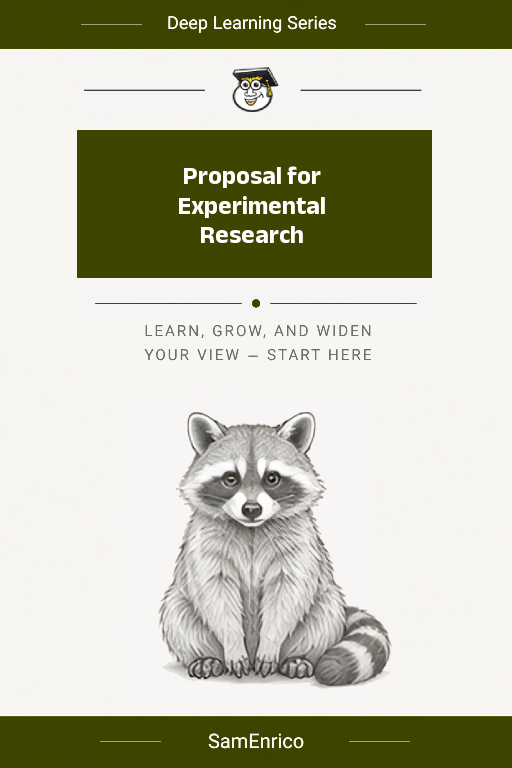
researchStudent's ShortcutExperimental Design
Proposal for Experimental Research
Design controlled experiments for STEM or social s
Design controlled experiments for STEM or social science proposals including randomization, blinding, and protocols.
Formats
About this book
Free sample
Chapter 1: The Replication Epidemic--Imagine, for a moment, that you are a patient diagnosed with a serious illness. Your doctor explains that a widely prescribed drug has been shown in a major study to reduce mortality by 40 percent. You take the drug. Later, you learn that another team of researchers tried to replicate that landmark study – and found no effect whatsoever. The original result was a false positive, a statistical ghost.
The drug you took was no better than a sugar pill. This is not a hypothetical nightmare. It has happened. It happens more often than any of us would like to admit.In 2015, the Reproducibility Project in psychology attempted to replicate one hundred studies published in top journals. Only thirty-six percent produced statistically significant results in the replication attempt, compared to ninety-seven percent in the original studies.
The average effect size in the replications was half that of the originals. In cancer biology, a similar effort found that only eleven out of fifty-three landmark studies could be reproduced. In economics, roughly sixty percent of published results held up in large-scale replication efforts. These numbers are not fringe findings. They are the skeleton key to understanding why this book exists.The replication crisis – or, as some prefer, the credibility revolution – has exposed a uncomfortable truth.
A great deal of published research, including research that shapes medical guidelines, public policy, and technological development, may be unreliable. Not because of fraud. Not because of gross incompetence. But because of subtle, pervasive flaws in experimental design: underpowered samples, flexible analysis choices, unplanned multiple comparisons, lack of blinding, inadequate randomization, and post-hoc hypothesizing. These are not mysteries.
They are known problems with known solutions.Yet most researchers learn these solutions piecemeal – a lecture on power analysis here, a passing mention of randomization there, a footnote about pre-registration in a methods textbook. No single resource ties everything together into a coherent, actionable framework for designing experiments that can withstand scrutiny. Worse, the pressure to publish, to secure grants, to produce novel findings, actively encourages the very practices that make replication unlikely. The system incentivizes speed over…
This is the end of the free sample. Get the eBook to keep going. Buy now
Contents
- Chapter 1
- Chapter 2
- Chapter 3
- Chapter 4
- Chapter 5
- Chapter 6
- Chapter 7
- Chapter 8
- Chapter 9
- Chapter 10
- Chapter 11
- Chapter 12
Details
- Author
- Waterman Jamee
- Publisher
- SamEnrico
- Language
- English
- Genre
- research, Student's Shortcut, Experimental Design
- Released
- 2026-06-01
- Pages (approx.)
- 156
- Available as
- eBook, Audiobook

Read better in the ZLOADR app
Your eBooks on your phone or tablet. Sign in with your SamEnrico account and start reading.
More by Waterman Jamee
 Pain Lying Down PracticeWaterman Jamee$11.99
 The Body Scan for BeginnersWaterman Jamee$11.99
 Kigali Female Founder GuideWaterman Jamee$11.99
 Testosterone Therapy Delivery MethodsWaterman Jamee$11.99
 Perfectionism Recovery for High AchieversWaterman Jamee$11.99
 The Unseen Visionary: How Ridley Scott Shaped Sci-Fi ForeverWaterman Jamee$11.99
 The Love Code: How Kim Kardashian and Pete Davidson’s Whirlwind Romance Redefined Modern MarriageWaterman Jamee$11.99
 Understanding ChancroidWaterman Jamee$17.99
 Global Talent Visa For GradsWaterman Jamee$12.99
 Design LeadWaterman Jamee$11.99
 How to Start a Retail Store BusinessWaterman Jamee$11.99
You may also like
 Scientific Research On TM GuideMartens Nathanial$11.99
 Research Proposal Methodology Section MasteryPauley Debroah$11.99
 Research Proposal Appendix CompilationRaines Tyisha$11.99
 Academic Researcher Distraction GuideFord Virgil$11.99
 TM Research and ScienceCovert Nicki$11.99
 Social Anxiety Research ReviewRoberge Cole$11.99
 Research Proposal Significance Section GuideBock Tory$12.99
 Research Proposal Reviewer PsychologyLugo Tawanda$11.99
 Research Proposal Research Questions DesignLara Robbi$11.99
 Research Proposal References and CitationsPatten Shanice$11.99
 Research Proposal Mixed Methods DesignCameron Omega$11.99
 Research Proposal Data Management PlanAnderson Roberto$12.99