
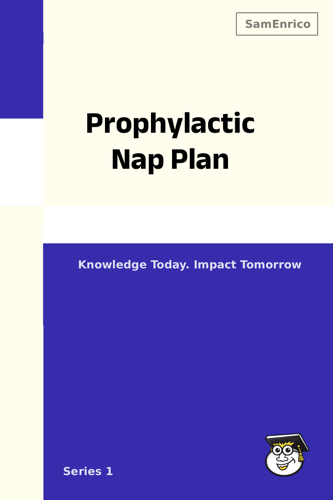
Non-FictionHealth & WellnessPrevention
Prophylactic Nap Plan eBook
Nap before expected sleep loss to build resilience
Nap before expected sleep loss to build resilience.
Formats
Free sample
Chapter 1: The Hidden Epidemic...--–- The exhaustion hit Sarah at 2:47 AM on a Tuesday. Not the gentle tiredness that signals bedtime, but the kind that arrives like a collapsing building—sudden, total, and terrifying. She was standing over an open surgical patient, her scalpel paused mid-motion, when she realized she could not remember the last three seconds. The scrub nurse had asked her a question. Sarah had heard words, but they had dissolved before reaching meaning.
Her attending surgeon, Dr. Chen, noticed the pause and stepped in seamlessly, completing the cut and murmuring, "You've been on for twenty hours. Step out. Now."Sarah walked to the on-call room, sat on the edge of the bed, and did something she had never done before in eight years of training: she wept. Not from sadness, but from recognition.
She had just experienced a micro-sleep while holding a scalpel. A three-second lapse that could have killed someone. And the worst part? She had seen it coming.For three days, her body had been sending her messages she chose to ignore. The yawning at 11 PM that lasted an hour.
The double vision when reading charts. The peculiar sensation of reading the same sentence four times without comprehension. The second wind at 1 AM—that deceptive burst of energy that is actually the brain flooding itself with stress hormones to keep a dying engine running. She had interpreted each signal as a challenge to overcome, a weakness to push through. She was training to be a surgeon, after all.
Surgeons don't rest. Surgeons endure.That night, Sarah made a decision that would shape her entire career. She stopped enduring. She started planning.By the time she finished her residency, Sarah had perfected what she called her "pre-game nap protocol." Before every overnight call, she slept for ninety minutes starting at 4 PM. Before every twenty-four-hour shift, she took a twenty-minute "caffeine nap" at the two-hour mark.
She tracked her chronotype, optimized her environment, and learned to distinguish between the tiredness that required rest and the tiredness that required only a strategic pause. Her error rate dropped forty-three percent. Her complication rate fell by more than half. And while her co-residents stumbled through their shifts in a fog of exhaustion and recovery, Sarah operated with a clarity they called "inhuman."She would correct them: it wasn't inhuman. It was prehab.The Epidemic We Refuse to Name Sarah's story is not exceptional.
It is archetypal. Every day, millions of people experience the same cascade of ignored signals, the same belief that exhaustion is a test of character rather than a biological fact, the same crash that could have been prevented if only they had rested before they needed it.We have a name for this phenomenon in sleep medicine, though you have almost certainly never heard it. It is called anticipatory fatigue—the predictable, preventable exhaustion that accumulates when we knowingly face a period of sleep loss without taking advance protective measures. Night shift workers who do not nap before their shift. Parents who wait for the baby to sleep before they rest.
Long-haul travelers who board planes already sleep-deprived. Students who pull all-nighters after a full day of classes. Emergency responders who report for twenty-four-hour shifts having slept normally the night before, as if a normal night prepares you for an abnormal day.Anticipatory fatigue is the hidden epidemic because it is normalized to the point of invisibility. We do not see it as a problem to solve but as a reality to accept. "Of course I'm tired," we say.
"I worked late. I have a newborn. I'm studying for the bar exam. I just flew across the Atlantic." We treat exhaustion as the inevitable price of a meaningful life, the receipt we show to prove we have been productive.But here is what the research shows, and what Sarah learned the hard way: anticipatory fatigue is not inevitable. It is a choice.
Specifically, it is the choice to wait until after the damage occurs to repair it, rather than strengthening the system before the strain begins.The False Binary: Sleepy vs. Not Sleepy Most people operate with a binary understanding of alertness: you are either tired or you are not. This framework is catastrophically wrong, and it is the primary reason prophylactic napping remains a radical idea rather than a routine practice.The reality is that alertness exists on a spectrum, and the relationship between sleep debt and performance is not linear but threshold-based. You can lose twenty percent of your optimal sleep and experience virtually no subjective fatigue while your objective performance has already declined by thirty percent. You can lose forty percent of your sleep and still believe you are "fine" while your reaction time has doubled and your error rate has tripled.
And then, somewhere between fifty and sixty percent sleep debt, the wall appears without warning. You are not gradually tired. You are suddenly non-functional.This is why people so often say, "I was fine until I wasn't." The crash feels sudden because the brain is evolutionarily designed to hide mild to moderate sleep debt from conscious awareness. Why? Because from an evolutionary perspective, the animal that feels tired when it is only mildly sleep-deprived is the animal that rests too often and gets eaten.
The brain prioritizes survival over accuracy. It tells you that you are functional long after you have stopped being functional.Consider the data. A study of medical interns published in the New England Journal of Medicine found that interns working traditional twenty-four-hour shifts made thirty-six percent more serious medical errors than those working sixteen-hour shifts. But when surveyed, the interns on twenty-four-hour shifts rated their own performance as only slightly worse than their better-rested colleagues. They did not know how impaired they were.
The brain protected them from the knowledge because the knowledge would not help them survive the shift.This is the trap. By the time you feel exhausted, you have already been impaired for hours. The signals you ignore—the yawning, the micro-sleeps, the decision fatigue—are not the beginning of the problem. They are the emergency broadcast system activating after the problem has been underway for some time.Acute Sleepiness vs. Cumulative Debt: A Crucial Distinction To understand why prophylactic napping works, we must first understand what it treats.
This requires a distinction that most sleep advice ignores: the difference between acute sleepiness and cumulative debt.Acute sleepiness is what you feel after a single night of insufficient sleep. You stayed up too late finishing a project, woke up early for a flight, or had a newborn who kept you up every two hours. You are tired, but your underlying physiology is largely intact. A single recovery nap—twenty minutes, ninety minutes, even just ten minutes in a parked car—can restore you to near-baseline function. Acute sleepiness is a shallow hole.
You can climb out quickly.Cumulative debt is different. Cumulative debt is what happens when acute sleepiness is repeated night after night, week after week, without full recovery. The body does not reset to zero each morning. Instead, it carries forward a deficit that compounds over time. After five nights of six hours…
This is the end of the free sample. Get the eBook to keep going. Buy now
About this book
Details
- Author
- Wilbur Janella
- Publisher
- SamEnrico
- Language
- English
- Genre
- Non-Fiction, Health & Wellness, Prevention
- Released
- 2026-06-10
- Pages (approx.)
- 154
- Available as
- eBook, Audiobook

Read better in the ZLOADR app
Your eBooks on your phone or tablet. Sign in with your SamEnrico account and start reading.
More by Wilbur Janella
 Immigrant Green Card Startup PathWilbur Janella$11.99
 Road Rage for Police OfficersWilbur Janella$11.99
 Depreciation for Startup EquipmentWilbur Janella$11.99
 Working Memory JournalWilbur Janella$11.99
 Egg Dream SymbolismWilbur Janella$11.99
 Corazon AquinoWilbur Janella$11.99
 Metta for a Hoarding ParentWilbur Janella$11.99
 NVC Workbook ExercisesWilbur Janella$11.99
 The Last Whisper of the Oracle: How Ancient Prophecies Shaped Modern WarsWilbur Janella$11.99
 The Sweet Deception: How Sugar Built Empires and Broke NationsWilbur Janella$11.99
 The Druid’s Code: A Spy Among the SidheWilbur Janella$11.99
 Smart City Technology ApplicationsWilbur Janella$11.99
You may also like
 Hong Kong Handover 1997Dunn Johnnie$11.99
 Zumba For Postnatal Recovery CourseNeal Christian$11.99
 Zumba for BeginnersLadner Nikia$11.99
 YouTube Comment Mining GuideHumes Pandora$12.99
 Worry Box MeditationCarlin Rudy$11.99
 Workplace Stress MeditationNguyen Lynn$11.99
 Workplace Stress and Sleep RepairHawley Ivory$11.99
 Workplace Perfectionism CureDelaney Jeffry$11.99
 Workplace Injustice Anger GuideWallen Isabelle$11.99
 Work Addiction and Burnout LinkGreenwood Ester$11.99
 Women in Yoga and WellnessBeattie Galina$11.99
 Women in Stand Up ComedyChun Evangeline$11.99