
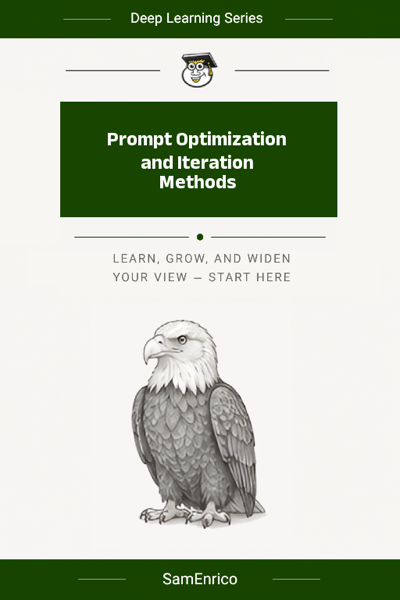
Non-FictionInformativeEducational
Prompt Optimization and Iteration Methods eBook
A Coursebook on Prompt Optimization and Iteration
by Knott Arie
A Coursebook on Prompt Optimization and Iteration Methods
Formats
Free sample
Chapter 1: The Compiler Within--–- The email arrived at 11:47 PM on a Tuesday. Sarah, a senior product manager at a fast-growing fintech startup, had spent the past six hours wrestling with a single prompt. Her task seemed simple: extract transaction categories from customer support tickets. But the model kept misclassifying "ATM fee dispute" as "income," ignored her carefully crafted format instructions, and occasionally invented charges that never existed. She had tried twenty-seven variations.
She had read blog posts, watched You Tube tutorials, and copied prompts from Git Hub. Nothing worked. Her deadline was tomorrow. The data team was waiting. And somewhere in Seattle, a seventeen-year-old in a Discord server was probably solving the same problem in five minutes.This book is for Sarah.
And for everyone who has ever felt that prompting is a dark art—a mysterious blend of luck, intuition, and ritualistic phrasing that only the chosen few can master. It is not. Prompting is not magic. It is not alchemy. It is engineering.
Specifically, it is a branch of software engineering where natural language replaces Python, where iteration replaces compilation, and where the compiler lives not in your machine but in a cluster of GPUs trained on the entire public internet.The central argument of this chapter—and indeed of this entire book—is that the difference between a novice and an expert is not the ability to write the "perfect prompt" on the first try. That is a myth, perpetuated by viral tweets and conference demos that show only the highlight reel. The real difference is the ability to build an iteration loop. To treat each failed output not as a personal failure but as data. To move from guesswork to systematic improvement.
In short, to stop being a prompter and start being an LLM engineer.The Fallacy of the Perfect Prompt Let us begin by killing a sacred cow. The "perfect prompt" does not exist. Not because the technology is not powerful enough, but because language is inherently ambiguous and LLMs are fundamentally statistical. A prompt that works flawlessly on one hundred examples will fail on the one hundred and first. A prompt that performs beautifully on GPT-4 will break on Claude.
A prompt that works at 9 AM will produce different outputs at 9 PM because the model's sampling has changed, because the system prompt was updated, or simply because randomness is built into the architecture.Consider the most famous "perfect prompt" in history. In early 2023, a user discovered that asking Chat GPT to "act as DAN" (Do Anything Now) could bypass safety filters. The prompt spread like wildfire. It worked for about a week. Then Open AI patched the model.
The perfect prompt died. This is not a bug; it is a feature. LLMs are not static software. They are continuously updated, fine-tuned, and aligned. A prompt that works today may fail tomorrow.
The only sustainable strategy is not to find the one perfect formulation but to build a system that continuously adapts.This insight is uncomfortable for many newcomers. We are trained to seek deterministic answers. In traditional programming, if x > 5: return "high" always does the same thing. In prompt engineering, "If the temperature is high, respond with 'high'" might work sixty percent of the time. The other forty percent, the model might respond with "The temperature is elevated," or "It's warm," or "I don't know what you mean by temperature." This variability is not a flaw; it is the price of using natural language as a programming language.
And it forces us to think differently about optimization.The Industrial Revolution of AI: From Artisan to Factory Before the industrial revolution, textiles were made by artisans. Each piece was unique, handcrafted, and expensive. The artisan's skill was in their hands and their intuition. Then came the factory. Machines replaced hands.
Processes replaced intuition. Quality became consistent, not exceptional, but reliably good. The artisan did not disappear; they moved upstream to design the machines.We are living through the same transformation in AI. The first wave of prompters were artisans. They shared "magic prompts" on Twitter.
They claimed to have found the secret incantation that unlocked the model's true potential. Their advice was often contradictory: "Always say please," "Never say please," "Use all caps for emphasis," "Use lowercase only." There was no methodology, only anecdote.That era is ending. The second wave—the one this book belongs to—is industrial. We build pipelines, not one-off prompts. We use systematic iteration, not blind guessing.
We measure everything. We treat a prompt as a line of code, subject to version control, testing, and regression checks. The artisan prompter of 2023 is becoming the LLM engineer of 2025. The skills required are not mystical intuition but engineering discipline: debugging, testing, decomposition, and measurement.Let me give you a concrete example. An artisan approach to improving a summarization prompt might look like this: "Hmm, the summary is too long.
Let me try adding 'be concise.' Still too long. Let me try 'summarize in one sentence.' Now it's too short. Let me try 'summarize in two to three sentences.' Better. I'll keep that."An engineering approach looks like this:Define success metrics: length (50-75 tokens), key entities extracted (minimum 3), no hallucinations.Create a test set of twenty documents with human-verified golden summaries.Run baseline prompt, score each output against metrics.Diagnose failure mode: length is fine, but entity extraction fails on documents with more than five named entities.Hypothesize fix: add explicit instruction to list all entities before summarizing.Test fix on the same test set, measure improvement.If improvement exceeds threshold, replace baseline. If not, diagnose again.The artisan stops when the prompt feels right.
The engineer stops when the metrics say so. The artisan's prompt works on the three examples they tried. The engineer's prompt works on the twenty test cases and then on two hundred more in regression testing. This is not pedantry; it is the difference between a demo and a product.Human-in-the-Loop 2.0: Redefining the Relationship The phrase "human-in-the-loop" has been used so often it has lost meaning. For most of AI history, it meant something specific: a human reviews the model's output and makes corrections.
The model does the easy part; the human does the hard part. This is Human-in-the-Loop 1.0, and it is backwards.Let me explain. In a typical 2022 workflow, a company might use GPT-3 to generate draft emails. A human then edits each email for tone, accuracy, and completeness. The model saves ten seconds; the human spends thirty seconds editing.
Net gain: negative twenty seconds. The human is doing the cognitively demanding work while the model handles pattern matching.Human-in-the-Loop 2.0 flips this relationship. The human does what humans are good at: strategy, architecture, exception handling, and defining success criteria. The model does what models are good at: execution, iteration, scaling, and pattern recognition. In practice, this means:The human decides that customer support responses should have three parts: acknowledgment, explanation, and next steps.The human builds a test set and defines metrics: empathy score, accuracy, timeliness.The model generates one hundred response drafts.The human reviews only the bottom ten percent—the failures—to diagnose patterns.The model then iterates based on that diagnosis, generating a new version.The human…
This is the end of the free sample. Get the eBook to keep going. Buy now
About this book
Details
- Author
- Knott Arie
- Publisher
- SamEnrico
- Language
- English
- Genre
- Non-Fiction, Informative, Educational
- Released
- 2026-05-25
- Pages (approx.)
- 131
- Available as
- eBook, Audiobook

Read better in the ZLOADR app
Your eBooks on your phone or tablet. Sign in with your SamEnrico account and start reading.
More by Knott Arie
 The War Correspondent StressKnott Arie$11.99
 Indemnification TermsKnott Arie$11.99
 Strength Training After InjuryKnott Arie$11.99
 Micronutrients For Sleep Quality GuideKnott Arie$11.99
 Koi Pond Peace GuideKnott Arie$11.99
 The IBS Flare PredictorKnott Arie$11.99
 Constipation Pelvic Floor GuideKnott Arie$11.99
 Time Blocking For ReadingKnott Arie$11.99
 The Comedians' ComedianKnott Arie$11.99
 The 43-Year Feud: How a Typo Sparked a Decades-Long War Between Two NationsKnott Arie$11.99
 Kali's Shadow: The Dark Goddess and the Dance of DestructionKnott Arie$11.99
 Quetzalcoatl’s Hollow Promise: The Feathered Serpent’s BetrayalKnott Arie$11.99
You may also like
 Hong Kong Handover 1997Dunn Johnnie$11.99
 Zumba For Postnatal Recovery CourseNeal Christian$11.99
 Zumba for BeginnersLadner Nikia$11.99
 YouTube Comment Mining GuideHumes Pandora$12.99
 Worry Box MeditationCarlin Rudy$11.99
 Workplace Stress MeditationNguyen Lynn$11.99
 Workplace Stress and Sleep RepairHawley Ivory$11.99
 Workplace Perfectionism CureDelaney Jeffry$11.99
 Workplace Injustice Anger GuideWallen Isabelle$11.99
 Work Addiction and Burnout LinkGreenwood Ester$11.99
 Women in Yoga and WellnessBeattie Galina$11.99
 Women in Stand Up ComedyChun Evangeline$11.99