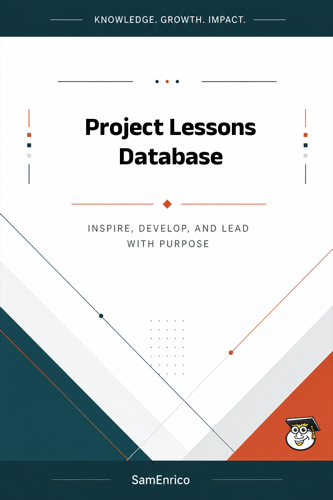
Project Lessons Database eBook
Store learnings for future project planning.
by Wynne Ahmad
Store learnings for future project planning.
Formats
Free sample
Chapter 1: The $75 Million Stupidity Tax--–- Every organization pays the stupidity tax. Most just don't know it yet.The email arrived at 11:47 on a Tuesday morning. Diane, a procurement manager with thirty-one years of experience, had just submitted her retirement paperwork. Her manager skimmed it, clicked "approve," and forwarded it to HR. Standard procedure.
No exit interview. No knowledge transfer. No one asked Diane what she knew.Six months later, Omega Tel—a mid-sized telecommunications equipment manufacturer—lost $75 million.Not because of a market crash. Not because of fraud. Not because of a natural disaster or a cyberattack or a global pandemic.Because of a typo.The typo lived in a master service agreement with Omega Tel's sole-source component vendor.
Somewhere in the dense legal language, a payment term read "net-90" instead of "net-30." That meant Omega Tel was paying its largest vendor sixty days early, every single month, for two consecutive years. The cumulative effect—lost interest, cash flow penalties, and missed investment opportunities—totaled $75 million.Here is the part that haunts the executives who still work there: Diane knew about the typo. She had discovered it in 2018, during her first month on the job. Every month, she manually adjusted the payment date in the accounting system. It took her twelve minutes.
She never documented the fix. She never told anyone. She just... handled it. Because that was Diane's job.
That was what good employees did.When Diane left, the typo stayed. The knowledge walked out the door with her coffee mug and her retirement cake.Omega Tel paid the stupidity tax.And so does your organization. Maybe not $75 million. Maybe not this quarter. But you are losing money right now—today—because someone in your company knows something that someone else does not, and there is no system to transfer that knowledge before it is too late.This book is the system.The Five Reasons Lessons Die Before we build the cure, we must understand the disease.
Over the past decade, I have studied project failures across forty-three organizations—from two-person startups to Fortune 500 construction firms. The same five killers appear in every single post-mortem, retrospective, and after-action review. They are not technical problems. They are not budget problems. They are memory problems.Reason 1: The Post-Mortem Graveyard Let me describe a ritual you have probably attended.The project ends.
Maybe it succeeded. Maybe it failed. Either way, the project manager schedules a two-hour meeting on a Friday afternoon. Someone books a conference room with a whiteboard and stale coffee. Fifteen people show up, most of them exhausted and ready for the weekend.For the first thirty minutes, everyone avoids conflict.
"Things went pretty well." "The team worked hard." "Communication could have been better." (The phrase "communication could have been better" is the project management equivalent of "thoughts and prayers"—it costs nothing and changes nothing.)For the next hour, three people dominate the conversation. The loudest voice in the room is rarely the wisest. They generate a list of forty-seven bullet points on a flip chart. Forty-six of them are either too vague ("improve stakeholder alignment") or too specific ("Jenny's laptop crashed on Tuesday, August 14").For the final thirty minutes, someone volunteers to "write up the lessons learned" and share them with the team. Everyone nods.
The meeting ends. The project manager sends an email with an attached Word document. The document is never opened again. It sits in a shared drive named "Lessons Learned" alongside sixty similar documents from the past five years. The folder is a graveyard.Here is what most organizations refuse to admit: that folder is not an asset.
It is a monument to wasted effort. Every hour spent creating a document that no one will ever read is an hour stolen from productive work.The post-mortem graveyard exists because we treat lessons as artifacts to be filed rather than insights to be applied. We mistake documentation for learning. We confuse activity with progress.Reason 2: Hero-Driven Knowledge Every organization has heroes. They are the people who "just know" how to fix the broken build, navigate the difficult client, or work around the broken process.
They are invaluable. They are also a catastrophic risk.Hero-driven knowledge is knowledge that lives only in one person's head. It is not written down. It is not stored in any system. It is transferred only through whispered conversations, late-night phone calls, and tribal apprenticeship.Here is what happens to hero-driven knowledge: it retires.
It quits. It gets hit by a bus. It transfers to a competitor. It gets promoted to a role where that specific knowledge no longer matters. And when the hero leaves, the knowledge leaves with them.The Omega Tel typo is a textbook example.
Diane was a hero. She fixed the problem every month, silently, competently, without drama. Her manager did not even know there was a problem to fix. Because Diane made it look easy, no one asked how she did it. And when she left, the organization discovered that her "easy" was actually a brittle, undocumented workaround that only she understood.Here is the uncomfortable truth about hero-driven knowledge: heroes are not the solution.
They are the symptom. An organization that relies on heroes has failed to build systems. Heroes exist because processes are broken, documentation is absent, and institutional memory is treated as optional.Reason 3: Retrospective Bloat The Agile movement gave us retrospectives. In theory, retrospectives are short, focused meetings where teams inspect and adapt. In practice, retrospectives have become bloated ceremonies that produce more noise than signal.Let me show you the math.A typical end-of-project retrospective lasts three hours.
Eight team members attend. That is twenty-four person-hours. If the average loaded cost of a team member is $75 per hour (conservative for professional services), that retrospective costs $1,800 in labor. Add the time spent preparing slides, booking rooms, and writing the final report. Call it $2,500.Now ask yourself: what is the return on that $2,500 investment?For most organizations, the return is zero.
The retrospective produces a list of observations. Those observations are never operationalized. They are never integrated into planning. They are never validated. They are simply...
collected. Like stamps. Like baseball cards. Like receipts for a business trip you forgot to expense.Retrospective bloat happens because we have confused frequency with effectiveness. A three-hour retrospective once per project is worse than useless.
It consumes resources, creates fatigue, and produces artifacts that no one trusts. The only thing worse than no retrospective is a bad retrospective, because a bad retrospective convinces everyone that retrospectives don't work.Reason 4: No Common Language Here is a thought experiment. Walk into your office and ask ten different people to define the following terms: risk, issue, lesson, insight, learning, and action item. Write down their answers.I have done this exercise with thirty-seven teams. The results are depressing.
One person's "risk" (something that might happen) is another person's "issue" (something that is already happening). One person's "lesson" (a specific observation about a specific event) is another person's "insight" (a general principle that might apply elsewhere). One person's "action item" (a task with a deadline) is another person's "suggestion" (an idea that might be worth considering).When teams lack a…
This is the end of the free sample. Get the eBook to keep going. Buy now
About this book
Details
- Author
- Wynne Ahmad
- Publisher
- SamEnrico
- Language
- English
- Genre
- Non-Fiction, Business Brief, Knowledge Management
- Released
- 2026-06-08
- Pages (approx.)
- 135
- Available as
- eBook, Audiobook

Read better in the ZLOADR app
Your eBooks on your phone or tablet. Sign in with your SamEnrico account and start reading.
More by Wynne Ahmad
 Seniors Walking Meditation CourseWynne Ahmad$11.99
 Dementia Prevention Lifestyle PlanWynne Ahmad$11.99
 Solo Drinking Recovery GuideWynne Ahmad$11.99
 Body Scan for High Blood PressureWynne Ahmad$11.99
 The Unseen Hand: How a Single Tweet Toppled a Billion-Dollar EmpireWynne Ahmad$11.99
 Understanding Nuchal Bleb, FamilialWynne Ahmad$17.99
 Albemarle ManufacturingWynne Ahmad$12.99
 International Student German Uni HandbookWynne Ahmad$12.99
 Shipping SpecialistWynne Ahmad$11.99
 How to Start a Orthopaedic Goods (wholesale) Business (Beginners Guide)Wynne Ahmad$11.99