
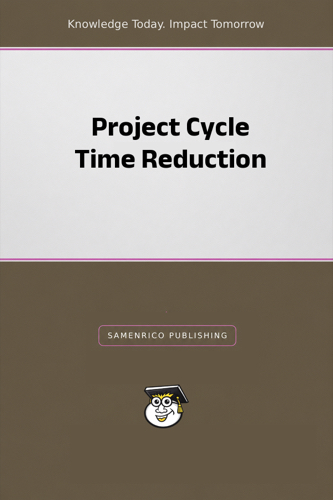
Project Cycle Time Reduction eBook
Shorten time from start to finish for all projects
Shorten time from start to finish for all projects.
Formats
Free sample
Chapter 1: The 4,000-Week Deadline--You don't have a time management problem.Let me say that again, because it will feel wrong at first. You have likely spent years searching for the perfect calendar app, the ideal to-do list system, the morning routine that will finally make you productive. You have attended time management seminars, read bestselling books about getting things done, and tried waking up at 5 AM. And yet, your projects still take too long. Deadlines still slip.
You still end most weeks wondering where the time went.The problem is not that you are managing your time poorly. The problem is that you are trying to manage time at all.Time management is a seductive lie. It promises that with enough optimization, enough discipline, enough systems, you can fit everything into the hours you have. But the hours you have are fixed. There are exactly 168 of them each week, and no amount of productivity hacking will create a 169th.
The average human lifespan contains about 4,000 weeks. If you are thirty-five years old and reading this book, you have roughly 2,000 weeks left. Two thousand. That is not a typo.This chapter will reframe everything you think you know about speed. It will introduce the concept of cycle time reduction—not time management, but something fundamentally different and far more powerful.
It will give you the mental models, the psychological tools, and the personal productivity systems you need to finish projects in half the time, without working more hours. And it will resolve a tension that most productivity books ignore: how to feel the weight of finite time without collapsing into burnout.The Difference Between Being Busy and Being Fast Let us start with a simple distinction that will change how you see every project you touch.Being busy means filling your time with activity. Being fast means minimizing the clock time between when a project starts and when it finishes. These are not the same thing. In fact, they are often opposites.A team can be extremely busy—sixty-hour weeks, working through lunch, answering emails at midnight—and still take a year to finish a two-month project.
Another team can work forty-hour weeks, take real lunch breaks, and finish the same project in three months. The difference is not effort. The difference is cycle time discipline.Consider two identical software development projects at two different companies. Both projects have the same scope, the same number of engineers, the same budget. The first company takes twelve months to ship.
The second company takes five months. When asked to explain the difference, the first company says, "We worked hard." The second company says, "We worked differently."What did the second company do differently? They did not work more hours. They worked fewer hours, in fact. But they eliminated waiting.
They reduced handoffs. They stopped starting new things before finishing old ones. They focused on the critical path and ignored everything else. In other words, they reduced cycle time.This book is about becoming the second company. It is not about getting more done in each hour.
It is about needing fewer hours to finish the same work. It is about compressing the calendar, not filling the clock.The Cycle Time Equation To understand how cycle time works, we need a simple formula. Do not worry—there will be no complex math in this book. But this equation is worth memorizing because it explains every technique you will learn in the chapters ahead.Cycle Time = (Total Work) / (Focused Action × Flow)Let us break that down.Total Work is the sum of everything you have to do. It includes two components: Scope (how many features, tasks, or deliverables) and Quality (how polished each one must be).
If you increase scope, cycle time goes up. If you increase quality, cycle time goes up. This seems obvious, but most people forget that they have control over both. Scope and quality are not fixed by the universe. They are choices.Focused Action is the amount of deep, uninterrupted, single-tasking work your team can do.
Multitasking is the enemy of focused action. Every time you switch between tasks, you lose twenty to forty minutes of cognitive momentum. A team that works on five projects at once has almost no focused action. A team that works on one project at a time has a great deal of it.Flow is the smoothness of your handoffs. When one person finishes a task, how quickly does the next person start?
When one department completes its work, how long does it wait before the next department receives it? Most cycle time is not spent doing work. Most cycle time is spent waiting.Here is the liberating implication of this equation: You can reduce cycle time by changing any of these variables. You do not have to work faster. You do not have to work longer.
You can reduce scope. You can reduce quality to an acceptable minimum. You can increase focused action by stopping multitasking. You can increase flow by eliminating waiting.This book will teach you how to do all four. But before we get to tactics, we need to talk about the one thing that makes all of this matter.The 4,000-Week Deadline The average human lifespan is about four thousand weeks.
That number comes from Oliver Burkeman's book Four Thousand Weeks: Time Management for Mortals, and it is meant to be unsettling. It is meant to make you realize that time is not an infinite resource to be optimized. It is a finite, non-renewable, and shockingly short gift.If you live to eighty, you get 4,160 weeks. If you are forty, you have already spent roughly half. If you are thirty, you have about 2,500 weeks left.
Every week you spend on a project that could have finished in half the time is a week you will never get back.I am not telling you this to make you anxious. Anxiety is not the goal. The goal is clarity. Most procrastination, most slow decision-making, most scope creep, most perfectionism—all of it comes from a subconscious belief that you have infinite time. You do not.
Accepting that fact should not crush you. It should liberate you. It gives you permission to say no. It gives you permission to ship imperfect work. It gives you permission to stop optimizing and start finishing.But here is a critical distinction that most productivity books miss.
There is a difference between existential urgency and daily panic.Existential urgency is the quiet, steady awareness that your weeks are numbered. It sits in the background like a gentle alarm. It does not make you frantic. It makes you selective. It asks, "Is this project worth one of your remaining weeks?" That is a useful question.Daily panic is the opposite.
It is the feeling of having seventeen urgent tasks, eleven unread emails, three back-to-back meetings, and a boss who needs something "by end of day." Daily panic makes you reactive. It destroys deep work. It creates faux urgency—the illusion of speed that actually slows everything down.This book will help you cultivate existential urgency while eliminating daily panic. You will learn to feel the weight of your 4,000 weeks…
This is the end of the free sample. Get the eBook to keep going. Buy now
About this book
Details
- Author
- Saldana Billy
- Publisher
- SamEnrico
- Language
- English
- Genre
- Non-Fiction, Business Brief, Cycle Time
- Released
- 2026-06-09
- Pages (approx.)
- 156
- Available as
- eBook, Audiobook

Read better in the ZLOADR app
Your eBooks on your phone or tablet. Sign in with your SamEnrico account and start reading.
More by Saldana Billy
 Walking Meditation For Kids HandbookSaldana Billy$11.99
 Art Class Cognitive StimulationSaldana Billy$11.99
 The Body Scan for Teachers GuideSaldana Billy$11.99
 Medical Careers Alcohol RecoverySaldana Billy$11.99
 The Blood and Glory of the Celtic Derby: A Clash of Celtic and Rangers in Ancient BritainSaldana Billy$11.99
 Stan Store Digital Product SellingSaldana Billy$11.99
 Production Leveling and Sequencing GuideSaldana Billy$12.99
 Understanding Occupational AsthmaSaldana Billy$17.99
 How to Start a Chimney Construction Business (Beginners Guide)Saldana Billy$11.99