
Non-FictionInformativeEducational
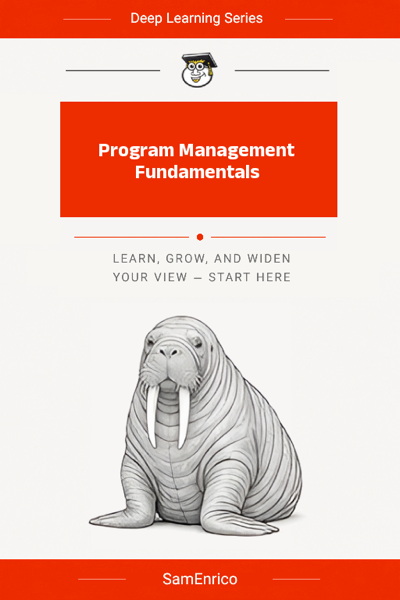
Program Management Fundamentals eBook
A Coursebook on Program Management Fundamentals
by Enos Troy
A Coursebook on Program Management Fundamentals
Formats
Free sample
Chapter 1: The Landscape of Value--The conference room on the forty-second floor smelled of stale coffee and expensive cologne. A vice president of strategy had just finished a twenty-slide deck arguing that the company needed to launch three new initiatives simultaneously. The room nodded politely. Then someone asked the question that no one wanted to answer: "Which of these actually connects to our five-year revenue target, and which ones are just busy work?"Silence. Then shuffling papers.
Then a quiet admission that no one had actually mapped the initiatives to measurable business outcomes.This scene plays out in organizations every single day. Not because people are lazy or incompetent, but because they confuse activity with progress. They mistake project completion for value creation. They deliver exactly what was asked for and then wonder why nothing changed.This chapter exists to close that gap. Before you can manage a program, you must understand what makes a program worth doing at all.
The answer is not a Gantt chart, a budget, or a steering committee. The answer is value. But not the vague, abstract value that consultants talk about over expensive dinners. Real value. Measurable value.
Strategic value that moves the needle for an organization.This chapter redefines the landscape of program management by anchoring everything that follows to a single question: does this program create strategic advantage? If the answer is no, nothing else matters. If the answer is yes, then every subsequent decision about governance, planning, risk, and team management serves that purpose.The Strategic Gap That Kills Programs Let us begin with a hard truth. According to decades of research from the Project Management Institute, approximately 67 percent of organizational strategies fail due to poor execution. This is not a problem of bad ideas.
It is a problem of failed translation.The typical sequence of failure looks like this. The C-suite develops a strategy. They communicate it through a series of town halls and email blasts. Middle managers interpret the strategy through their own filters. Projects are launched.
Resources are allocated. Work proceeds. And then, eighteen months later, the strategy has somehow become unrecognizable. What started as a bold plan to enter new markets has become a routine upgrade of an internal reporting system.This is the Execution Gap. It is the space between what leaders intend and what teams deliver.
And it is where programs go to die.Program management exists specifically to bridge this gap. A project manager ensures that work gets done correctly. A program manager ensures that the right work gets done at all. The distinction is subtle but profound. A project manager asks, "Are we building this product according to specifications?" A program manager asks, "Is this product still the right thing to be building, given our current market conditions and strategic priorities?"The difference between these two questions is the difference between efficiency and effectiveness.
Efficiency is doing things right. Effectiveness is doing the right things. Program management prioritizes effectiveness, then uses project management to ensure efficiency in service of that effectiveness.Redefining Value: Beyond Cost Savings Most business cases are works of fiction. They are written to justify decisions already made, not to test whether those decisions are sound. They exaggerate benefits, underestimate costs, and treat intangible value as an afterthought.
This chapter rejects that approach entirely.Value in program management must be defined with precision. There are two categories of value: tangible and intangible. Both matter. But they must be measured differently and reported separately.Tangible value is anything that can be counted, calculated, and verified. This includes revenue growth, measured in currency.
Cost reduction, measured in currency or percentage points. Market share gains, measured in percentage points. Productivity improvements, measured in output per labor hour. Cycle time reductions, measured in days or hours. Error rate reductions, measured in percentage points.
Compliance penalty avoidance, measured in currency.Tangible value is the easiest to defend and the hardest to fabricate. When a program claims it will reduce manufacturing defects by fifteen percent, that claim can be tested against historical data. When it claims that reduction will save two million dollars annually, that calculation can be audited. Tangible value creates accountability.Intangible value is more slippery but no less real. It includes brand reputation, which has no direct price tag but affects customer acquisition costs and premium pricing power.
Employee morale, which has no line on a balance sheet but drives retention, productivity, and innovation. Strategic positioning, which cannot be measured quarterly but determines long-term survival. Regulatory goodwill, which influences how aggressively regulators scrutinize the organization. Customer loyalty, which predicts future revenue more reliably than current revenue.The mistake most organizations make is ignoring intangible value because it is hard to measure. The better approach is to measure it imperfectly rather than not at all.
Use proxy metrics. Conduct surveys. Track sentiment analysis. Assign a confidence interval. But do not pretend intangible value does not exist simply because it is inconvenient.The Program Charter: Strategy Made Concrete Every program must begin with a single document that answers three questions.
Why are we doing this? What will be different when we are done? How will we know if we succeeded? That document is the Program Charter.The Program Charter is not a project charter scaled up. A project charter authorizes a project manager to spend money and use resources.
A Program Charter does that, but it also does something more important. It establishes the contract between the program and the organization. It defines the value the program promises to deliver and the metrics by which that delivery will be judged.A properly constructed Program Charter contains the following elements.First, the strategic linkage. This is a direct statement connecting the program to one or more organizational OKRs. Objectives and Key Results are a goal-setting framework popularized by John Doerr and used by companies from Google to the public sector.
An OKR has two parts. The Objective is a qualitative statement of what the organization wants to achieve, such as "Dominate the North American electric vehicle market." The Key Results are quantitative measures of progress toward that objective, such as "Achieve fifteen percent market share by Q4 of next year."The Program Charter must name the specific OKRs the program serves. If a program cannot be mapped to an OKR, it should not exist as a program. It might be a standalone project. It might be operational work.
But it is not a program, because it lacks strategic intent.Second, the business case. This is the quantitative justification for the program. It includes the estimated costs of the program, broken down by year and by major cost category. It includes the estimated tangible benefits, also broken down by year. It includes the net present value calculation, internal rate of return, payback period, and benefit-to-cost ratio.
These financial metrics are not optional. They are the language in which executives think about trade-offs.Third, the value framework. This is where intangible value is documented. The value framework names each intangible benefit, defines how it will be measured, identifies the baseline measurement taken before the program begins, and sets a target for improvement. For brand reputation, the measurement might be Net…
This is the end of the free sample. Get the eBook to keep going. Buy now
About this book
Details
- Author
- Enos Troy
- Publisher
- SamEnrico
- Language
- English
- Genre
- Non-Fiction, Informative, Educational
- Released
- 2026-06-02
- Pages (approx.)
- 151
- Available as
- eBook, Audiobook

Read better in the ZLOADR app
Your eBooks on your phone or tablet. Sign in with your SamEnrico account and start reading.
More by Enos Troy
 Indemnification Term Extraction GuideEnos Troy$11.99
 The Breath Candle AnalogyEnos Troy$11.99
 Event Planner Crisis GuideEnos Troy$11.99
 Progressive Peace ScriptEnos Troy$11.99
 Diver's Bioluminescent ArtEnos Troy$11.99
 Emotion Regulation for HSPEnos Troy$11.99
 Campus Assault SurvivorEnos Troy$11.99
 Rewiring Retirement IdentityEnos Troy$11.99
 Egyptian Music GuideEnos Troy$11.99
 The Lion of the Punjab: Ranjit Singh's Rise to Power (1799-1839)Enos Troy$11.99
 The Last Ride of the Pony Express: A Gallop Through History’s Fastest MailEnos Troy$11.99
 Black Sunday: The Storm That Broke the PlainsEnos Troy$11.99
You may also like
 Hong Kong Handover 1997Dunn Johnnie$11.99
 Zumba For Postnatal Recovery CourseNeal Christian$11.99
 Zumba for BeginnersLadner Nikia$11.99
 YouTube Comment Mining GuideHumes Pandora$12.99
 Worry Box MeditationCarlin Rudy$11.99
 Workplace Stress MeditationNguyen Lynn$11.99
 Workplace Stress and Sleep RepairHawley Ivory$11.99
 Workplace Perfectionism CureDelaney Jeffry$11.99
 Workplace Injustice Anger GuideWallen Isabelle$11.99
 Work Addiction and Burnout LinkGreenwood Ester$11.99
 Women in Yoga and WellnessBeattie Galina$11.99
 Women in Stand Up ComedyChun Evangeline$11.99