
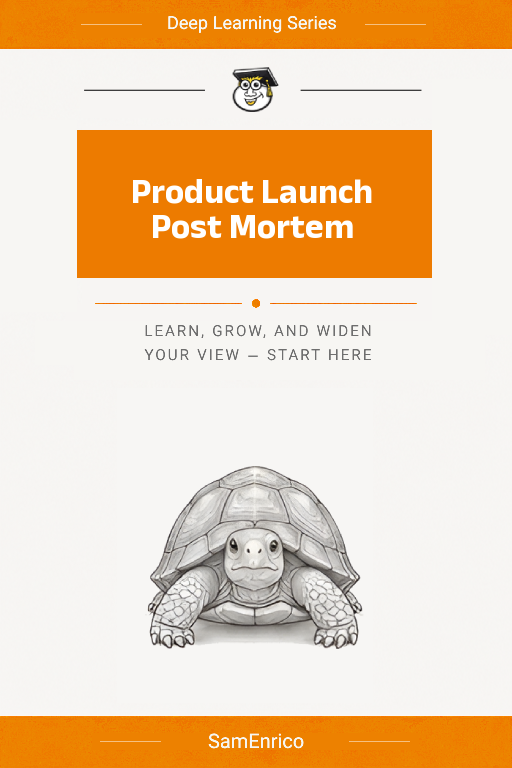
Non-FictionFirst 30 DaysRetrospective
Product Launch Post Mortem eBook
Analyze what worked and what didn't after launch t
Analyze what worked and what didn't after launch to improve next product cycle.
Formats
Free sample
Chapter 1: The Blame Trap--–- On a Tuesday morning in March, a senior product manager named Elena walked into a conference room to face twenty-seven angry faces. Her team had just spent nine months building a feature called "Instant Analytics" for a B2B Saa S platform. The launch, which had cost roughly $1.2 million in development and marketing, had generated exactly forty-seven signups in its first week. The target had been fifteen thousand. The CEO had called the meeting personally.
The title on the calendar invitation read, simply: "Lessons Learned."Elena had prepared a forty-two slide deck. She had categorized failures by function. She had identified seven "root causes" and proposed fourteen "action items." She was ready.The meeting lasted four hours. The CTO blamed Marketing for overpromising. The VP of Sales blamed Product for building the wrong thing.
The Head of Marketing blamed Engineering for delivering late. The CEO sat at the head of the table, arms crossed, saying almost nothing until the final fifteen minutes, when he asked a single question: "Who is responsible for this?"The room went silent for eighteen seconds.Elena raised her hand.She was fired three days later. The company replaced her with a consultant who recommended rebuilding the feature from scratch. Eight months and another seven hundred thousand dollars later, the second version also failed, because no one had actually diagnosed why the first version failed. They had only assigned blame.This book exists because Elena’s story happens every day, in every industry, at every scale.
It happens to startups and Fortune 500 companies. It happens to marketing campaigns and hardware releases and mobile app updates. And it happens for one reason: most organizations do not know how to learn from failure. They know how to punish it. They know how to bury it.
They know how to rebrand it as a "learning experience" while quietly firing the person who raised their hand. But they do not know how to turn failure into fuel.That changes now.The Opening Gambit: Why You Cannot Trust Your Own Memory Let us begin with an uncomfortable truth about your brain. Your memory is not a recording device. It is a storytelling device. Every time you remember an event, you are not replaying a video.
You are reconstructing a narrative, and your brain automatically edits that narrative to make you look better, to reduce cognitive dissonance, and to protect your sense of competence.Psychologists call this "hindsight bias." After an outcome is known, you genuinely believe you saw it coming. After a launch succeeds, you believe the success was inevitable. After a launch fails, you believe you always knew the risks. This is not dishonesty. It is how human memory works.For product launches, hindsight bias creates two specific and dangerous cognitive distortions.
The first is "success amnesia." When a launch goes well, teams rapidly forget the near-misses, the broken processes, the eleventh-hour heroics, and the luck that carried them across the finish line. They remember the victory. They forget that the victory was fragile. Six months later, when the next launch fails in exactly the same way, they are genuinely surprised.The second distortion is "failure shame." When a launch goes badly, teams remember the pain more vividly than the data. They want to move on.
They want to put the failure behind them. So they conduct a perfunctory "post-mortem" that is actually a ritualized blame assignment, produce a report that no one reads, and then never speak of the failure again. The learning, if any, dies with the meeting.Here is the paradox that drives this entire book: the launches that feel best to remember are the ones you learn the least from. And the launches that feel worst to remember are the ones that contain the most valuable data.The Blame Loop: The Antagonist of This Book Every failed launch follows a predictable psychological arc. It begins with disappointment.
The disappointment triggers a search for explanation. The search for explanation, in most organizations, quickly becomes a search for a person to blame. That blame triggers defensiveness. Defensiveness triggers information hiding. Information hiding ensures that the same mistake will happen again.
And when it happens again, the cycle repeats.I call this the Blame Loop. It is the consistent antagonist of this book. It is not a person. It is not a department. It is a systemic pattern that emerges whenever psychological safety is low and consequences for failure are high.The Blame Loop operates through four stages:Stage One: The Trigger.
A launch underperforms relative to expectations. Red line metrics are missed. The CEO sends a terse email. The team feels the temperature drop.Stage Two: The Search. Someone calls a meeting to discuss "what went wrong." But because the culture does not distinguish between explaining failure and admitting fault, participants instinctively begin constructing defensive narratives.
Marketing says Sales overpromised. Sales says Product built the wrong thing. Product says Engineering delivered late. Engineering says Marketing changed requirements halfway through.Stage Three: The Verdict. A consensus forms around a single cause, usually one that does not implicate the most powerful person in the room.
The verdict is almost always a person or a team, not a system. "The QA team missed the bug." "The project manager set unrealistic timelines." "The copywriter used the wrong tone."Stage Four: The Consequence. Someone is punished, reassigned, or simply humiliated. Everyone else watches and learns the lesson: do not raise your hand. Do not admit uncertainty.
Do not surface problems until they are too big to hide. The information that could have prevented the next failure goes underground.The Blame Loop is not malice. It is physics. In organizations where failure carries personal consequences, rational actors hide failure. The only way to break the loop is to change the physics—to separate the analysis of what happened from the evaluation of who is to blame.Blameless Post-Mortems: The Google Invention That Changed Everything In the early 2000s, Google’s Site Reliability Engineering (SRE) team faced a problem.
Their systems were failing in complex, unpredictable ways, but every time they tried to investigate a failure, the conversation turned into a blame assignment. The engineer who had pushed the bad code. The manager who had approved the risky deployment. The on-call who had missed the alert. The SRE team realized that blame was not just emotionally destructive—it was operationally destructive.
Blame drove learning underground.So they invented a radical protocol: the blameless post-mortem.The principle was simple. When a system fails, the question is never "Who made a mistake?" The question is always "How did the system allow a mistake to cause an outage?" The first question leads to punishment and secrecy. The second question leads to redesign and resilience.Here is how Google’s SRE team described it in their own documentation: "A blameless post-mortem is a process for understanding the causes of an incident without assigning fault to any individual or team. The goal is to produce actionable changes that reduce the likelihood or impact of similar incidents in the future. Punishment is counterproductive because it discourages the very behavior—honest reporting—that is necessary for learning."This principle has since been adopted by…
This is the end of the free sample. Get the eBook to keep going. Buy now
About this book
Details
- Author
- Sauls Maragret
- Publisher
- SamEnrico
- Language
- English
- Genre
- Non-Fiction, First 30 Days, Retrospective
- Released
- 2026-05-30
- Pages (approx.)
- 144
- Available as
- eBook, Audiobook

Read better in the ZLOADR app
Your eBooks on your phone or tablet. Sign in with your SamEnrico account and start reading.
More by Sauls Maragret
 Burnout and Cardiovascular HealthSauls Maragret$11.99
 Retail Customer Data Breach ScriptsSauls Maragret$11.99
 Workaholic Self Forgiveness ManualSauls Maragret$11.99
 IBS Essential Oil Remedy GuideSauls Maragret$11.99
 The Lead Scoring GuideSauls Maragret$11.99
 The Great Reset: How 2008 Rewrote the Rules of PowerSauls Maragret$11.99
 The Forgotten Navigator: Aku-Shima’s Pacific Odyssey (1760-1770)Sauls Maragret$11.99
 Understanding Circumscribed Cutaneous Aplasia of The VertexSauls Maragret$17.99
 Investor Target List BuilderSauls Maragret$12.99
 Microlight FlyingSauls Maragret$11.99
 How to Become a Certification And Selection SpecialistSauls Maragret$11.99
You may also like
 Hong Kong Handover 1997Dunn Johnnie$11.99
 Zumba For Postnatal Recovery CourseNeal Christian$11.99
 Zumba for BeginnersLadner Nikia$11.99
 YouTube Comment Mining GuideHumes Pandora$12.99
 Worry Box MeditationCarlin Rudy$11.99
 Workplace Stress MeditationNguyen Lynn$11.99
 Workplace Stress and Sleep RepairHawley Ivory$11.99
 Workplace Perfectionism CureDelaney Jeffry$11.99
 Workplace Injustice Anger GuideWallen Isabelle$11.99
 Work Addiction and Burnout LinkGreenwood Ester$11.99
 Women in Yoga and WellnessBeattie Galina$11.99
 Women in Stand Up ComedyChun Evangeline$11.99