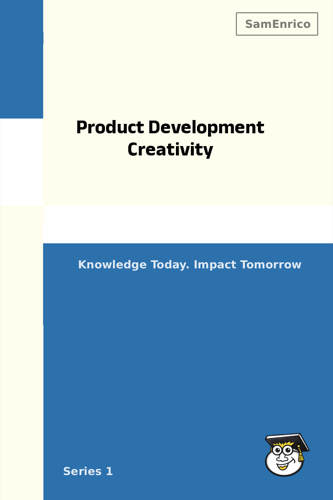
Product Development Creativity eBook
Design innovative products using customer centered
by Shannon Roma
Design innovative products using customer centered ideation methods.
Formats
Free sample
Chapter 1: The Brainstorming Lie--–- In 2016, a product team at a mid-sized software company did something unusual. They locked themselves in a conference room with whiteboards, sticky notes, and a catered lunch. The facilitator stood at the front and announced the rules: no criticism, no judgment, no limits. Every idea was welcome. Quantity over quality.
The goal was one hundred ideas by four o’clock.They generated one hundred and forty-seven ideas. The team felt electrified. The whiteboard looked like a rainbow explosion of possibility. They high-fived, packed up, and went home feeling creative.Six months later, exactly zero of those one hundred and forty-seven ideas had been built. Not one.The team wasn’t lazy.
They weren’t untalented. They had fallen into the most pervasive, most expensive, and most quietly destructive trap in product development: the belief that unstructured brainstorming is the engine of creativity.This book exists because that belief is a lie.Over the past three decades, a quiet revolution has taken place in the science of creativity. Researchers at institutions like Yale, the University of Texas, Columbia University, and the Hebrew University of Jerusalem have systematically dismantled the mythology of the "Eureka!" moment. They have proven, through controlled experiments and field studies, that the most innovative products in the world—from the i Phone to the Nespresso machine to the Nest thermostat—were not born from random chaos. They were born from systematic templates applied to deep customer empathy.This chapter will do three things.
First, it will bury the brainstorming trap once and for all, explaining why your brain actively works against you when you try to "think outside the box" in a group. Second, it will introduce the crucial distinction between artistic creativity (expression) and product creativity (utility). Third, it will lay out the foundational model for the entire book: the Design Wheel, a five-phase framework that replaces chaotic ideation with structured, repeatable, and vastly more effective innovation.By the end of this chapter, you will never run a traditional brainstorming session again. And you will be grateful for it.The Yale Study That Changed Everything In 1958, Yale University researcher Donald Taylor conducted an experiment that should have ended the brainstorming industry before it began. He gathered several groups of participants and gave them creative problems to solve.
Half the groups used traditional brainstorming (shouting out ideas, no criticism). The other half worked individually and then pooled their ideas.The results were devastating for brainstorming advocates. The individuals working alone generated nearly twice as many ideas as the groups. More importantly, when independent judges rated the ideas for quality and feasibility, the individuals’ ideas scored significantly higher.This finding has been replicated dozens of times over sixty years. In 2015, a meta-analysis published in the journal Group Dynamics: Theory, Research, and Practice reviewed twenty-two separate studies comparing group brainstorming to individual ideation.
The conclusion was unambiguous: people working alone produce more ideas, better ideas, and more novel ideas than people working in traditional brainstorming groups.Why does this happen? The answer lies deep in the architecture of the human brain.Cognitive Fixedness: Your Brain’s Worst Enemy Imagine you are holding a hammer. Everything you look at suddenly looks like a nail. This is not a character flaw; it is a neurological reality called cognitive fixedness. Your brain is an energy-expensive organ—it consumes about twenty percent of your calories despite being only two percent of your body weight.
To save energy, your brain builds mental shortcuts, patterns, and assumptions. It hates true novelty because true novelty requires recalculation.When you sit in a brainstorming session, your brain is not entering a state of limitless possibility. It is entering a state of high alert. You hear someone else’s idea—say, a purple toaster that plays music—and that idea becomes an anchor. Your brain now unconsciously filters all subsequent ideas through that anchor.
You might think you are building on the idea, but more often you are merely circling it. The group’s collective imagination narrows rather than expands.This is called anchoring bias, first documented by Amos Tversky and Daniel Kahneman. In a brainstorming session, the first loud voice in the room sets the anchor. Everyone else becomes a variation on a theme, not a true departure.Even worse, brainstorming triggers social loafing—the tendency for individuals to exert less effort when working in a group. Why shout out your half-formed, potentially embarrassing idea when someone else will fill the silence?
Why wrestle with a difficult problem when the group seems happy with the current direction?And then there is evaluation apprehension. Despite the “no criticism” rule, everyone knows they are being judged. The facilitator is writing ideas on the board. The boss is in the corner. The quiet skepticism of a colleague feels louder than any shouted encouragement.
So you self-censor. You offer safe ideas. You offer ideas you have already heard work elsewhere.The result is a perfect storm of mediocrity: anchored, loafed, and self-censored ideas that feel productive but deliver nothing.The Critical Distinction: Artistic vs. Product Creativity To understand why structured creativity works, we must first understand what kind of creativity we are actually trying to achieve.Artistic creativity is about self-expression. It is emotional, subjective, and often thrives on chaos.
A poet staring at a blank page, a painter throwing paint at a canvas, a jazz musician improvising a solo—these are artistic creative acts. Their value comes from their originality, their emotional resonance, and their ability to surprise. You cannot judge a poem by whether it “works” in the same way you judge a can opener.Product creativity is fundamentally different. Product creativity is about utility. It is problem-focused, measurable, and thrives under constraints.
A better can opener is a creative product. A redesigned checkout flow that reduces cart abandonment by fifteen percent is a creative product. A new feature that brings users back to your app three times more often is a creative product.Product creativity is not less valuable than artistic creativity. It is simply a different domain with different rules. And in the domain of product creativity, constraints are not the enemy.
Constraints are the engine.Consider the Post-it Note. The story is famous: a failed adhesive (too weak) meets a frustrated churchgoer whose bookmarks keep falling out. The constraint—the “weak” adhesive—became the feature. Without the constraint, there is no Post-it Note. Consider Twitter’s 140-character limit.
Without the constraint, there is no brevity, no wit, no unique voice. Consider the Nespresso machine: the constraint of a single-serve capsule, previously seen as limiting, became the foundation of a multi-billion dollar category.Constraints force trade-offs. Trade-offs force decisions. Decisions force clarity. And clarity is the birthplace of breakthrough products.The Design Wheel: A Five-Phase Alternative If brainstorming is the wrong tool, what should replace it?The answer is the Design Wheel, a refinement of the classic Double Diamond model used by the British Design Council.
We call it a wheel rather than a diamond because innovation is not a linear path from problem to solution; it is a continuous loop. You will go around this wheel many times, for many products, and…
This is the end of the free sample. Get the eBook to keep going. Buy now
About this book
Details
- Author
- Shannon Roma
- Publisher
- SamEnrico
- Language
- English
- Genre
- Non-Fiction, Self-Help, Product Design
- Released
- 2026-06-07
- Pages (approx.)
- 153
- Available as
- eBook, Audiobook

Read better in the ZLOADR app
Your eBooks on your phone or tablet. Sign in with your SamEnrico account and start reading.
More by Shannon Roma
 HIIT Fat Burning GuideShannon Roma$11.99
 OCD And Body Dysmorphic DisorderShannon Roma$11.99
 Survey Dropout Analysis with AIShannon Roma$11.99
 The Alchemist's Canvas: Secrets of the Forgotten PaletteShannon Roma$11.99
 How to Start a Construction of Pumping Stations Business (Beginners Guide)Shannon Roma$11.99
 Client Development ManagerShannon Roma$11.99
 Spanish Public University Master GuideShannon Roma$12.99
 Research Blog and Public ScholarshipShannon Roma$12.99
 Understanding Camptodactyly TaurinuriaShannon Roma$17.99